

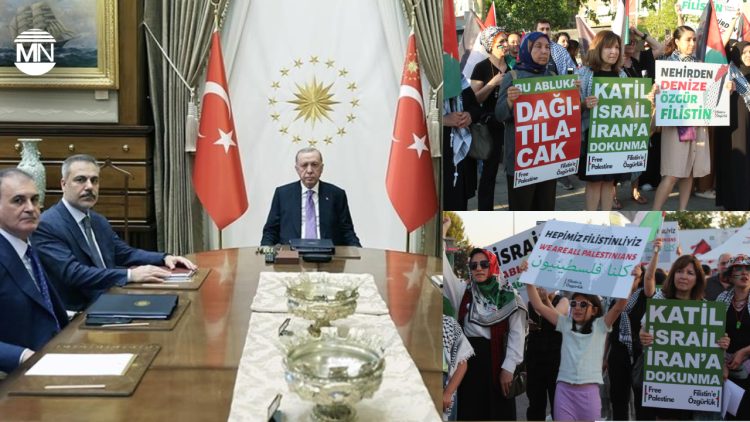
Turkish President Recep Tayyip Erdoğan chaired a high-level security meeting in Ankara on Saturday, following Israel’s airstrikes on Iran and Tehran’s subsequent retaliation. The meeting brought together top defence and intelligence officials to assess the regional fallout and review contingency plans as fears grow over broader destabilisation in the Middle East.
According to a statement by the Presidential Communications Directorate, the meeting addressed “Israel’s expanding aggression”, the risks it poses to global and regional security and measures Turkey may need to take in the coming weeks. Officials present included Foreign Minister Hakan Fidan, National Defence Minister Yaşar Güler and intelligence chief İbrahim Kalın.
The Turkish government has expressed concern over the escalating conflict between Israel and Iran, but critics argue that Ankara’s foreign policy is sending contradictory signals. In recent months, Turkey has condemned Israel’s actions in Gaza and called for a ceasefire. However, growing public scrutiny is focused on Turkey’s ongoing military and trade ties with Israel, as well as the country’s hosting of key NATO infrastructure perceived by some as aiding Israeli defence strategies.
Central to this criticism is the Kürecik radar station in Malatya province, operated under NATO command and widely believed to be contributing to missile detection systems that protect Israeli airspace. Opposition politicians have called for the base’s closure or transfer to Turkish military control. “This facility indirectly provides intelligence to Israel. Iran has openly named it a legitimate target, and Malatya is now in the crosshairs,” Barış Yıldız, provincial chair of the main opposition Republican People’s Party (CHP) in Malatya, said on Saturday.
The government has strongly denied these claims. Turkey’s state-run Centre for Combating Disinformation asserted that data from the radar station is shared “exclusively within NATO” and that “transmitting information to non-NATO states such as Israel is absolutely out of the question”. The centre labelled allegations to the contrary as “black propaganda” and potential “fifth column activity”.
The controversy surrounding Kürecik echoes earlier debates over the US-operated İncirlik airbase in Adana, which has also drawn public ire during previous regional crises. Critics argue that Turkey’s hosting of foreign military installations ties the country too closely to Western defence structures, even as its government seeks to position itself as a neutral mediator.
Public frustration with the country’s balancing act was visible during a protest in İstanbul’s Kadıköy district on the same day as the security meeting. Organised by the Turkey-based Freedom for Palestine Platform, the demonstration drew attention to what organisers described as Turkey’s “double standards” — denouncing Israel in its rhetoric while maintaining economic and military channels. “You cannot claim to stand with Palestine while allowing Israel-linked ships in our waters and continuing NATO operations from our soil,” read one of the protest statements.


