

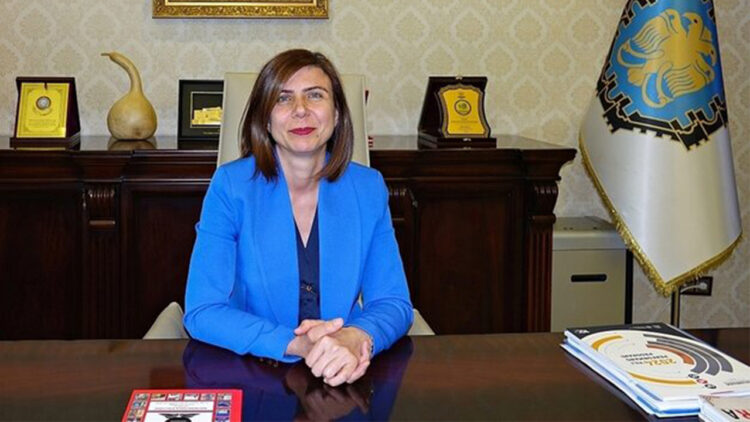
Kurdish politician Ayşe Serra Bucak, co-mayor of Diyarbakır (Amed), says that she needs to be prepared for arrest at any moment as Turkey continues its crackdown on Kurdish political representatives.
Pro-Kurdish Peoples’ Equality and Democracy (DEM) Party member Bucak, elected in March, said that the replacement of elected Kurdish mayors by government-appointed trustees undermines democracy and stokes tensions. “It is very dangerous to be in local politics here. We have no immunity. Arrests often happen at dawn,” she explained, referencing the dismissal of her predecessors after the 2015 and 2019 elections.
Three Kurdish mayors were recently removed from towns near Diyarbakır on terrorism-related charges, which Bucak dismissed as baseless. “These accusations are vague, trials have barely started, and the process is not transparent. This is politically motivated,” she said, attributing the crackdown to Kurdish political success and its challenge to Ankara’s Islamist ideology.
“The arrests usually happen at five in the morning. I know colleagues who are always fully dressed at that hour to avoid being taken away in pyjamas. I too have to assume that I could be arrested at any moment,” Bucak said in an interview with Taz.de on Monday.
The Turkish judiciary has moved against thousands of Kurdish politicians in recent years, accusing them of links to the banned Kurdistan Workers’ Party (PKK). Other Kurdish mayors in the southeast of Turkey have recently been removed from office on terrorism charges, with government-appointed trustees taking their positions.
“The files are not public, so we don’t know what these allegations are based on or know any witness statements or evidence. There are no verdicts, some court proceedings haven’t even begun,” Bucak explained.
Bucak, who speaks fluent German from her time studying in Cologne, returned to Diyarbakır in 2006. She criticised the eight-year tenure of a government-appointed trustee in Diyarbakır, saying infrastructure and cultural projects were neglected. “Multilingual education programmes were reduced, and the administration seemed uninterested in serving certain communities. It aimed to weaken ties to Kurdish identity,” she noted. She describes finding the city’s infrastructure in disarray after nearly a decade under state-appointed trustees. “We’re cleaning the sewers now and can’t believe our eyes—it hasn’t been done for eight years,” she said.
The co-mayor highlighted how cultural suppression accompanied administrative neglect: “Bilingual kindergarten programmes were reduced, and events that were previously held in both Kurdish and Turkish were conducted only in Turkish. It was a deliberate policy to weaken the population’s connection to the Kurdish identity.”
Despite the risks, Bucak remains committed not only to her role but also to democracy and reconciliation. “The mayoral office gives me the opportunity to make the system better, more democratic and freer. That gives me strength, even if it puts me in danger,” she said. “A peaceful resolution requires dialogue and the recognition of Kurdish identity in the constitution. We demand human rights and equality,” she added, expressing hope for an end to the conflict.


