

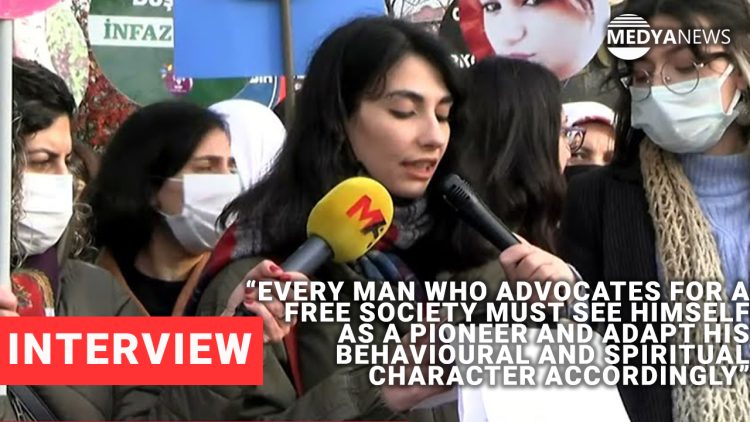
In Turkey, women continue to face legal shortfalls and policies of impunity in their fight against violence. Perpetrators, emboldened by such policies, persist in their actions, while women are afraid to seek support from state institutions, feeling unable to trust them. Zeynep Tağtekin, a member of the Van (Wan) Star Women’s Association, noted in an interview with Medya News that legal measures alone are insufficient. Tağtekin stressed the importance of promoting an understanding of gender equality through education and underlined the necessity of transforming societal structures to bring an end to violence.
The interview was conducted in the Turkish language and translated into English. Full transcript below:
Medya News:
Gender-based violence continues to evolve as new forms emerge. What can you say about the root causes of gender-based violence?
Zeynep Tağtekin, Star Women’s Association:
Alongside its constantly changing forms, we are now encountering new manifestations of violence such as online abuse and dating violence, as well as physical, psychological and economic dimensions. In other words, the violence is perpetually reproduced through various dynamics within society. Whether or not conservative or secular tendencies dominate within a community, as well as the degree to which laws are enforced, directly influence both the nature of violence and the methods used to combat it.
Looking at our own country, it seems that nearly every day begins with news of a murder. Reports of violence against women, children and LGBTQ+ individuals are unrelenting. The policies of impunity implemented by those in power, the lack of protective measures, and decisions such as that to withdraw from the Istanbul Convention [A Council of Europe Convention on preventing and combating violence against women and domestic violence], embolden the perpetrators. Violence is not only fuelled by this, but also continuously reinvented in its many forms.
Are gender discussions alone sufficient to address violence against women? What roles and responsibilities do men have in changing the current system?
They are not sufficient on their own of course. When discussing gender, we also need to delve into the root causes of violence. Are the methods used to combat violence truly adequate to the factors that produce violence? Can we genuinely talk about equality within a male-dominated system, and is it possible to claim that we are fighting violence without addressing the systemic structures that enable it? These are critical issues that must also be explored.
In the current male-dominated system, violence perpetuates itself. For instance, during the feudal era, women were massacred in “witch hunts”. When societies transitioned to capitalist systems, it was argued that women entering the workforce would resolve such issues. However, with the rise of capitalism, new problems emerged, such as unequal pay for equal work, workplace harassment, and precarious, insecure working conditions. In short, violence persists but takes on new forms in every system dominated by men. Thus it is impossible to claim that gender discussions alone offer a complete solution.
Moreover, the belief that men in the current system are “free” is a delusion. The misconception that individuals can be free without a free society is a fallacy rooted in dominant cultural narratives and is common among men who benefit from the existing structure. A society where women experience violence and are not recognised as individuals is incomplete—crippled, in fact. Paradoxically, it is men that make up one of the crippled legs of this society.
Bearing in mind that the majority of the global population comprises women, men’s hegemony over women represents a form of anti-freedom for men as well. Philosophically and sociologically, just as nature is founded on the balance of feminine and masculine realities, with one being unable to exist without the other, a society where one gender dominates the other violates its own existential truth. This dynamic places men within a system of enslavement, even if they remain unaware of it.
Therefore, it is essential for men to recognise this reality and educate and transform themselves accordingly. Such transformation is critical for altering the societal structure as a whole.
The patriarchal mindset that views a woman’s identity solely within the family also fuels gender inequality. Could the inability of women to engage as individuals in public life be connected to this identity definition? What are your thoughts on this?
There is a connection of course. The current male-dominated system burdens women with domestic labour and caregiving responsibilities within the family. It defines women only through roles such as mother or wife and fails to recognise them as individuals. Consequently, it’s fair to say that women have to fight harder than men, whether in education or in the workplace. It can also be said that from being taught to obey their husbands, to suffering intimidation in the workplace with comments like, “she’s going on maternity leave, she’s increasing the workload”, to being seen in the workplace as earning a supplementary income for the household, women still do not receive equal pay for equal work compared to men, they work under less secure, more flexible and lower-paid contracts, and they are the first to be laid off in times of crisis.
At times, economic and social concerns, or the belief that patriarchy will never change, can leave women feeling powerless or indifferent to confronting the violence against them. Do you think changes in the legal system alone would be sufficient to overcome this mindset?
While we can’t say that they would be enough on their own, they would certainly have some effect. Based on data from 2024, it is clear that, under the current system, women are reluctant to approach state institutions, as they don’t trust the laws or those who enforce them—they don’t feel safe. When women are subjected to violence and go to the police, they are often interrogated, their statements aren’t taken seriously, or they are sent away. In addition, many women continue to face violence and even death despite multiple restraining orders.
Perpetrators are empowered by the impunity they enjoy. In other words, while women are left to deal with violence alone, the perpetrators are protected. To effectively tackle violence against women, protective measures need to be put in place, perpetrators must face penalties without [inappropriate] mitigation that will act as a deterrent, and instead of forcing women to endure violence to preserve ‘the sacred family’, efforts should focus on combating the violence itself. However, this does not mean legal change would be sufficient on its own. We must also recognise that violence is not simply the problem of a few malicious individuals but a societal and political issue. So while the legal system is important, it is not enough on its own.
Recently, there has been an increase in cases of abduction and murder of young girls and women. What are the reasons behind this, and what societal and legal measures can be taken to prevent this? What is the role of state and society in this matter?
Women are being disappeared, and the cases are often closed with claims of suicide or suspicious death, as we have said publicly before. Effective investigations are not carried out, and the deaths are left ambiguous. For example, the highly publicised case of Narin Güran [schoolgirl disappeared in August and found dead two weeks later] remains unresolved. Similarly, there are still contradictions in the autopsy reports of Rojin Kabaiş [student found dead two and a half weeks after disappearance in September], and it is evident that there are attempts to cover up this case. Perpetrators are empowered by one another and the existing culture of impunity. To prevent this, first and foremost, women must not be isolated when facing violence, such violence should never be justified, and perpetrators should be given deterrent penalties. The state has an obligation to protect women. Unfortunately, in our country no woman feels safe.
In cases of violence, when state institutions sometimes act with statements like “there’s nothing to exaggerate” or “the balance of the killer’s mind was disturbed”, is this driven by the need to preserve the sanctity of the family? We also know that when women are subjected to harassment, rape, or physical and psychological violence by security forces, there are efforts to cover up these incidents. How do you evaluate this situation?
Indeed, women are killed, subjected to violence, and erased within the so-called “sacred family”. The Istanbul Convention, which was a victory for women, was repealed overnight by Presidential Decree, citing the need to protect the so-called family structure. The current government is not only failing to protect women, but is also targeting and abolishing their hard-won rights. To treat the family as sacred, especially with the scale of femicides we are witnessing, means that everything happening within that family is considered untouchable and unchallengeable. The state tells women that regardless of what happens, they must remain within the family, by force if necessary, and only death can separate them from it.
While this is happening across the country and in the Kurdish regions, we are fighting a different form of violence—state violence carried out by uniformed men. As a result of the counter-insurgency policies in the region, Kurdish women are becoming open targets for violence, systematically subjected to abuse by military personnel, enduring strip searches and sexual violence in prisons and detention, and being forced into prostitution. Perpetrators are protected, investigations are not initiated, or even when they are, they do not lead to consequences, and at no time are perpetrators held accountable.
What steps should be taken first to reach a future where gender-based violence has ended in society? In what areas do you think this change will first manifest itself?
To end violence, deterrent penalties must first be implemented, and women must be protected from violence. However, in order to achieve a societal transformation beyond legal processes, changes must take place in the education system. Children should not be taught ideas like ‘obedience to the husband’, but rather [they should receive] gender equality education. Of course, we cannot claim that these changes will completely end violence. The end of violence requires a long-term struggle. However, this struggle must not only be against violence itself but also against the class-based society that creates violence. It is particularly common to see that men expect women to lead the way in changing and transforming men.
This is a mistaken view. In the world that men have created, women are forced to focus on self-preservation. This situation should not develop solely from women’s desires. Men should see the problems they face as traumatic issues, trace their societal and historical roots, and understand that their harmful attitudes towards women are a pathological issue. In short, if men want to reinvent themselves and create a free society, they must fight for this themselves and take responsibility. Otherwise, they will only be displaying a superficial attitude. Every man who claims to be a defender of a free society must see himself as a leader in this regard and must change his behavioural and mental character accordingly. Social change and transformation can only happen in this way.


