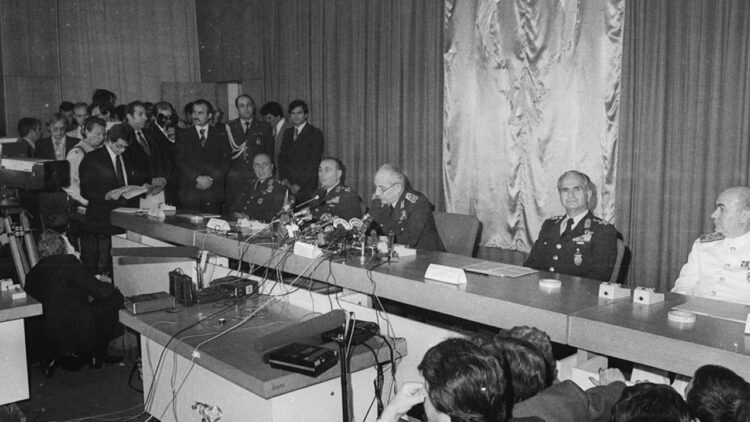
On the 44th anniversary of Turkey’s 1980 military coup, critics argue that the authoritarian mindset behind the intervention still influences the country’s political and social structures, with repression and limitations on freedoms continuing today. The head of the military junta which took power after the coup, General Kenan Evren led the repression and suspension of civil rights during imprisonment of thousands, and Cihan Deniz claims that an underlying “coup mentality” is still alive in modern Turkey.
Deniz reflects, in an Opinion piece in Yeni Özgür Politika, on the legacy of the 1980 12 September coup d’etat.
Deniz writes that its aim was to crush any organized opposition to state control, and left-wing activists, Kurdish movements, and trade unions were among the hardest hit. “The coup was not just about seizing power, it was a project of political and social engineering,” he claims, adding that its legacy continues to influence how Turkey is governed.
This ‘engineering project’, Deniz said, had the aim of eradicating three major elements: truth, organised resistance and public protest. Deniz believes that while the military coup itself was over several decades ago, its authoritarian principles remain very much intact and have shaped political and civic life to this day. “The mentality of the 12 September coup,” he says, “continues to dominate through updated forms of repression.
Deniz refers to the recent government actions, such as the removal of elected officials in Kurdish-majority municipalities and the appointment of trustees in their place, as continuations of this mentality. He further draws an analogy between the policies of the current government and the repressive measures of the 1980 coup, especially with regard to freedom of expression and political dissent.
While there have been attempts at reconciliation with Turkey’s coup-ridden past, Deniz argues these were superficial. “The ruling bloc today embodies the purest form of the coup mentality,” he says, adding the country has failed to break free from the authoritarian grip set up in 1980.
Deniz calls for a deeper reckoning with the legacy of the coup on this anniversary. For him, Turkish society cannot be said to have overcome the consequences of the 1980 intervention if the mentality underlying it is not dealt with.