

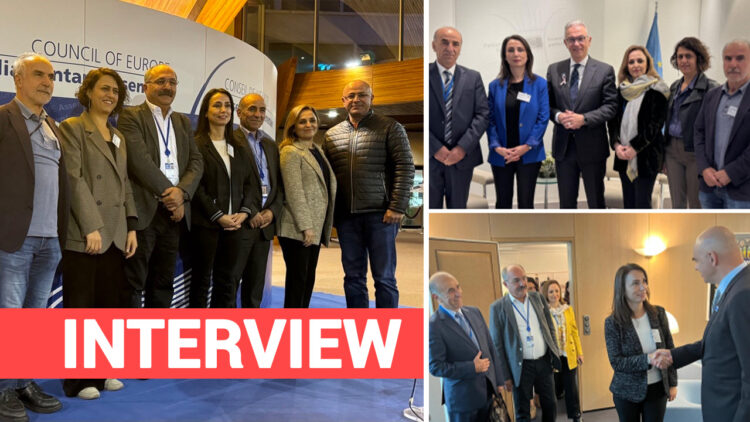
This week, DEM Party co-chair, Tülay Hatimoğulları was at the Council of Europe in Strasbourg, and in between updating leading figures at the Council on the situation in Turkey, she took time to sit down with Sarah Glynn and answer her questions. Fayik Yagizay, the party’s representative in Strasbourg, acted as an interpreter, and the transcript below is an edited version of that on-the-spot translation.
To begin with more personal questions – what got you involved in politics, and do you have politics in your family?
No-one in my family was involved in politics. I became involved when I was 16, at high school, beginning with organising in student associations.
What spurred you? Was there an event that made you interested?
At that time, it was very normal for lycée pupils to be involved in politics, organising themselves within socialist groups, and I was affected by this and joined their activities. I have been organising political activities ever since. At the same time, as an Alevi Arab I have struggled for the rights of my people. I was impressed by the struggle of Kurdish people. We took part in struggles for the ability to use our mother tongue.
I know that in the past – and you’ve already mentioned some of these – you’ve described your various identities as a person and as a politician: Arab, Alevi, socialist, and also a woman. How do these interact with each other in your politics?
Living with all these identities is very difficult in Turkey. Turkey approaches minorities in a very racist way. They are antagonistic to the left and socialists. They regard Alevis, who make up half of Turkey, as other. Their approach to women is based on violence. Being affected by all these things is very difficult, but at the same time it opens a vision for struggle.
You’re from Hatay, so does that also play a part in your politicisation, because it’s different from a lot of other parts of Turkey?
We call it Antakya rather than Hatay – by its own name. Being from Antakya is an advantage for us. Antakya has witnessed a lot of civilisations, and you can see the signs of all these civilisations on the people who are living there now. Arabs, Kurds, Turks, Armenians, and Assyrians all live together. Antakya can provide an example for the whole of Turkey and for the Middle East, which is now in conflict. The coexistence of different peoples is an example – a very rare example. I feel lucky to be from there.
What made you choose to be part of the HDP, now DEM Party, rather than a more socialist party like the Workers’ Party of Turkey?
The HDP is a combination of the Kurdish struggle and Kurdish people’s movement and the Turkish left and socialist movements. And when we look at its programme and statutes, we see that it represents all the different ethnic and religious groups in Turkey. The HDP, now DEM Party, promises that everyone can live together, preserving their culture, their language, and their differences. And the HDP is a home for those who are struggling for women’s rights, for youth organisations, for all other different groups within society, for those struggling against violence and struggling for the protection of nature. In Turkey, only in the HDP, or the DEM Party, can you find all these points altogether. And the Party that I am a part of – the SYKP [the Socialist Refoundation Party] – is one of the six parties that formed the HDP, it is a constituent party.
How do the smaller parties, such as the SKYP of which you are co-chair, operate within the HDP?
The DEM Party has six different constituent parties. It was founded by these parties, but individuals and other organisations can also be part of the DEM Party. Our programme prioritises the rights of individuals and organisations, and this provides a very democratic base from which to operate.
How do you balance demands from people to make it just a Kurdish party, with demands to make it more socialist and to attract people from outside the Kurdish areas?
That is a difficult question because it is very difficult to balance these, but our programme and our statutes, which we have worked on very carefully, help simplify this difficult task.
Turkey’s major problems motivate us to come together and work together in a better way. It is very important for us to handle all these difficult issues together. This is historical and existential for us. Finding a political solution to the Kurdish Question implies the democratisation of Turkey: and, at the same time, the democratisation of Turkey implies finding a solution to the Kurdish Question. This is very important.
Could you say a little bit about the Bread and Justice campaign that you have been running. What have you been doing, and what happens next?
It’s about three months since we launched this campaign. There is a very serious and deepening economic crisis along with an unemployment problem in Turkey. After the failed coup d’état of 15 July 2015, there was a regime change in Turkey. The new regime defends the interests of the rich, and at the same time there is a very serious violation of human rights and of democracy. The situation in the prisons, the isolation of Mr Öcalan in İmrali Island, the pressure on the women’s movement and the assassinations of women, the assassination of children (as in the example of Narin), the harming of nature, the pressure on young people – all this pushed us to start this campaign. Within the context of the campaign, we are coming together with women, young people, workers, other ethnic groups, religious groups, everybody, all segments of society. We are aiming to defend their rights, and also to empower them to defend themselves.
I was wondering how you would assess the restrictions on the party at the moment, because the government has removed the mayor of Hakkari and replaced him with an appointed trustee, but they have not removed other mayors. Are they going to restart this practice, or are they using other techniques to prevent the DEM Party from functioning?
The closure case against the HDP is still going on, and the same oppression continues against our party. We hope that the imposition of trustees will stop with Hakkari, and that they will restore the mayor of Hakkari and abandon this policy: we are struggling for this. The oppression of our party – the operations, the detentions, the attacks, the prevention of our demonstrations – continues non-stop. Despite all this oppression, we never give up our struggle for progress. Of course, we expect more support and solidarity from national and international human rights defenders and friends of democracy.
I was wondering about the relative importance of your work nationally and locally, because nationally you are only one opposition party, but locally you have DEM Party mayors. Which is more important?
Both are equally important for us.
And finally, you talked about wanting more support: for people who might read this article, what should they be demanding of politicians in European countries?
Turkey and the whole world now need peace. The whole world is in danger of destruction. The war we are now experiencing is not like the first and second world wars. In these digital times, and with the existence of nuclear weapons, our whole planet faces existential danger. The world’s policy makers and governments should consider these issues and dangers when deciding on war or peace. In our times, there will be no winners after the war; everyone will lose.
More specifically, with respect to us and our perspective: as the DEM Party, we expect strong solidarity from democratic forces. Kurdish people are the dominant group in our party, and the Kurdish Question is our priority. We expect democratic forces across the world to take the initiative and support a political solution to the Kurdish Question. The oppression of Mr Öcalan through isolation in Imrali should be ended. Turkey should comply with human rights conventions and implement the judgements of the European Court of Human Rights, so that our friends, Selahattin Demirtaş and Figen Yüksekdağ, who are in prison and have been given sentences of many years in the Kobanê Case, can be free. Also, from the Gezi Park Case, Osman Kavala, Can Atalay, and other friends should be free.
We want to create a new world that is free of war, free of violation, free of oppression; and for this we need strong international struggle and solidarity. We, the DEM Party, can be a part of this world struggle.


