

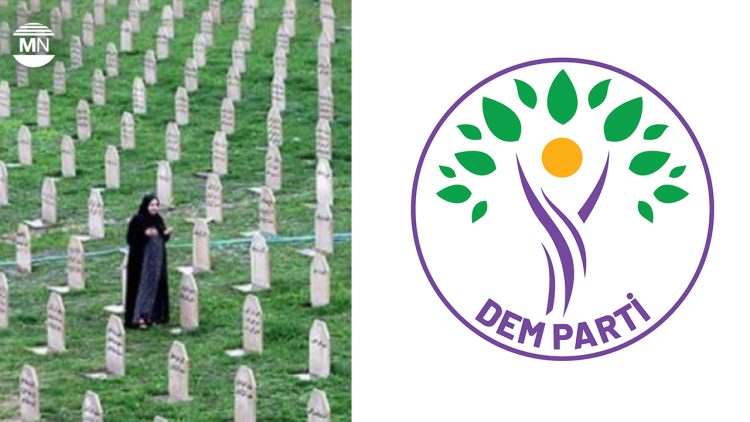
The Peoples’ Equality and Democracy (DEM) Party has announced plans to submit a draft law to the Turkish parliament recognising the 1988 Anfal Massacre as a genocide, marking the 37th anniversary of the atrocities committed by Saddam Hussein’s regime against Kurdish civilians in Iraq.
The proposed legislation was confirmed by DEM Party parliamentary group deputy chair Gülistan Kılıç Koçyiğit during a press conference at the Turkish Grand National Assembly on Monday. Koçyiğit said the Anfal Massacre continues to occupy a vivid place in the collective memory of Kurds and remains unpunished, describing it as one of several Kurdish massacres that have gone unaddressed in both Turkey and internationally.
The Anfal campaign, led by Saddam Hussein’s cousin Ali Hassan al-Majid—known as “Chemical Ali”—took place between 1986 and 1989, with its most intense phase in 1988. The campaign involved systematic attacks against Kurdish rural communities in northern Iraq, including aerial bombardments, ground assaults, mass executions and the use of chemical weapons. One of the most notorious attacks was the chemical assault on Halabja on 16 March 1988, in which up to 5,000 civilians were killed.
Estimates of the death toll from the Anfal campaign range widely. Human Rights Watch has cited figures between 50,000 and 100,000, while Kurdish sources and some international organisations estimate up to 182,000 fatalities. Thousands of villages were destroyed, and survivors were forcibly displaced or interned.
Koçyiğit noted that the massacre has been officially recognised as a genocide by several governments, including Iraq, Norway, Sweden and the United Kingdom. She stated that the DEM Party’s proposed law is intended to secure similar recognition in Turkey, expressing hope for a unified and constructive response in parliament.
“This will not only address the historic pain of the Kurdish people but also contribute positively to discussions on the democratic resolution of the Kurdish issue and efforts to reshape relations between Kurds and Turks,” she said.
In a separate statement, Yüksel Mutlu, DEM Party’s deputy co-chair for the Peoples and Beliefs Commission, marked the anniversary by commemorating the victims and reaffirming the party’s commitment to justice. Mutlu described Anfal as “a comprehensive annihilation campaign against the Kurdish people’s language, culture, history and future”, declaring that the crime should not remain unpunished.
The Anfal Massacre, named after the eighth chapter of the Quran, “Al-Anfal” (meaning “the spoils of war”), was carried out under the pretext of suppressing Kurdish resistance during the Iran-Iraq War, as part of a wider policy of Arabising strategic areas around oil-rich Kirkuk (Kerkûk).


