

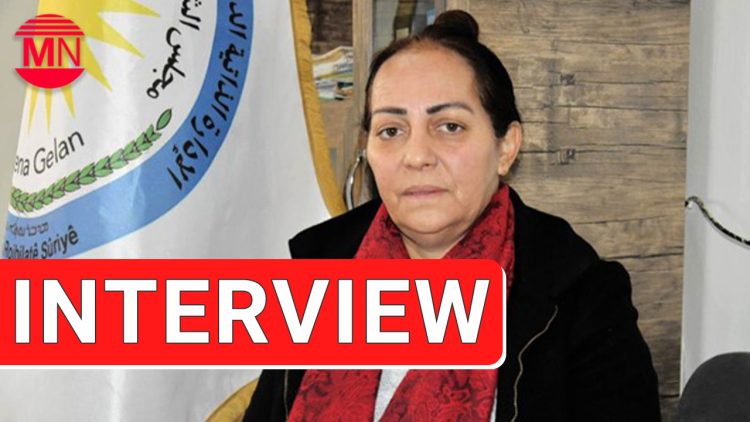
Rosheen Mahmoud, co-chair of the Euphrates People’s Council, discussed the evolving situation in Kobani (Kobanê) and potential future developments in an interview published on 9 January by JungleWorld. The interview, conducted by Christopher Wimmer and Khalil Ahmed Muhammad, comes amid escalating violence, including Turkish strikes on critical infrastructure such as the Tishreen (Tişrîn) Dam and Qara Quzak (Qara Qozaq) Bridge—key crossings along the Euphrates River. The Syrian Democratic Forces (SDF) have mounted a strong defence in response to the attacks.
Kobani, a city synonymous with the Kurdish resistance against the Islamic State (ISIS), holds immense strategic and symbolic significance in northern Syria. It was the site of a landmark victory in 2015, marking the beginning of the militant group’s decline. Since the fall of the Assad regime, the region has again become a focal point of shifting power dynamics, with intense clashes as Turkey continues to launch multiple military incursions and occupy swathes of northern Syria under the pretext of securing its borders, while in the process, targeting civilians and forcing displacement.
The Euphrates People’s Council is a governing body within the Euphrates Region, one of the administrative divisions of the Autonomous Administration of North and East Syria (AANES), also known as Rojava. The council is responsible for managing governance, coordinating public services, and addressing the needs of the diverse communities within the region, which includes the cantons of Kobani and Tall Abyad (Gire Spi).
Full transcript below, translated from original interview in German:
Journalists Christopher Wimmer and Khalil Ahmed Muhammad: What is the situation in Kobani?
Rosheen Mahmoud, co-chair of Euphrates People’s Council: The people in Kobani are on alert because they don’t know what to expect. After the fall of Bashar al-Assad, the Turkish-backed Islamist mercenaries of the Syrian National Army (SNA) advanced into northern Syria and captured the towns of Tel Rifaat (Til Rifat) and Manbij (Minbîc), which belong to the self-administration. The SNA and Turkish troops continue to attack the entire administration on an almost daily basis. Kobani and the neighbouring villages are particularly affected. The city is still reasonably stable, but the entire region is subject to indiscriminate attacks by artillery and drones, which primarily hit the infrastructure. Most recently, high-voltage power lines and a large grain warehouse were destroyed near Kobani. Turkey is doing everything it can to conquer and occupy Kobani and drive out the population.
Where is the front currently located?
The SNA is around 30 kilometres from Kobani. The front line is currently the river Euphrates to the west of the city. There is fierce fighting at the two crossings, the Tishreen dam and the Qara Quzak bridge. But our troops, the Syrian Democratic Forces (SDF), are holding both points and have even repeatedly launched small counter-offensives in recent days. Many SDF fighters have already fallen. But we will continue to defend our territories against the Islamists.
What does the war mean for the people in Kobani? How are they dealing with the situation?
The city has been in complete darkness since the beginning of December. The region’s previous main power source, the Tishreen dam, was damaged by the fighting and can no longer produce electricity. Cooking, heating – all this has to be done in Kobani without electricity.
The power cut has had an impact on the drinking water supply in the region. The water pumps on the Euphrates no longer work, meaning that the people of Kobani have to rely on groundwater from makeshift, self-built wells. Food supplies are the third problem in Kobani. There is a little agriculture in the area surrounding the city, but no industry. We have always been dependent on imported goods. Until now, they have mainly come from Manbij, which is now occupied by the SNA. Trade has completely collapsed here. Now we have to rely on goods from Raqqa or other areas of the self-administration. But they are further away and much more expensive. In Kobani, we now have to pay many times the previous prices. It is a war of attrition that the people of Kobani and the entire self-administration are facing. So far, however, there has been no major mass exodus from the city.
So most people will stay? Will they defend themselves against the threat of attack?
Our armed forces recently issued a call to arms to the entire population to take up arms and defend themselves, their families, communities and cities. Many people from the city have responded to the call. I can already see that there is a great deal of popular support for the SDF and many people are determined to defend their town if it comes under attack.
Recently, the commander-in-chief of the SDF, Mazloum Abdi proposed setting up a “demilitarised zone” in Kobani that would be controlled by the USA. What do you think of this proposal?
It is an option. In my view, however, disarmament at this point in time would be extremely dangerous, as the new rulers in Damascus have not yet made a binding commitment to protect the rights of the Kurds and other ethnic and religious minorities in Syria. As long as there is no democratic Syrian constitution, we Kurds must defend ourselves and the SDF should not lay down their arms.
In the past few days, the USA has negotiated a ceasefire between the SNA and the SDF. Will it be honoured?
The ceasefire was announced by the US, but the Turkish state and its mercenaries have nevertheless not adhered to it and have continued their attacks. Our canton continues to be shelled and the ceasefire agreements are being violated time and again.
US troops recently entered Kobani. The Stars and Stripes are now flying over the town hall. How do you assess this development?
Firstly, I would like to emphasise that there is no permanent or long-term deployment of US troops in Kobani. What is true, however, is that there have been patrols by US forces in the city and near the front line on the Euphrates in recent days. For the people of Kobani, the US presence is certainly a relief, as it means first and foremost that the war is not coming to the city. Turkey will not bomb or attack Kobani directly as long as international troops are here. In my opinion, the presence of the US forces primarily fulfils the SDF’s demand to get an idea of the situation on the ground and to clarify the conditions of the war.
You have already mentioned that the SNA has conquered large areas of self-administration. What consequences does this have for those affected and for Kobani?
This attack has put around 200,000 people in a life-threatening situation. Over 120,000 people have been displaced from the Tall Rifaat region alone. They had been living there in informal settlements since 2018, displaced from the nearby Kurdish canton of Afrin (Efrîn). Now they have had to flee again. We as the self-administration have set up large camps, especially in the cities of Thabqa and Raqqa, to provide for the people, but there is a lack of everything. Several children have already died of hypothermia. Hygiene conditions are poor and diseases are spreading. But many people have also fled to Kobani. Despite our limited resources, we are doing our best to help the refugees. It is very difficult for the people living in the occupied areas. Crimes committed by the SNA and the Turkish army have been documented in numerous videos and reports. They loot and burn and kill anyone who opposes their brutal actions.
What international support do you expect in this situation?
Ten years ago, we defeated the jihadists in Kobani with the help of the international anti-ISIS coalition. The city became known worldwide. I am confident that we will also be able to defend ourselves against attacks this time. To this end, I call on all countries in the coalition to help Kobani, as they did during the war against ISIS. The international community should support Kobani in the fight against Turkey and its mercenaries.
However, Turkey is a NATO member. Why should other NATO states act against Turkey?
Out of self-interest. If the war in northern Syria continues, it will spread to other regions and could become a threat to the whole world. The “Islamic State” could return and spread, posing a threat to many countries.
Let’s assume we talk to each other again in a year’s time. What do you wish for Kobani and Syria until then?
The SDF are endeavouring to negotiate by all means to prevent further bloodshed, but Turkey seems determined to continue the war. We don’t want any more victims. We are against war and violence. Ultimately, as residents of Kobani, we demand peace and stability in our region. To achieve this, it is necessary to secure the rights of Kurds and other minorities within the framework of a new constitution. We want a decentralised, democratic Syria in which everyone can speak their own language, live their own culture and in which all people are protected. I don’t know whether this will be possible in a year’s time, but we will continue to fight for it.


