

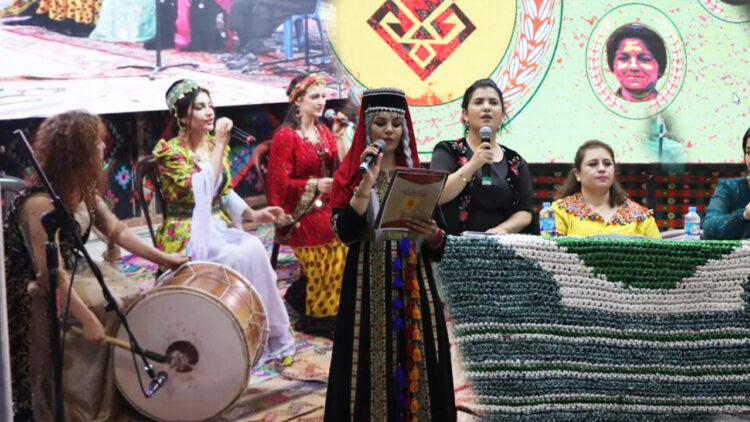
The four-day event featured musical performances, poetry readings, and panel discussions on the role of women in Kurdish literature and the lasting influence of Abdullah Öcalan on Kurdish thought. Thousands attended the festival, which also highlighted the legacy of Berçem Efrîn, a Kurdish activist and singer known for her contributions to the Kurdish liberation movement. Despite travel restrictions preventing some international artists from attending, the festival underscored the resilience of Kurdish culture through art and collective expression.
The festival, held in the city of Kobanê in northern Syria, has drawn participation from dozens of local artists and community members since it began on September 6. On Sunday, Kurdish poets Khalide Hisên and Meryem Temir recited their works at the Baki Xido Cultural Center, while a panel on women’s art and the role of Abdullah Öcalan in Kurdish cultural thought was moderated by Mizgîn Çolaq, Şêrîn Reşîd, and Botan Hoşê.
Musical performances were held in the Şehid Egîd area, where thousands of residents gathered to hear artists Munetullah Xemîs and Nesrîn Botan. Several local music and dance groups, including the Şehid Barîn, Şehid Hêva, Şehid Alanya, Şehid Delîla and Şehid Nalîn ensembles, also performed.
Organisers had planned for Tunisian artist Emel Mathlouthi and Kurdish artist Shadî Xulamî from Iranian Kurdistan to participate in the festival, but authorities from the Kurdistan Democratic Party (KDP) denied them passage into Rojava, the Autonomous Administration North and East Syria.
The Martyr Berçem Efrîn Festival was first held in 2022 in the Sheikh Maqsoud neighbourhood of Aleppo. It is named after Berçem Efrîn, a Kurdish activist and singer from the Afrin region who was born in 1974 and became involved in the Kurdish resistance movement. She was killed after several years of activism, leaving behind a legacy of songs, including “Bêrîtana Min.”


