

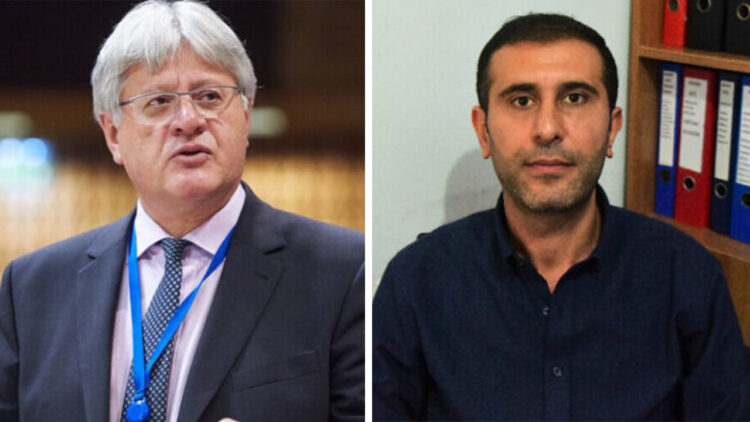
İbrahim Bilmez, lawyer for imprisoned Kurdistan Workers’ Party (PKK) leader Abdullah Öcalan, took part in a press conference at the European Council, and pointed out that the Committee of Ministers (CoE) is responsible for the implementation of the European Convention of Human Rights (ECHR). Bilmez, who works for Asrin Law Office, demanded that the Committee puts renewed pressure on the Turkish state to improve conditions for Öcalan.
The press conference was held on the occasion of the publication of a new report by the Parliamentary Assembly of the Council of Europe (PACE), who sent a delegation to visit Turkish prisons in June 2024. The PACE delegation visited high profile Kurdish and Turkish prisoners such as Selahattin Demirtaş, Figen Yüksekdağ and Osman Kavala, but was not permitted to visit Öcalan.
The PACE Report
The report, prepared for PACE by delegation member Stefan Schennach, urged that urgent measures should be taken to implement the ECHR decisions regarding isolation.
The rapporteurs points out in the report that numerous civil society organisations in Turkey were concerned about the isolation conditions Öcalan was being held under.
During his June 2024 visit, Schennach stressed to authorities in Ankara that: “the execution of ECtHR judgments was a legal obligation enshrined in the European Convention on Human Rights. I strongly called on the Turkish authorities to take without delay all necessary measures to implement the ECtHR judgments concerning Messrs Kavala and Demirtaş. I stressed that the resolving of these cases lay in the hands of the Turkish judiciary, which should be impartial and free from political pressure and had the capacity to find a legal solution in compliance with the requirements of the Committee of Ministers.”
Schennach reiterated the above points, including Turkey’s legal obligations to limit isolation of prisoners, in the conclusion of the report.
Öcalan’s lawyer speaks out
Bilmez pointed out, during the press conference, that Öcalan has been held on the prison island of İmralı for 25 years, and that his family and lawyers had not heard from him for close to four years. He said that the Council of Europe’s (CoE) Committee for the Prevention of Torture (CPT) had visited Öcalan nine times during his sentence, but had failed to publish its findings.
The CPT argues that it cannot publish its findings, because it doesn’t have agreement from the Turkish state. But Bilmez pointed out that it had published its report about prison conditions in Azerbaijan, despite objections from the government of Azerbaijan.
Bilmez maintained that the sentencing of Mr Öcalan did not comply with international human rights standards. Öcalan was initially sentenced to death, but had the charge commuted to an ‘aggravated life sentence’, as his execution would have interfered with Turkey’s application to join the European Union at that time. Bilmez pointed out that the category of aggravated life sentences was created specifically for Öcalan, but is now widely used by the Turkish state, and that the sentence does not allow prisoners any realistic hope of release, despite the ‘right to hope’ being enshrined in the ECHR. He emphasised that Turkey is refusing to disclose the number of people currently serving aggravated life sentences, which he called a new kind of death penalty.
Bilmez highlighted, with concern, that prisoners serving these sentences are not released, even when their physical health is too poor for them to remain in prison.
Finally, Bilmez called on the members of the Committee of Ministers and other European institutions to be more vigilant about the obligations of Turkey, which is a member of the CoE.
Asrin Law Office has submitted an application to the ECHR for a ruling over the conditions in İmralı.
Lawyer Deepa Driver criticises culture of ‘transnational repression’
Deepa Driver, who is legal observer in the cases against journalist Julian Assange and vice-chair of the Haldane Society of Socialist Lawyers also spoke at the press conference. She mentioned that Öcalan’s imprisonment is taking place in the context of “transnational repression”. She said that the “extreme measures” being used against Öcalan are percolating through society, and are being implemented in Turkey’s F-Type prisons. Driver said that isolation conditions in F-Type Prisons were becoming increasingly normalised.
Driver pointed to the United Nations’ Mandela Rules, which stipulate that isolation of more than 15 day is akin to torture.
According to Driver, “If Turkey is able to get away with this, and the Council of Ministers is unable or unwilling to do anything about it”, then it will create an incentive for Turkey both to “do other bad things, and to facilitate the bad behaviour of other states”.
Global Free Öcalan Days
This week saw the start of the Global Free Öcalan Days, which is set to run from 1-10 October, aimed at raising awareness of the ongoing isolation of Öcalan, while advocating for a political resolution to the Kurdish question. Operating under the slogan “Freedom for Abdullah Öcalan – A Political Solution to the Kurdish Question”, the initiative seeks to underscore Öcalan’s contributions to democracy, human rights, and peace, alongside calls for his release.


