

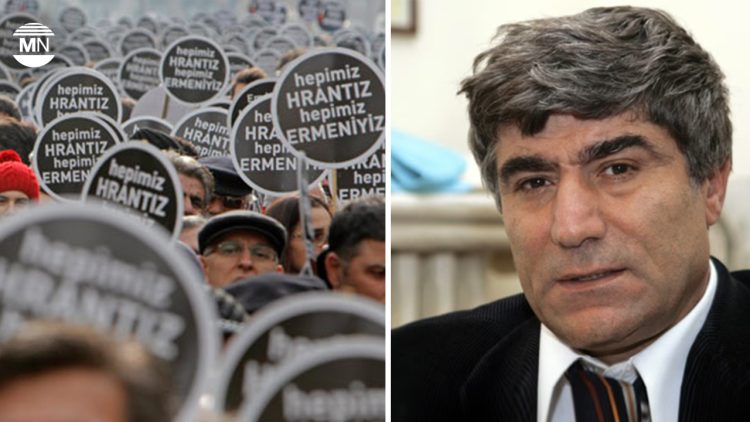
As Armenians and rights defenders across the world mark the 110th anniversary of the 1915 genocide, a haunting article by the late Armenian-Turkish journalist Hrant Dink has resurfaced, offering a poignant reflection on a century-old trauma—and the difficult duality of identity in modern Turkey.
Dink, the founder of Istanbul-based bilingual newspaper Agos, wrote “23.5 April” in 1996 to convey the emotional turmoil of being both Armenian and Turkish. The piece was published on 23 April, National Sovereignty and Children’s Day in Turkey—a joyful national holiday—juxtaposed with the solemn remembrance of 24 April, the day widely recognised as the beginning of the Armenian Genocide.
“Imagine being both Armenian and from Turkey,” Dink wrote. “Experiencing the full enthusiasm of 23 April and then being a part of the sorrow that follows the next day. How many people live through such a dilemma?”
On 24 April 1915, hundreds of Armenian intellectuals, artists, and politicians were arrested in Istanbul. Most were never seen again. The date marks the beginning of mass deportations and killings that would claim an estimated 1.5 million Armenian lives across the Ottoman Empire.
While Turkey continues to reject the term “genocide”, the memory of the atrocities remains vivid in the global Armenian diaspora. For many, Dink’s essay—named “23.5 April” after the night his first child was born—has become symbolic of the possibility for reconciliation.
Dink was assassinated in 2007 outside his newspaper’s office, a killing that sparked mass protests and is widely seen as a turning point in Turkey’s reckoning with its past.
“This isn’t an unsolvable question,” he wrote. “If 23 April is for all children, then let it also belong to the children of Armenia.”
As remembrance ceremonies take place worldwide, Dink’s message resonates anew: that healing may only come when children are allowed to inherit a future unburdened by the pain of the past.
The article titled “23.5 April” written by Hrant Dink, founder and editor-in-chief of Agos newspaper, published on 23 April 1996, has etched itself in memory as a striking piece reflecting on Turkey’s recent history. Below, you can find the translation of Dink’s article:
23 April is a very significant bright day in the history of a nation emerging from painful decades. It is the day the principle “Sovereignty unconditionally belongs to the nation” was inscribed into the parliamentary hall. And such a day has been passed on as a legacy to the child called ‘life’ and to the future. It is perhaps the date of the wisest foresight the Turkish nation ever had. How beautifully ‘the future’ and ‘the child’ have been brought together. And what a masterful gesture it is, years later, not to keep 23 April limited only to Turkey, but to share it with the children of the world. May it be a joyful occasion for Turkish children as well as for children everywhere.
24 April is a very dark day in the history of the Armenian nation, which has been ‘scattered’ across the world. Let a few Armenians come together, and immediately they take banners in hand and spill out into the streets. What is the reason for all this, why do these people take to the streets on 24 April? The date is the dawn of 24 April 1915. In particular, Armenian intellectuals, writers, artists, teachers, lawyers, doctors, and MPs in Istanbul are taken from their homes one by one. They are taken away… and never return. This date marks the beginning of the ‘historical Armenian tragedy’ that would soon unfold across the entire Ottoman Empire.
I don’t know how anyone could comprehend this, but imagine being both Armenian and from Turkey; experiencing the full enthusiasm of 23 April and then being a part of the sorrow that follows the next day. How many people in this world live through such a dilemma? It is neither easy to understand nor to explain.
I hope no one else ever has to experience such a dilemma again. How can 23 April be lived more joyfully? How can 24 April be erased from memory? These aren’t actually unsolvable questions. If 23 April is to belong to all children, then I say let it also, in some form, belong to the children of Armenia. Invite them to these celebrations as well. Let the children be reconciled with each other, let them meet. And don’t stop there—don’t limit it to 23 April. Include 24 April too. Let those days grow longer, include the whole of April, include all of spring. Let’s say you can’t manage it, that existing resentments stand in the way. Then at least leave the world to the children—they’ll sort it out, just don’t stand in their way.
I hold a special affection for 23 April. It is also the day my wife and I were married. Our wedding night coincided with the night linking 23 April to 24 April. It is the moment we gave life to our first child. Neither 23 April nor 24 April, perhaps it was 23.5 April.
Hrant Dink, Agos, 23 April 1996


