

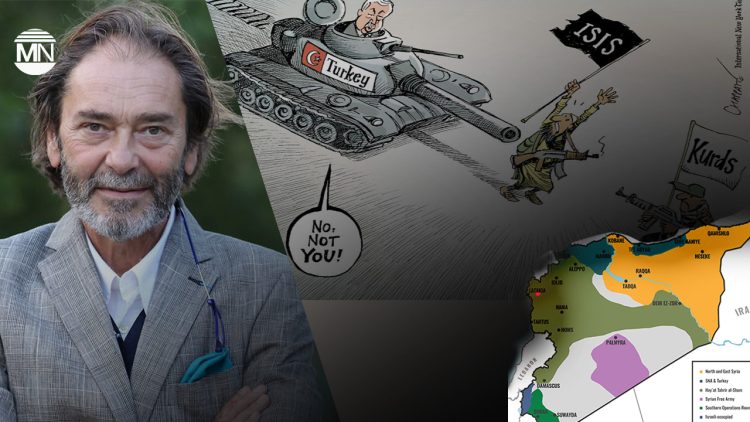
Turkey’s growing presence in Syria continues to be a source of contention, as Ankara pushes for greater control in the war-torn country. While its involvement is framed as a security measure, critics argue that Turkey is imposing a colonial-style administration, suppressing Kurdish forces, and disrupting diplomatic efforts.
Exiled journalist Cengiz Aktar contends that Ankara has long viewed Syria as a strategic extension of its influence. “Turkey wasted no time in claiming victory after the fall of the Assad regime, pushing its own vision for Syria’s future,” Aktar states. He argues that Turkey’s actions mirror its previous attempts to reshape Egypt during the Muslim Brotherhood’s short-lived rule.

Since 9 December, Turkey has intensified its efforts in Syria, embedding officials in ministries, planning a new constitution, and proposing the restructuring of Syria’s public infrastructure. According to estimates from 2019, reconstruction costs could range from $250 to $400 billion—figures that have likely risen significantly.
"Ankara wasted no time in claiming to be the big winner from the fall of the Assad regime in Syria, only to draw premature conclusions."
According to Aktar, Turkey has already established a significant presence in northwestern Syria, occupying more than 8,800 square kilometres and administering the area with military and civilian structures. Turkey’s deployment of the Syrian National Army (SNA) – a force reportedly made up of many fighters, including former ISIS fighters – is seen by Aktar as part of a wider plan to expand its sphere of influence.
Aktar notes, likening the arrangement to a “colonial pilot project”:
"In addition to the armed forces, Ankara has deployed civilian administrators in the area to manage education (in Turkish and Arabic, but not Kurdish), communications, finance and all aspects of public life,"
Aktar claims that the main aim is to marginalise or expel the Kurdish population from the disputed areas, creating a ‘cleansed’ buffer zone that extends well beyond the border strip. He stresses that the Autonomous Administration of Northeastern Syria (AANES) has formed an army of 100,000 fighters – including many trained by the Pentagon – and poses a formidable obstacle to Turkey’s ambitions.
EMBED RELATED ARTICLES
Related Articles:
Villagers from Tell Abyad in North East Syria condemn attacks by Turkish backed gangs

Locals safeguard northern Syria’s Tishreen Dam as Turkish-backed attacks rage on
At the same time, diplomatic initiatives to unite Syria’s various factions are causing concern in Ankara. Aktar highlights attempts by the AANES to engage in talks with other players, including the Syrian government.
“It is plausible that the NATO-trained forces of the AANES will form the backbone of the new Syrian army,” the exiled journalist notes, suggesting that the Kurds may yet secure a seat at the negotiating table.
Although Aktar accuses Turkey of lacking the “technical, financial and intellectual means” to impose its strategy on the entire country, he acknowledges Ankara’s central role in facilitating the eventual return of refugees. He calls on regional and Western powers to encourage Turkey to abandon what he describes as “irrational claims and anti-Kurdish monomania”.
Concluding his assessment, Aktar sees Ankara’s stance as detrimental to a lasting peace settlement in Syria, but acknowledges that Turkey remains an essential actor for the stability of Syria, if only because of the need to resolved the refugee crisis. He ends the article with a call “to all other actors both inside and outside Syria, to urge Turkey to abandon its irrational pretensions and anti-Kurdish monomania”.


