

Sütun 1
Sütun 2
Sütun 3
Medya News
Daily News
Breaking News
Subscribe
No Result
View All Result
  • Home
  • All News
  • Opinion
  • Kurdistan
  • Women
  • Politics
  • Human Rights
  • INTERVIEW
  • More
    • SPECIAL REPORTS
    • ECOLOGY
    • WORLD
    • AUDIO ARTICLES
    • JOURNALISM
    • ECONOMY
    • CULTURE & ART
    • LONG READS
    • NEWSLETTER
    • DAILY NEWS
MULTIMEDIA
PODCAST
LIVE BLOG
  • Home
  • All News
  • Opinion
  • Kurdistan
  • Women
  • Politics
  • Human Rights
  • INTERVIEW
  • More
    • SPECIAL REPORTS
    • ECOLOGY
    • WORLD
    • AUDIO ARTICLES
    • JOURNALISM
    • ECONOMY
    • CULTURE & ART
    • LONG READS
    • NEWSLETTER
    • DAILY NEWS
MULTIMEDIA
PODCAST
No Result
View All Result
Medya News

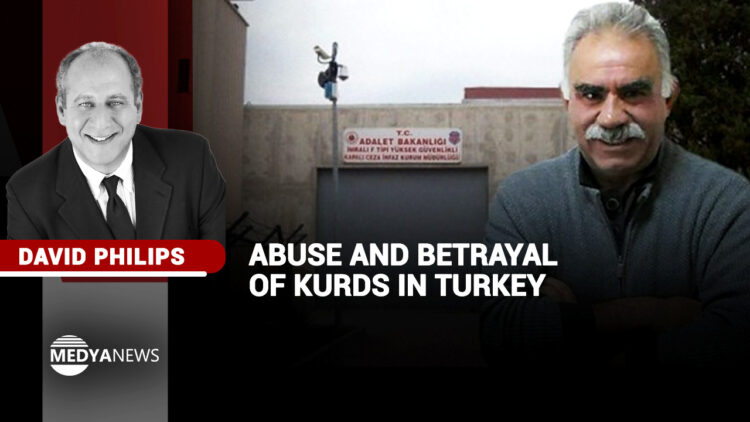
Abuse and betrayal of Kurds in Turkey

David Philips, who is a Georgetown University Professor, and an Oxford University visiting research scholar, explains the historical context to why freedom for Kurdistan Workers’ Party (PKK) leader Abdullah Öcalan is a prerequisite for peace between Turkey and the Kurds.

7:57 am 10/08/2024
A A
Abuse and betrayal of Kurds in Turkey
Share post

David L. Phillips

Twenty million Kurds in Turkey have suffered a century of abuse and betrayal. Ongoing conflict impacts Turkish democracy and undermines Turkey’s standing in NATO. Fixing the problem requires a solution to the Kurdish question involving Abdullah Öcalan, the Kurdish leader imprisoned for 25 years, who is still revered by Kurds for standing up to the Turkish state. The international campaign seeking Öcalan’s release deserves international support.

The 1920 Treaty of Sèvres promised the Kurds a referendum on independence, but the referendum was never held. Instead, the Turkish state launched a systematic campaign denying their right to self-determination as well as their political and cultural rights.

In response, Kurds launched the Sivek and Hilvan rebellions against Turkish security structures. Öcalan founded the Kurdistan Workers’ Party (PKK), an organisation which targeted instruments of oppression and policies of “Turkification”. They resisted the Resettlement Law, which authorised the Turkish state to collect taxes, seize land, and relocate Kurds deemed a security risk. The existence of Kurdish identity in Turkey was denied. Kurdish language and geographical place names were banned. Kurds were officially called “Mountain Turks”. These policies resulted in constant conflict. Tens of thousands of Kurds were killed and displaced.

The PKK was a product of the revolutionary left. Its ideology was a mix of radical Marxist-Leninism and Kurdish nationalism. It declared a “worker-peasant alliance” as the vanguard of its global socialist movement. Syria’s foreign minister, Farouk al-Sharaa, called the PKK a credible “resistance movement”.

The PKK relocated from southeastern Turkey to the Bekaa Valley in Syria. The 1998 Adana Agreement was a deal between Turkey and Syria intended to pressure the PKK into surrender. Turkey threatened to disrupt the supply of water to Syria from the Euphrates River, which was vital for agriculture and electricity. When Turkey massed troops on the Syrian border and threatened to invade, Hafez al-Assad succumbed and designated the PKK a terrorist organisation, banned its activities, and took steps to interdict the flow of weapons, money, and political support.

Öcalan was apprehended in February 1999. But imprisoning Öcalan did not solve Turkey’s Kurdish question rooted in inequality and social injustice. Öcalan pleaded for peace, but his entreaties fell on deaf ears. Öcalan was imprisoned and given a death sentence in 2002. The sentence was commuted to satisfy Turkey’s aspirations to join the European Union. To this day, he is still imprisoned on Imrali Island in his maximum-security prison.

Despite his circumstances, Öcalan developed a settlement of the PKK problem. Hakan Fidan, Turkey’s former spy chief and currently its foreign minister, served as Öcalan’s interlocutor to explore an equitable solution that would ensure the rights of Kurds within Turkey’s borders. Talks ended abruptly in 2015 with a deadly suicide bombing against pro-Kurdish demonstrators, attributed to Islamic State.

Öcalan reinvented himself as a proponent of peace. He promulgated a doctrine of grassroots democracy, environmentalism, and women’s empowerment, which define the PKK to this day. Even after his imprisonment, Abdullah Öcalan is still regarded as the undisputed leader of the Kurdish community.

Supporters of the Kurds launched an international campaign advocating Öcalan’s release from prison in 2024. They are calling for a peaceful and democratic solution to the Kurdish question. Until the realisation of this goal, social harmony between Kurds and Turks is a distant dream. Turkey’s democracy will suffer, and its economy will continue to decline. Opposition to Erdoğan will intensify.

Twenty-five years after his arrest, Öcalan maintains huge influence with Kurds in both Turkey and Syria. By focusing on a security solution, Erdoğan has discredited Turkey and spoiled its prospects of joining the EU. In 2021, the European Parliament suspended Turkey’s membership application on human rights grounds. Democratic backsliding has affected all Turks, including Kurds, Christians, Yazidis, Armenians, and Greeks.

Öcalan has since evolved. He no longer supports the creation of a “Greater Kurdistan” on all traditional Kurdish lands in Mesopotamia and Anatolia. Instead, he has endorsed Turkey’s membership in the EU based on the country’s continued democratisation. This represents a big step for Öcalan with potential benefit to all Turkish citizens.

Is Erdoğan willing to engage in a dialogue on reforms, which would enable peace and progress for all citizens? Previous efforts to advance the goal of reconciliation have failed. Turkey needs a political solution involving the disarmament, demobilisation and reintegration of the PKK, enhancing Turkey’s integration with Euro-Atlantic institutions.

Next year is the 100-year anniversary of the Turkish Republic. Instead of dividing society, Erdoğan should align himself with Mustafa Kemal Atatürk’s plea for “Peace at Home, Peace Abroad”.

David Phillips is an adjunct professor at Georgetown University’s School of Foreign Service and a visiting research scholar at Oxford University.


Share post
Tags: Abdullah ÖcalanDavid PhilipsFreedom For ÖcalannegotiationsPKKTurkey

Related Posts

After the war the crackdown: in this week’s Kurdish news

After the war the crackdown: in this week’s Kurdish news

June 29, 2025
Turkey’s Pro-Kurdish DEM Party delegation engages US officials on peace, democratic reforms

Turkey’s Pro-Kurdish DEM Party delegation engages US officials on peace, democratic reforms

June 29, 2025
Amnesty International urges freedom for peaceful protest in Galatasaray Square

Amnesty International urges freedom for peaceful protest in Galatasaray Square

June 29, 2025
Mezopotamya Cultural Centre opens new İstanbul venue on 35th anniversary

Mezopotamya Cultural Centre opens new İstanbul venue on 35th anniversary

June 29, 2025
Journalist İrfan Değirmenci detained at Pride forum in İstanbul

Journalist İrfan Değirmenci detained at Pride forum in İstanbul

June 29, 2025
Sayın: Only Öcalan’s model can resolve war driven by corridor competition

Sayın: Only Öcalan’s model can resolve war driven by corridor competition

June 29, 2025

The news content on our website cannot be quoted without permission, even by citing the source. It cannot be copied or published elsewhere, contrary to the law or without permission.

Follow Medya News

Categories

  • All News
  • Politics
  • Human Rights
  • Opinion
  • Kurdistan
  • Human Rights
  • Interview
  • Women
  • Audio Articles
  • Special Report

Quick Menu

  • Daily News
  • Live Blog
  • Podcast
  • Videos
  • Breaking News

About

Impressum

About us

Privacy Policy

Welcome Back!

Login to your account below

Forgotten Password?

Retrieve your password

Please enter your username or email address to reset your password.

Log In
We use cookies on our website to give you the most relevant experience by remembering your preferences and repeat visits. By clicking “Accept All”, you consent to the use of ALL the cookies. However, you may visit "Cookie Settings" to provide a controlled consent.
Cookie SettingsAccept All
Manage consent

Privacy Overview

This website uses cookies to improve your experience while you navigate through the website. Out of these, the cookies that are categorized as necessary are stored on your browser as they are essential for the working of basic functionalities of the website. We also use third-party cookies that help us analyze and understand how you use this website. These cookies will be stored in your browser only with your consent. You also have the option to opt-out of these cookies. But opting out of some of these cookies may affect your browsing experience.
Necessary
Always Enabled
Necessary cookies are absolutely essential for the website to function properly. These cookies ensure basic functionalities and security features of the website, anonymously.
CookieDurationDescription
cookielawinfo-checkbox-analytics11 monthsThis cookie is set by GDPR Cookie Consent plugin. The cookie is used to store the user consent for the cookies in the category "Analytics".
cookielawinfo-checkbox-functional11 monthsThe cookie is set by GDPR cookie consent to record the user consent for the cookies in the category "Functional".
cookielawinfo-checkbox-necessary11 monthsThis cookie is set by GDPR Cookie Consent plugin. The cookies is used to store the user consent for the cookies in the category "Necessary".
cookielawinfo-checkbox-others11 monthsThis cookie is set by GDPR Cookie Consent plugin. The cookie is used to store the user consent for the cookies in the category "Other.
cookielawinfo-checkbox-performance11 monthsThis cookie is set by GDPR Cookie Consent plugin. The cookie is used to store the user consent for the cookies in the category "Performance".
viewed_cookie_policy11 monthsThe cookie is set by the GDPR Cookie Consent plugin and is used to store whether or not user has consented to the use of cookies. It does not store any personal data.
Functional
Functional cookies help to perform certain functionalities like sharing the content of the website on social media platforms, collect feedbacks, and other third-party features.
Performance
Performance cookies are used to understand and analyze the key performance indexes of the website which helps in delivering a better user experience for the visitors.
Analytics
Analytical cookies are used to understand how visitors interact with the website. These cookies help provide information on metrics the number of visitors, bounce rate, traffic source, etc.
Advertisement
Advertisement cookies are used to provide visitors with relevant ads and marketing campaigns. These cookies track visitors across websites and collect information to provide customized ads.
Others
Other uncategorized cookies are those that are being analyzed and have not been classified into a category as yet.
SAVE & ACCEPT

Add New Playlist

Contact

[contact-form-7 id=”18690″ title=”Contact form 1″]

[email-subscribers-form id=”1″]

No Result
View All Result
  • All News
  • Kurdistan
  • Women
  • Politics
  • Human Rights
  • Interview
  • Long Reads
  • World
  • Journalism
  • Ecology
  • Economy
  • Culture & Art
  • Daily News
  • Breaking News
  • Newsletter
  • Opinion
  • Authors
  • Podcast
  • LIVE BLOG

© 2020 Medyanews. All Rights Reserved