


Amed Dicle
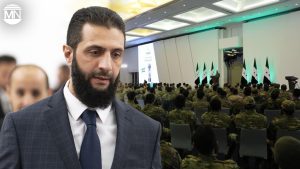
Syria is undergoing a major transformation. Hay’at Tahrir al-Sham’s (HTS) leader Abu Mohammed al-Jolani has declared himself the interim president. With this move, the existing constitutional and institutional structure of Syria has been completely dissolved. The Syrian army, parliament, and the 2012 Constitution have been annulled. The Ba’ath Party and the National Progressive Front have also been abolished.
Following this development, HTS and 18 affiliated armed groups announced their self-dissolution. The Turkey-backed Syrian National Army (SNA) and the Joint Forces have also aligned with this decision. So, what process will these developments trigger in Syria? What are the possible scenarios?
HTS’s takeover and international repercussions
HTS’s seizure of power has sent shockwaves across the international community. Israel has declared that with the collapse of the Syrian regime, the UN-monitored Golan Buffer Zone Agreement is now null and void. This development has created significant uncertainty in terms of border arrangements and regional security dynamics.
Meanwhile, Turkey is claiming that the 1999 Adana Agreement is still in force, arguing that it retains the right to launch attacks across Syria against anyone it labels as being “linked to the PKK”. However, how the United Nations will interpret and respond to this claim remains a crucial question. If the UN determines that the Syrian state still exists, Turkey’s presence in Syria could be legitimised under international law.
If the new administration declares institutional continuity with the former Syrian state, it will be obliged to repay its trillion-dollar debts to Russia and Iran. However, if it asserts “we are a new state,” Turkey’s justification for conducting military operations under the Adana Agreement will be rendered invalid.
The fate of the Syrian National Army and possible war scenarios
Although the Syrian National Army (SNA) has officially dissolved itself, if it is de facto integrated into the new central army, two scenarios may unfold:
1. The new Syrian Army launches an attack on Tishreen Dam, continuing the current offensives and triggering a full-scale war between the Syrian Democratic Forces (SDF) and the new regime.
2. Attacks on Tishreen cease, leaving Turkey isolated in its military operations against Rojava.
If an agreement is reached between the Autonomous Administration of North and East Syria (AANES) and the new Damascus administration, then accordingly:
SDF brigades could assume security responsibilities in Kurdish-majority areas such as Afrin and Serêkaniyê. Arab military units under the new administration could be stationed in Deir ez-Zor and Raqqa.
Under this scenario, the autonomous structure in eastern Syria could be constitutionally recognised. If a provincial system is introduced, allowing governors to be elected by the people, the legal foundation for self-rule would be strengthened. This scenario would likely not involve the full integration of the SDF into the new regime, but rather see the SDF continuing as a regional security force within Rojava.
Turkey’s strategy: Preventing a democratic Syria
Turkey continues its direct intervention in Syria’s internal affairs. Ankara’s greatest fear is the Kurds. It perceives a democratic Syria as a threat to its own security because such a model could grant the Kurds political and administrative status. For this reason, Turkey actively supports the establishment of an authoritarian and repressive regime in Syria.
Related Articles:
Turkey targets Kurdish autonomy, aims to block inclusive Syria in diplomatic pushTurkey’s covert influence in Damascus transitional government
Currently, Syria stands at a critical crossroads between two competing futures:
1. The construction of an authoritarian and centralised regime (led by HTS and backed by Turkey).
2. The creation of a democratic Syria (expanding the Autonomous Administration model).
The AANES has developed a pluralistic, multicultural, and democratic model that could serve as a viable solution for all of Syria. This system ensures equal representation for all ethnic and religious groups and promotes participatory governance through local assemblies.
However, for this model to succeed, there must be strong cooperation and organisation across Syria’s different regions. Democratic opposition forces must unite—not only to counterbalance HTS’s authoritarian rule but also to challenge Turkey’s imposition of a repressive governance model.
If the Syrian people and opposition forces fail to take effective action, foreign powers and occupying forces will dictate Syria’s future. This would result in prolonged conflict and decades of instability for the people of Syria.
* Amed Dicle was born and raised in Diyarbakır, Turkey. He has worked for Kurdish-language media outlets in Europe, including Roj TV, Sterk TV and ANF. His career has taken him to Rojava, Syria, Iraq and many other countries across Europe. Follow him on Twitter.


