

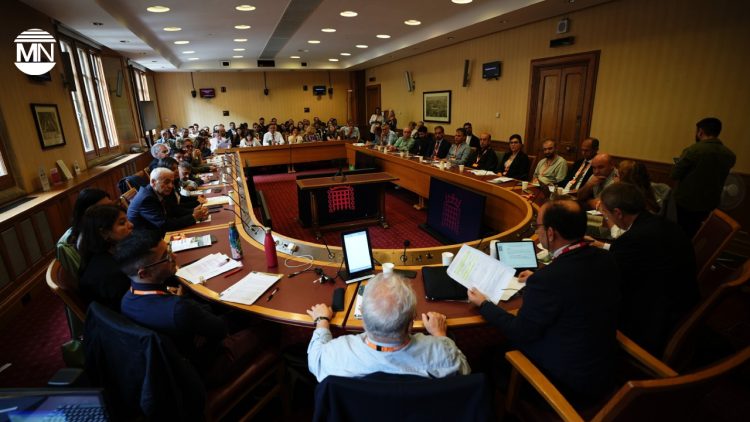
A high-level international conference hosted at the UK Parliament has called for the immediate revival of peace talks between Turkey and the Kurdish movement, with the release of Abdullah Öcalan named as the principal demand in a joint declaration issued on 26 June.
The conference, titled “Turkey, the Kurds and the Middle East Today – The Road to Peace & Stability,” was co-organised by the Centre for Kurdish Progress and the Freedom for Öcalan Campaign. It brought together lawmakers from the UK’s House of Lords, Kurdish political figures, trade union leaders, and international experts to explore prospects for regional stability.
Speaking during the event, Peoples’ Equality and Democracy (DEM) Party Co-Chair Tuncer Bakırhan said, “We are committed to dialogue and democratic resolution. The release of Mr Öcalan and recognition of the Kurdish people’s rights are essential to a lasting peace.”
The event followed a series of diplomatic meetings in Berlin and London, where a DEM Party delegation presented Öcalan’s 27 February “Call for Peace and Democratic Society” to European counterparts. That statement, released from İmralı Island prison via legal channels, has since been adopted by the party as the basis of its peace strategy.
Three-panel structure
The conference opened with a session on regional dynamics chaired by Osman Baydemir, former mayor of Diyarbakır (Amed). Speakers included Oxford-based journalist Ezgi Başaran, Prof. Abbas Vali, and Rojava-based journalist Ferhad Hemmi. Each emphasised the historical significance of the Kurdish question and the urgency of reviving stalled peace efforts.
Başaran argued that regional instability—including Israel’s war on Gaza—has pushed Turkey to reconsider its diplomatic posture, potentially creating new space for internal dialogue.
Vali said that “peace without democratisation is not possible”, calling for institutional reforms and social inclusion.
The second session, chaired by trade unionist Clare Baker, focused on comparative peace processes. Mariela Kohon, a veteran of Colombia’s negotiations, and Seán Byers of the Irish think tank Trademark, shared experiences on engaging non-state actors in political dialogue. Labour peer Maurice Glasman added that UK parties should take an active role in supporting Kurdish peace.
A message from Irish republican party Sinn Féin underlined Öcalan’s key role, stating: “His freedom is essential for any inclusive process.”
The third panel, led by Simon Dubbins of Unite the Union, assessed Britain’s potential role. Meral Çiçek from the Kurdish Women’s Movement linked peace to gender justice, while barrister Stephen Knight reviewed the UK’s ban on the PKK, suggesting it obstructs democratic dialogue.
Baroness Verma and Baroness Foster, both from the Conservative Party, hosted the conference and supported open debate on the issue.
Final declaration: key demands
In the closing session, a multi-point final declaration was presented, calling for:
• The immediate end of Öcalan’s isolation, citing the European Court of Human Rights and the legal principle of the “Right to Hope”;
• Establishment of a cross-party parliamentary commission in Turkey by mid-July to monitor the peace process;
• Release of political prisoners including Selahattin Demirtaş, Figen Yüksekdağ and Osman Kavala;
• Suspension of Turkish military operations in Iraqi Kurdistan (Başur) and North and East Syria (Rojava);
• Review of the PKK’s proscription in the UK, in line with past models of inclusive negotiations in Northern Ireland, Colombia and South Africa;
• Stronger UK diplomatic engagement in support of Kurdish rights in Turkey and Syria;
• An end to the criminalisation of Kurdish activists in the UK;
• Support for the Democratic Autonomous Administration of North and East Syria (AANES) as a model of inclusive governance.


