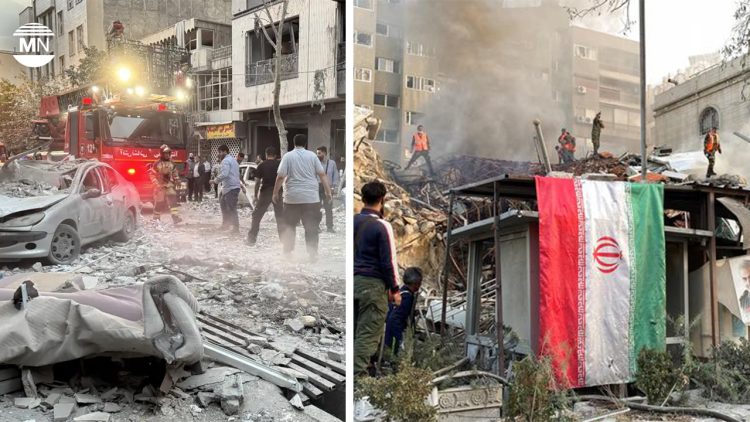
Intensifying military exchanges between Iran and Israel since 13 June have spilled beyond direct targets, unsettling Armenian minority communities in both countries and raising fears of broader regional escalation, Turkey’s Armenian newspaper Agos reported on Wednesday.
A missile strike in Tehran landed near the editorial office of Alik, an Armenian-language newspaper. Aram Shahnazaryan, the paper’s editor-in-chief, said the explosion shattered the building’s windows and disrupted internet access, temporarily halting publication. “Thankfully, no one was inside at the time,” he stated.
In Israel, Armenian residents in Petah Tikva, one of the cities struck during Iran’s retaliatory ballistic missile attack, were also caught in the chaos. Artyom Chernomoryan, president of the Nairi Armenian Association and editor of Israelahayer, posted on social media: “This time, it hit close. Four are dead and dozens wounded in Petah Tikva, but there are no Armenian casualties. We’re safe.”
While panic was avoided, Chernomoryan noted that community members followed emergency protocols, moving to shelters each time sirens sounded. “People know what to do. We stay alert,” he said.
Israel’s military said that between 80% and 90% of Iranian projectiles were intercepted by its air defence systems. However, some missiles reached urban centres, including Tel Aviv and Haifa. New buildings in Israel are required to include fortified safe rooms, but many older homes lack such protection. Several Armenian families in Petah Tikva reported rushing to community shelters with children during attacks.
The situation escalated after Israel reportedly targeted Iranian nuclear and military facilities, as well as residences of senior officials. Iran has urged the UN Security Council to formally condemn Israel’s “aggression”.
Experts warn that each exchange grows in intensity. Regional analyst Vardan Voskanyan said Iran suffers from a lack of allies, while Israel’s advanced air defence still fails to guarantee complete security. “This conflict has the potential to redraw regional power dynamics,” he said.
According to the Stockholm International Peace Research Institute (SIPRI), the global nuclear arsenal now includes 12,241 warheads, with 9,614 ready for deployment. The risk of escalation remains high as the international community watches anxiously.