

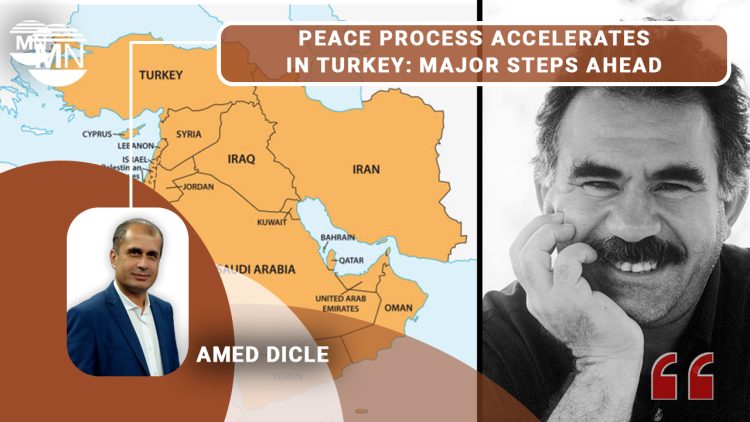
Amed Dicle
Abdullah Öcalan, the imprisoned Kurdish leader held for 26 years in İmralı Island Prison, issued his “Peace and Democratic Society” call on 27 February this year, marking not just a call for ceasefire but signalling a profound shift in political strategy and regional dynamics. It is clear that the process will advance in the coming days through increasingly visible and concrete steps. The Kurdish movement will not be content with its declared unilateral ceasefire; instead, it will pursue the process with political, diplo”matic, and societal moves that pave the way forward.
On 27 February 2025, Öcalan’s “Peace and Democratic Society” call heralded the opening of a new political threshold not only in the Kurdish issue but also in the future of Turkey and the Middle East. The call formalises the determined stance of a movement that has emerged from over fifty years of armed struggle, affirming that solutions must now be woven on political and societal grounds. This is not merely a ceasefire; it is the announcement of organisational transformation, historical closure, and the launch of a new founding process.
Where is the process heading?
Attention now turns to how this call will intersect with regional power balances, political polarisation within Turkey, and the organised reflex of Kurdish society. Öcalan’s intervention signals not an end, but the beginning of a new phase opened through struggle. It comes at a moment when the region is being reshaped, centres of power are shifting, and peoples are reasserting their historical role. As such, the call is not merely a demand for resolution; it is a strategic response, a counter-paradigm directed against the system’s denialist character.
It is evident that the process following this call will gain momentum with concrete steps in the coming days. The Kurdish movement will not settle for its unilateral ceasefire; it will drive the process forward through political, diplomatic, and societal initiatives. Öcalan’s intervention is not a passive search for peace but a declaration of political will strong enough to compel the state to act.
In this new phase, debates will no longer be shaped solely by wishes and hopes, but by concrete steps, proposed political models, and established negotiation grounds. Drawing on fifty years of struggle, the Kurdish movement will not stand by passively but will act as an active founding force.
Öcalan’s call and the structural steps the PKK is preparing to take will raise the process to a new threshold not only at the level of political actors but also within society. However, the historical outcomes of this process will depend not merely on declared decisions but on the societal response to them. No call can become a social reality without masses ready to embrace it. In this context, the response of the people, especially Kurdish society, will be decisive for the course of the process. This is not merely a matter of support; it is a matter of active participation, organised response, political subjectivity, and assuming a historical role.
Organisational transformation and the PKK reality
One of the most critical turning points in this process is the PKK’s decision to restructure its organisational form with the awareness that its historical mission has been fulfilled. This refers directly to convening its congress to make a decision towards dissolution — and as far as we can observe, this process is underway. To properly understand this development, one must assess not only current political events but also the ideological and historical context.
The PKK does not see this transformation as a retreat or collapse but as the outcome of historical fulfilment and strategic maturity. Only the strong can transform; only a movement capable of reckoning with itself can show the will to build a new future.
The weak cannot transform. Those who cannot confront themselves cannot reckon with history.
The theoretical foundation for this transformation has been shaped by the perspective of democratic modernity, which Öcalan defined in the early 2000s as the “new paradigm”. The PKK’s dissolution or departure from armed struggle is the natural result of this paradigm. The change in methods of struggle does not represent an ideological renunciation but the reorganisation of revolutionary continuity through new societal tools. In other words, this is not an “end” but a deeper, more inclusive, and long-term construction process.
It is clear that this call for transformation will be met with manipulation and attempts to stifle the process by war-favouring cliques within the state. The state’s basic reflex is to try to resolve the issue through suppression. The so-called “Collapse Plan” has defined the last decade’s dominant strategy. Yet this strategy has failed to liquidate the PKK; on the contrary, it has led to a deeper politicisation and organisational strengthening of Kurdish society.
Today, the state’s internal deadlock stems not only from its approach to the Kurdish issue but also from its broader authoritarian mindset that excludes democratic politics. Therefore, Öcalan’s call is directed not only at Kurds but at all social segments in Turkey who believe in democracy. Leftist-socialist circles, religious democrats, civil society, academia, and political opposition are all addressees of this call. The future Öcalan envisions carries the promise of reconstruction on the basis of equality and freedom not just for Kurds, but for all of Turkey.
At this point, peace is not a wish but a target of organised social effort. Power balances within the state may at times seek to turn the process to their own advantage. Yet the Kurdish people are no longer the passive society of the early twentieth century. Today, the level of political subjectivity also brings with it the capacity to shape peace. Therefore, the response to Öcalan’s call must come not only from official interlocutors but from the people themselves. The weaving of democratic society will form the main axis that determines the fate of this call.
Peace is no longer a matter of negotiation but a founding process. It is a societal construction that transcends the boundaries drawn by those in power and gives political form to the will of peoples to live together. This is not merely about forcing the state to reform; it is about society rebuilding itself.
The denialist paradigm is defeated
Today, while some attempt to confine the process within narrow frames such as “retreat” or “defeat”, the flow of history does not permit such simplifications. If the issue is to be debated in these terms, the real loser is the mentality of denial, destruction, and the monolithic nation-state.
The PKK is transforming on its own initiative. As it consigns itself as an organisational form to history, it continues as a spirit of struggle and a social movement. This is not a withdrawal but a strategic repositioning — and such change is a choice that can only be made by victorious movements backed by the will of the people.
This process opens the door not only to resolving the Kurdish issue but also to rebuilding the field of democratic politics in Turkey. It is not a matter of victory or surrender but a construction process focused on definitive achievement. For a movement emerging from armed struggle to organise peace with its organisational intelligence and reinforce its political legitimacy through new forms of struggle offers a fresh breath not only to the Kurdish people but to the whole of society.
A new construction process begins
The coming days will usher in a phase where the process gains momentum through more visible and concrete steps. The rise of societal organisation, the birth of new political grounds, and the deepening of democratic constitution debates will be the harbingers of this. Therefore, everyone must be ready for this new political equation and take part in this process.
Because this time, it is not just peace that will be built; a new country, a new region, and a new political equation will be established.
And the founding force of this equation will be the will of organised peoples.
Amed Dicle was born and raised in Diyarbakır, Turkey. He has worked for Kurdish-language media outlets in Europe, including Roj TV, Sterk TV and ANF. His work has taken him to Rojava, Syria, Iraq and many countries across Europe. Follow him on X (twitter).


