

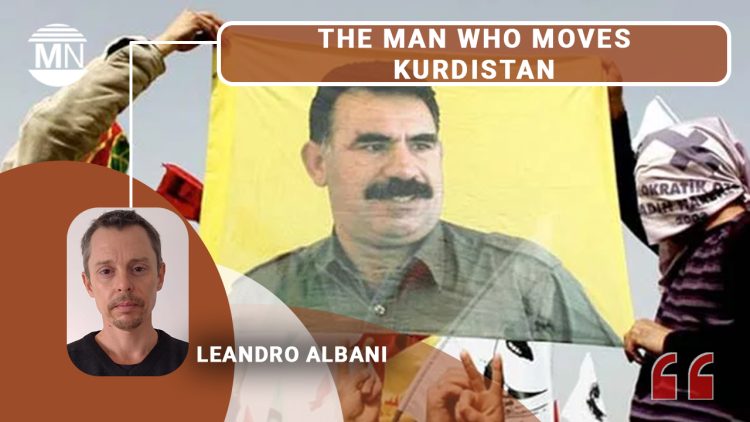
The first impression is that the years pass, inevitably. Grey hair and moustache, wrinkles on a gaunt face, pale hands and slender fingers. The description is not a sign of weakness. That’s how thousands of men and women in Kurdistan see it.
The man who appeared in a photo released on 27 February is Abdullah Öcalan, the founder of the Kurdistan Workers’ Party (PKK). For nearly four years, no one had heard anything about him. The Kurdish men and women who saw their leader’s face erupted with joy. Squares in towns and cities across the Kurdish region filled with men, women, children, and the elderly. They waited, with confidence, for Öcalan’s message—he has been imprisoned since 1999 on İmrali island, a Turkish military base in the Sea of Marmara. And the message came, once again, calling for peace.
Öcalan was born on 4 April 1949 in Ömerli (Amara), in the province of Şanlıurfa (Riha), in Bakur (Turkish Kurdistan). Although his family were farmers, he was able to study Political Science at the University of Ankara and work as a land surveyor. His youth coincided with a world shaken by national liberation movements, revolutions, and mass protests against wars and the status quo. This context shaped his political activism. He began meeting with others to discuss the Kurdish question.
Who were they, the Kurds? Why was their people systematically denied recognition by the Turkish state—and also in Syria, Iraq, and Iran? In that territory where these four nations meet lies the heart of Kurdistan, a “forbidden country”—as Basque-Navarrese journalist Manuel Martorell described it—and a population now exceeding forty million people who have never been granted full freedom.
Since those turbulent times, Öcalan has been known as “Apo” (“uncle” in Kurdish). And the group that formed the basis of what followed came to be known as the “Apoists”.
What were the Apoists seeking? To question their origins, to discuss the condition of their people in Turkey (denied as Kurds and labelled “mountain Turks”), and to reclaim what, over time, came to be called their “Kurdishness”. Around them, conflicts and struggles grew: Arab nationalism, Vietnam, Cuba, Latin America, and Europe, all shaken by student and workers’ protests.
The year 1978 was when the “Apoists” took another step forward. Just a handful of people gathered in the village of Fis, in the Kurdish province of Diyarbakır (Amed), and founded the PKK. Alongside Öcalan were Sakine Cansız, Cemil Bayık, Ali Haydar Kaytan, Mustafa Karasu, Haki Karer, and Kemal Pir, the last two being Turks from the country’s left-wing movement.
The PKK emerged amid events unfolding in many countries: Marxist and national liberation movements were driving the resurgence of the Third World. The victory of the Vietnamese resistance over the US war machine and the revolutionary fire burning in Cuba were also processes in which these few men and women saw themselves reflected. Their main goal was to liberate their ancestral territory and turn it into the foundation of an independent, socialist Kurdish state.
Öcalan and the newly committed PKK members began working door to door, dodging the repression and persecution of the Turkish state, which since the republic’s founding in 1923 had condemned the Kurdish people to ostracism and poverty.
But the 1980s in Turkey began with a military coup. The rise of the Turkish left and the first echoes of neoliberalism across the globe were the trigger. The military, always a shadow behind the country’s formal power, intensified the crackdown on the Kurds. A year earlier, Öcalan had moved to Syria and later to Lebanon. In the land of the cedars, PKK militants began their transformation into guerrilla fighters. Various factions of the Palestinian resistance trained them. Their baptism of fire came in 1982, when Israel invaded Lebanon. Alongside the Palestinians, the Kurds fought against Israeli soldiers; eleven PKK militants were killed in combat. Two years later, Öcalan and the party leadership made a decisive decision: to take up arms.
From Kurdistan to Syria
Öcalan lived for several years in Syria. In Damascus, the country’s capital, the PKK leader engaged in politics, led the party’s training academies, mediated between different Kurdish organisations, directed guerrilla operations in Bakur, and calculated how long the regime of Hafez al-Assad would allow him to remain in the country. Assad, in opposition to Turkey, allowed PKK guerrillas to maintain their rear base in Rojava (Syrian Kurdistan). This provided him with a buffer against Turkish expansionist efforts—a lingering echo of Ottoman imperial ambitions that continue to this day.
The collapse of the Soviet Union (USSR) found the PKK growing and engaged in fierce armed conflict with the Turkish army. For some time, Öcalan had been rethinking the destiny of his organisation. But it wasn’t a pragmatic or tactical decision: the Kurdish leader took long strides back through time, delving into the depths of his own history, which he believed began long before the Sumerian civilisation.
In the 1990s, Öcalan proposed several key shifts: that the PKK should no longer fight to seize power or establish a Kurdish state; that women were the political and historical agents of liberation; and that the Kurdish people, along with other peoples of Mesopotamia (Assyrians, Arabs, Armenians, Turkmens, etc.), should create a grand confederation of nationalities and religions able to coexist peacefully. As a first step, he called on the PKK to form self-defence forces and fight for “democratic autonomies” within the countries where the Kurds had become trapped. Öcalan argued that founding a new state in the Middle East would only further Balkanise the region and lead to the oppression of other minorities.
That was Öcalan’s position—caught between insurgent struggle and internal debate—when, on 9 October 1998, the Assad regime expelled him from Syria.
The arrest in isolation and the social protests against an unjust sentence
After several months in Europe, where no country was willing to grant him political asylum, Öcalan travelled to South Africa, where the government allowed him to stay. However, in Kenya he was abducted in a joint operation by the MİT (Turkish intelligence services), the American CIA, and the Israeli Mossad. Those who operated and designed the Turkish deep state celebrated. Their logic was simple: kill the dog and you end the rabies. But the opposite would happen.
In the isolation of Imrali island, Öcalan remained imprisoned and prepared his well-known “defences”, which were submitted in 2008 to the European Court of Human Rights (ECHR), which had already ruled five years earlier that the trial against the PKK founder had been unfair and that his right to a proper defence had been unduly restricted. Although the Kurdish leader was sentenced to death, massive protests in Kurdistan and pressure from Europe led Ankara to abolish the death penalty from its Civil Code in 2002. Öcalan was instead sentenced to life imprisonment. His legal defences later evolved into the Manifesto for a Democratic Civilization, the theoretical and practical foundation of the Kurdistan Liberation Movement (KLM). Divided into five volumes, the Manifesto ranges from an analysis of early humanity and the formation of Sumerian civilisation in Mesopotamia to his reflections and political proposals for modern times, with concepts such as “democratic nation”, “free life”, “democratic confederalism”, and “Jineolojî” (the science of women).
The so-called appeal “for peace and a democratic society” that Öcalan presented this past February is a handful of paragraphs in which the PKK leader offers to lead a peace process with the Turkish state to resolve the Kurdish question. He also calls on his party and its guerrilla forces—the People’s Defence Forces (HPG) and the Free Women’s Units (YJA Star)—to disarm.
Öcalan’s message began to take shape publicly in 2024, when his nephew, Ömer Öcalan, an MP from the pro-Kurdish Peoples’ Equality and Democracy Party (DEM), was able to visit him on Imrali after nearly four years without any news of the Kurdish leader. This year, a DEM Party delegation visited Imrali twice, where Öcalan is being held alongside three other Kurdish political prisoners under a regime of complete isolation.
Following the release of Öcalan’s call, the PKK declared a unilateral ceasefire and expressed its willingness to participate in a peace process. Armed Kurdish organisations in Syria, which share the Kurdish leader’s paradigm, clarified that the disarmament request was not directed at them. One thing Öcalan was unable to convey in his message (which was filmed but not authorised for broadcast by Turkish authorities) was that in order to reach a meaningful agreement with the state, a legal and democratic framework must be guaranteed.
In a recent article, Kurdish journalist Amed Dicle reflected on the words of the PKK founder and argued that the message “is not just a proposal for resolving the Kurdish question, but also an initiative for radical reconstruction to enable structural transformation in Turkey and a democratic future for the Middle East.”
Öcalan and the struggle for Kurdish women’s rights
Later, other messages from Öcalan became known. On International Women’s Day, the Kurdish leader stated that “the issue of women is an even deeper problem than the Kurdish issue. There is more of a women’s issue than a Kurdish issue. We have only made a small beginning in this regard. The culture of war and conflict is directed first and foremost against women. Being able to curb this culture, even to some extent, is the driving force of the struggle.”
Öcalan also emphasised: “Socialism can only be achieved through the liberation of women. There can be no socialism, and one cannot be a socialist, without women’s freedom. My first test of socialism is knowing how to speak to a woman. Whoever does not know how to speak to a woman cannot be a socialist. A man’s socialism is linked to the way he relates to a woman.”
A few days later, a message was released directed to the Yazidi people, mostly Kurds who practise a pre-Islamic religion. “The future of our Yazidi people will be forged on the basis of a democratic society, founded on their own strength and democratic will,” said Öcalan. “It is necessary to develop a social organisation that allows them to freely practise their faith. At this point, the construction of a democratic system is vitally important for the preservation and continuity of their historical existence.” In this new century, the PKK founder expressed his willingness to deepen, initially, democracy in Turkey so that Kurds and other minorities in the country may achieve full freedom. So far, the government of President Recep Tayyip Erdoğan has publicly stated its willingness to participate in a peace process, but it has not yet taken measures to pave that road with trust, concrete actions, and a plan leading to a real solution.
On the contrary, repression in Kurdistan continues, and the possibility of Öcalan gaining any freedom remains closed. The Turkish executive tried to present the Kurdish leader’s message and his call for the PKK to disarm as a success related to national security. Although for more than a hundred years the Turkish state has addressed the Kurdish issue within a military and repressive framework, it has not succeeded in defeating the Kurdish people and their liberation movement, which continues to have a clear leadership: that of Abdullah Öcalan, the man whose words always stir the hearts of the Kurds when he speaks.
Leandro Albani (1980, Pergamino). Journalist. Author of the books Kurdistan: Insurgent Chronicles (with Alejandro Haddad), Revolution in Kurdistan: The Other War Against the Islamic State, ISIS: The Army of Terror, Women of Kurdistan: The Revolution of the Daughters of the Sun (with Roma Vaquero Díaz), It Was Not a Riot: Chronicle of the Pergamino Massacre, Not a Single Day Without Fighting: Latin American Chronicles, and Urgent Kurdistan: Stories of a People in Resistance.


