

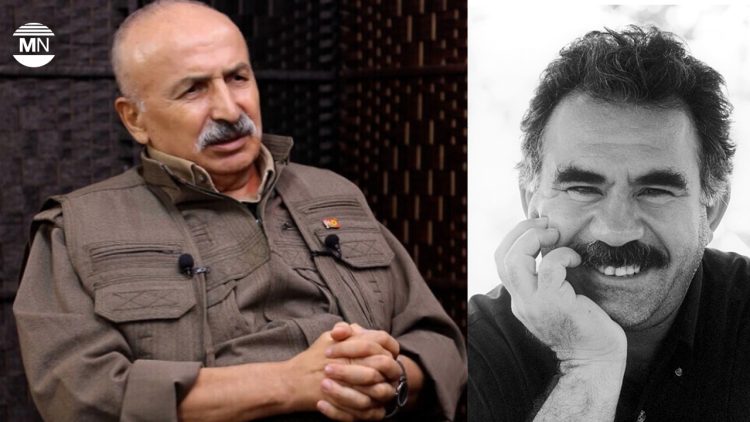
“If leader Apo [Abdullah Öcalan] does not join the congress, the PKK cannot make a decision,” said Kurdistan Communities Union (KCK) Executive Council member Mustafa Karasu on Tuesday during an interview with Medya Haber TV, underlining that any serious discussion on disarmament and peace must include the jailed Kurdish leader Abdullah Öcalan and move through legal and political channels.
Karasu criticised both the Turkish government and parliament for failing to respond meaningfully to Öcalan’s 27 February call for a democratic solution and ceasefire, which had reignited national debate over the Kurdistan Workers’ Party’s (PKK) potential disarmament.
The KCK member stated that while Öcalan’s call was a clear attempt to initiate a political and legal process, the government failed to take concrete steps. “A meeting with Öcalan was held only 40 days later, on 20 April. Is it acceptable to respond to such a critical initiative after more than a month?” he asked, adding that the delay reflected the government’s reluctance and lack of commitment.
Karasu also criticised the Turkish Justice Minister for offering vague reassurances instead of clear action. “The Minister of Justice only said ‘we will look into it’. We are still waiting to see what will come of that. What matters to us, and to our people, is that concrete steps must be taken without delay.”
He argued that despite Öcalan’s clear position and the PKK and the People’s Defence Forces’ (HPG) subsequent ceasefire announcements, the Turkish state continued military operations instead of engaging in dialogue. “After our ceasefire call, attacks should have stopped. In 2013, when the process started, they did. Continuing military action while we declare a ceasefire is sabotage. This is nothing but cheap heroism aimed at undermining the process,” Karasu said, pointing to Turkish Defence Minister Yaşar Güler’s statements as examples of provocation.
Karasu stressed that the Turkish parliament must play a central role in resolving the Kurdish question: “If the main opposition and other parties say this issue should be brought to parliament, then the government must do it. But we haven’t seen that.”
He also highlighted that Abdullah Öcalan’s participation is indispensable: “He is the founder of this movement. Without his direct or technical participation, the PKK cannot decide on such fundamental issues. The government’s failure to facilitate this is the main obstacle.”
Karasu warned that while there was still a strong willingness within the Kurdish movement to pursue a peaceful and democratic resolution, continued government inaction could endanger the fragile opportunity. “There’s no hesitation in Öcalan’s approach or among the Kurdish people. We strongly support shifting the process to a legal and political basis. Both domestic and international conditions are suitable. If this process fails, the government will bear responsibility.”
In closing, Karasu reiterated the KCK’s call for parliament to be activated as a platform for democratic resolution. “There can be no solution without parliament. If this issue doesn’t come before parliament, it cannot be resolved.”


