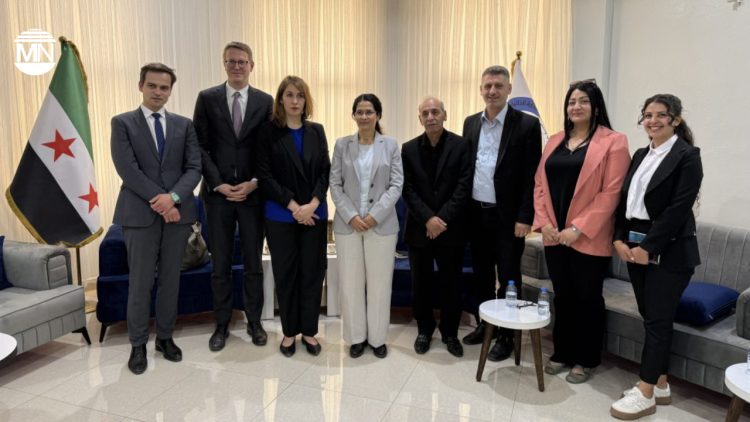
A German Embassy delegation, led by Ambassador Margaret Jacob, held talks with the Autonomous Administration of North and East Syria (AANES) on Sunday in Qamishli (Qamişlo), a key city in northeastern Syria. The meeting addressed the region’s political future, the collapse of Bashar al-Assad’s government, and the implications of reduced US military presence.
The AANES, the Kurdish-led authority governing parts of northern and eastern Syria, also referred to as Rojava, promotes local autonomy and multi-ethnic governance. The delegation met AANES Foreign Relations Department co-chairs Ilham Ahmed and Fener Al-Kait, along with deputies Rubel Baho and Gulistan Ali. Discussions focused on integrating the AANES’s administrative model into a unified Syrian framework, a critical issue as Syria navigates post-Assad transitions.
The AANES press office reported that both sides reviewed ongoing negotiations with the Syrian government in Damascus. Specialised committees are exploring how to align the AANES’s governance with national structures while preserving its autonomy. The talks also covered the US decision to scale back troops in the region, which Jacob noted could affect efforts to combat the Islamic State (ISIS). “Inclusive dialogue is essential for Syria’s stability,” Jacob said, stressing the need for agreements that reflect all communities’ interests.
The US troop reduction, announced in early 2025, plans to decrease the current force of approximately 2,000 – who support the local Kurdish-led Syrian Democratic Forces (SDF) – to around 1,000 or fewer by mid-2025. The SDF relies on US support to secure ISIS detention facilities and conduct counterterrorism operations. The drawdown, driven by shifting US priorities and the Syrian government’s collapse, has raised concerns about security gaps in areas like Raqqa (Raqa), where ISIS remnants remain active. Jacob and AANES officials underscored the need for sustained international support to prevent the group’s resurgence.
This meeting follows a pattern of Western engagement with the AANES. On 15 April, a British-European parliamentary group visited Qamishli to discuss political and economic challenges. Earlier, in August 2022, AANES officials met Norway’s Foreign Ministry to address Turkish threats and regional stability. In November 2020, Sweden’s Foreign Minister Anne Linde held a virtual meeting with AANES representatives, advocating for their inclusion in UN-led Syrian peace talks.
These interactions highlight the AANES’s growing role in Syria’s political landscape, despite tensions with Turkey and the Syrian government’s reluctance to recognise its autonomy.