

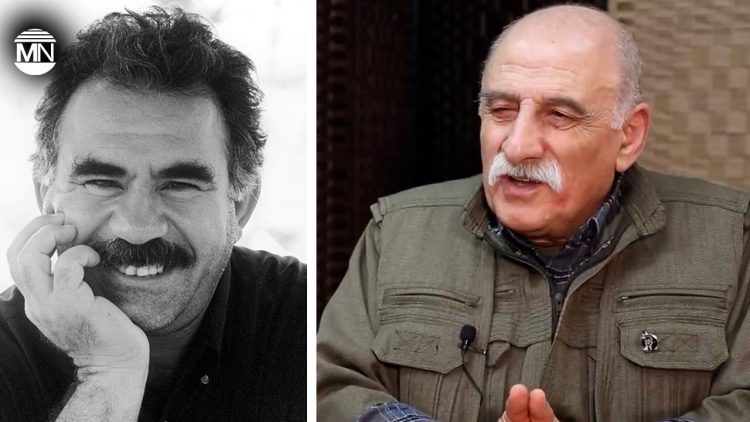
“Leader Apo [Abdullah Öcalan] has done more than his share. Truly, everyone was astonished,” said Duran Kalkan, senior member of the Kurdistan Workers’ Party (PKK) Executive Committee, during an interview with Medya Haber on Tuesday. His remarks followed recent political gestures around the Kurdish question, including a meeting between Turkish President Recep Tayyip Erdoğan and the İmralı delegation of the pro-Kurdish Peoples’ Equality and Democracy (DEM) Party.
Kalkan said that while such meetings were significant, “without practical steps, words alone are not enough. We can’t say anything based only on words.” He warned the public — particularly Kurdish youth, women, and the democratic sectors — not to misread symbolic gestures as substantive change: “These are only words and wishes. We should not see them as if they have already happened.”
At the centre of Kalkan’s message was Abdullah Öcalan, known to supporters as Leader Apo, who has been held in isolation on İmralı Island since 1999. Kalkan said there had been no meaningful change to his conditions despite Öcalan’s 27 February statement titled ‘Call for Peace and a Democratic Society’.
“Unfortunately, isolation continues on İmralı. We have not received any serious information about a change,” he said. “It was said that he would gain such conditions within a week. But no changes occurred. Up to now, there has been nothing serious observed or reflected in this area.”
Öcalan’s call was widely described as historic, but Kalkan argued it has not received a meaningful or practical response from the Turkish state. “We estimate that a crisis situation also occurred on İmralı, where the leadership took a stance to not normalise the situation,” he noted. “Whether this really happened or not, of course, we don’t have very concrete information.”
Kalkan underlined that the Kurdish question is rooted in systemic state policies of denial and repression. “This issue was created based on Kurdish hostility and a mentality and politics that aimed to annihilate and deny Kurds. This is the essence of the problem. And it was based on violence. Therefore, the solution will come from there.”
While affirming Öcalan’s commitment to peace, Kalkan said, “Peace in Turkey cannot be achieved by Leader Apo alone. Peace and war require both sides. It cannot be done by one side only.”
The PKK leadership responded to Öcalan’s call with a ceasefire and declared that they would implement it — but only under the condition that Öcalan is freed for political participation and to lead peace process negotiations. “We said that Leader Apo must gain his physical freedom or at least attain the conditions in which he can live and work freely. Why? Because only Leader Apo could hold a Congress,” Kalkan said. “Only Leader Apo could have the decisions foreseen at the Congress taken, and only he could implement them.”
Criticising contradictory government actions, Kalkan added: “If a body says, ‘Let armed struggle stop, let weapons be laid down,’ and at the same time carries out such military attacks, forcing the other side into war — how credible is their call for disarmament?”
He also condemned international meetings such as the joint mechanism with Iraq, which focused on so-called “PKK terrorism”. “But weren’t they supposed to be making agreements with the PKK? If that is true, why then are they running around the world… making deals against the PKK under the label of ‘fighting terrorism’?”
Kalkan warned that ongoing military campaigns and legal crackdowns indicate the government’s real intent. “From legal institutions to lawyers… With this approach, democracy will not come to Turkey. A mentality that cannot democratise Turkey cannot resolve the Kurdish issue either,” he said.
While praising civil society efforts, such as the recent Rome conference supporting Öcalan’s freedom, Kalkan urged Kurdish communities and international allies to intensify grassroots mobilisation: “It is essential to expand, spread, and make this initiative concrete—to continue the global freedom initiative aiming at Leader Apo’s physical freedom… in a widespread, effective manner, without weakening or interruption.”
According to Kalkan, “Leader Apo’s statement… was not directed to any particular individual, group, or place—it was addressed to everyone living in this world. No one can say, ‘This call is not for me.’”
Yet without removing what he called the “İmralı system of torture, isolation, and genocide”, Kalkan said real progress would be impossible. “If Leader Apo holds a congress and becomes able to lead—then the process will proceed in practice. There will be no problem. There is nothing obstructive from our side; on the contrary, our approach is always to facilitate.”
He also criticised opposition parties for failing to present concrete projects or utilise parliamentary means to support a resolution. “They are not forward-looking, they are not offering concrete proposals, they are not developing policy,” he said.
In conclusion, Kalkan delivered a pointed warning: “If the plan is to both implement the İmralı system, maintain the isolation and the hostage regime, and yet expect others to fulfil the call’s requirements, then that won’t work.”


