

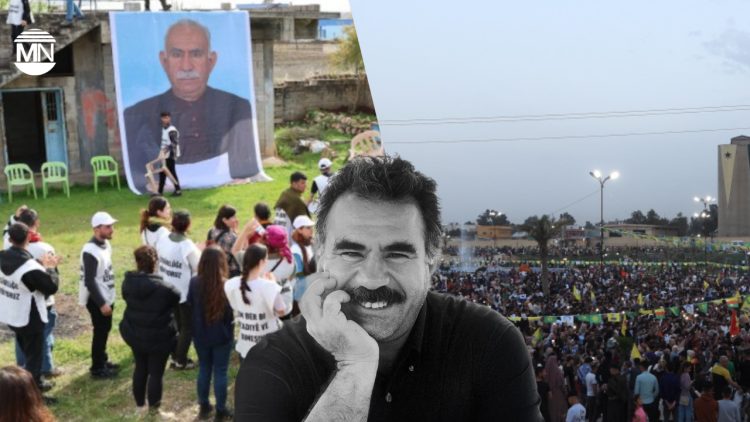
Kurds worldwide celebrated the 76th birthday of Abdullah Öcalan, the imprisoned founder of the Kurdistan Workers’ Party (PKK) on Friday, with events ranging from torchlit marches to sapling plantings, all united by demands for his release from a Turkish prison. Öcalan, held in isolation at İmralı F Type High Security Prison since 1999, is seen by supporters as pivotal to ending a decades-long conflict between Kurds and the Turkish state.
In Van (Wan), a Kurdish-majority city in eastern Turkey, hundreds gathered to honour Öcalan, voicing hope in his recent peace initiative announced on 27 February, which called for the PKK to disarm and dissolve, prompting a ceasefire on 1 March. Ömer Uçar, a participant, expressed cautious optimism: “We believe in Mr Öcalan, but Turkey must show sincerity by acting quickly.” Fazıl Canpolat urged swift progress, stating, “All our spirit and body stand with him—we want this process sped up.” The event, led by the Free Women’s Movement (TJA), Democratic Regions Party (DBP) and Peoples’ Equality and Democracy (DEM) Party, included sapling planting and a festival, ending with traditional dancing.
Supporters like Rabia Algöl in Van see his release as transformative: “His call could make this a world peace day.” Kevê Işık added, “We want an honourable future for the next generation.” Yet, distrust in Turkey persists, with many, including Xemê Aydın, insisting, “Only when Öcalan is free will Kurds be free.”
Meanwhile, in Amara, Öcalan’s birthplace in Urfa (Riha), a march culminated at his childhood home, where his brother Mehmet Öcalan welcomed a 76-person delegation, including DBP co-chairs, and called for a democratic resolution to the Kurdish issue.
Across Europe, celebrations echoed these sentiments. In Zürich, Switzerland, the Swiss Kurdish Women’s Union (YJK-S) led a torchlit march from Helvetia Square, with spokesperson Selma Sürer praising Öcalan’s 50-year struggle and peace call. In Geneva, a screening of his life preceded a cake-cutting by children, while Lausanne hosted poetry and a documentary.
France saw events in Marseille, where the Arin Mirkan Women’s Council held a vibrant gathering, and Paris (Villiers le Bel), where saplings were planted in a martyr’s garden.
Germany’s celebrations spanned cities like Cologne, where the Viyan Women’s Council planted trees, and Berlin, where the Dest Dan Women’s Council linked Öcalan’s ecological vision to freedom, all marked by “Bijî Serok Apo” (“Long Live Leader Apo”) chants and dancing.
In Mainz, Germany, Kurdish students planted a tree at Johannes Gutenberg University, calling it a symbol of peace, while in Hannover, events spanned days with “Jin, Jiyan, Azadî” (“Woman, Life, Freedom”) slogans, tying his legacy to broader liberation struggles.
In Syria’s Jazira (Cizîrê) Canton, part of the autonomous North and East region, Qamishli (Qamişlo) hosted an event at Freedom Park with martyr families, where Cewahir Osman hailed Öcalan’s ideas as a beacon for the oppressed, followed by music and dancing. In Tel Hamis (Til Hemîsê), 50 saplings were planted with Arab tribal leaders present, and Tel Temir (Til Temir) saw three events, including 150 saplings planted and a call for international pressure on Turkey to free Öcalan.
These gatherings underscored his influence beyond Turkey, rooted in his “democratic confederalism” philosophy advocating grassroots democracy and equality.
The global scale of the celebrations—from sapling plantings symbolising renewal to marches demanding action—reflects Öcalan’s enduring role.


