

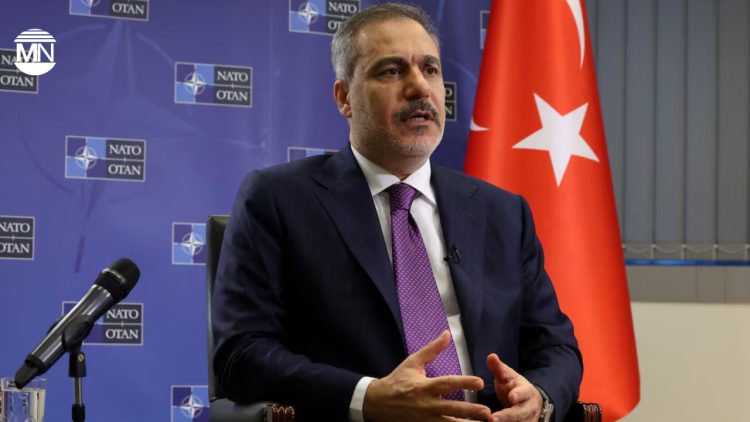
Turkey’s Foreign Minister Hakan Fidan has stated that Ankara seeks to avoid conflict with Israel in Syria, despite Israel’s ongoing airstrikes on Syrian military sites that Turkey aims to use in a military pact with Syria’s new leader, Ahmed al-Sharaa, risking escalation between the two nations.
Speaking to Reuters on Friday at a NATO meeting in Brussels, Fidan claimed these attacks are weakening Syria’s new government, a Turkish ally, as it attempts to stabilise the war-torn nation. “We don’t want to see any confrontation with Israel in Syria because Syria belongs to Syrians,” he said.
Israel’s strikes, including a bombing on 2 April of Hama military airport and the T4 airbase near Homs, have destroyed key infrastructure, with Syria’s foreign ministry reporting near-total loss at Hama. A Syrian human rights group said four defence ministry employees died and 12 were injured.
Israel says it targets sites to prevent weapons from reaching hostile groups, a policy intensified since Bashar al-Assad’s fall in December. Fidan claimed that such actions hinder Syria’s fight against threats like Islamic State (ISIS), yet Turkey’s own offensives against Kurdish forces in northeast Syria—key anti-ISIS fighters—have consistently been criticised for disrupting stability efforts and displacing civilians.
Syria’s interim President Ahmed al-Sharaa, backed by Turkey after leading rebel factions against Assad, is negotiating a military pact with Ankara, potentially involving control of airbases like T4.
Turkey has called the Israeli strikes an encroachment on Syrian territory, despite its occupation of northern Syria since 2016, which critics say undermines Syrian sovereignty.
Fidan’s call for calm contrasts with Turkey’s regional record. While he accused Israel of fuelling chaos, Turkey has faced allegations of supporting jihadist groups, including ISIS, to counter Kurdish autonomy in Syria’s northeast, known as Rojava. Kurdish forces, who recently signed a pact with Damascus, remain a target of Turkish operations, complicating al-Sharaa’s unification efforts.
Israel insists its strikes secure its borders, with a source telling Izvestia, “Israel considers the deployment of the Turkish base as a potential threat to its freedom of action.” Al-Sharaa, meanwhile, has signalled openness to peace with Israel, telling The Economist in February it’s too early for formal talks.
Turkey sees economic potential in Syria’s reconstruction and has urged the West to lift sanctions, a point Fidan raised with US officials last week, expressing hope in the Trump administration’s approach.


