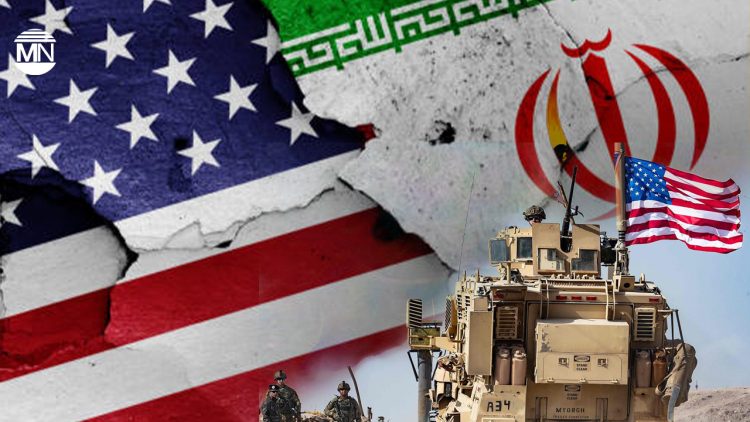
The United States has intensified its military presence in the Middle East, deploying additional naval and air forces in response to rising tensions with Iran, as Washington signals readiness to act against perceived threats.
Pentagon spokesman Sean Parnell announced on Tuesday that the Harry S. Truman Carrier Strike Group will remain in the US Central Command (CENTCOM) area of responsibility, while the Carl Vinson Carrier Strike Group will also be deployed there following an Indo-Pacific exercise. Additionally, the Nimitz Strike Group is heading to the Western Pacific to maintain US military superiority in the region.
To further reinforce CENTCOM’s defensive posture, Defence Secretary Pete Hegseth has authorised the deployment of extra air squadrons and support assets. “The United States and its partners remain committed to regional security and are prepared to respond to any state or non-state actor seeking to escalate conflict,” Parnell said, warning that the US would take “decisive action” if Iran or its proxies threatened American personnel and interests.
The military buildup comes amid growing speculation that Washington is preparing for a possible confrontation with Tehran, particularly over its nuclear programme. Tensions between the two nations have escalated since President Donald Trump reinstated his “maximum pressure” policy after returning to the White House in January, scrapping any revival of the 2015 nuclear deal. While Washington claims it is open to indirect talks, Iran has rejected direct negotiations under coercion.
Tehran has reacted strongly to the US military manoeuvres. A senior commander of Iran’s Revolutionary Guard, Amirali Hajizadeh, warned that American forces in the region are vulnerable to retaliation. “The Americans have around ten military bases near Iran, with 50,000 troops. It’s like they’re sitting in a glass house. And when you’re in a glass house, you don’t throw stones at others,” Hajizadeh said in an interview on state television.
Iran’s Supreme Leader Ali Khamenei also issued a stark warning on Monday, vowing a “strong counterattack” if the US or its allies launched a military strike. His remarks followed a threat by Trump, who told NBC News that if Iran refused to negotiate a new nuclear deal, “there will be bombing the likes of which they have never seen before”.
In response to Trump’s comments, Iran summoned the Swiss chargé d’affaires, who represents US interests in Tehran, and accused Washington of attempting to manipulate global opinion by portraying Iran as the obstacle to diplomacy.
Amid the escalating rhetoric, US ally Israel has reiterated its position that it will not tolerate a nuclear-armed Iran, raising concerns that military action in the region could widen into a broader conflict. Meanwhile, Russia has warned that any US attack on Iran’s nuclear infrastructure would have “catastrophic” consequences.
As Washington strengthens its military footprint, the risk of a new Middle East conflict looms large, with diplomacy appearing increasingly fragile.