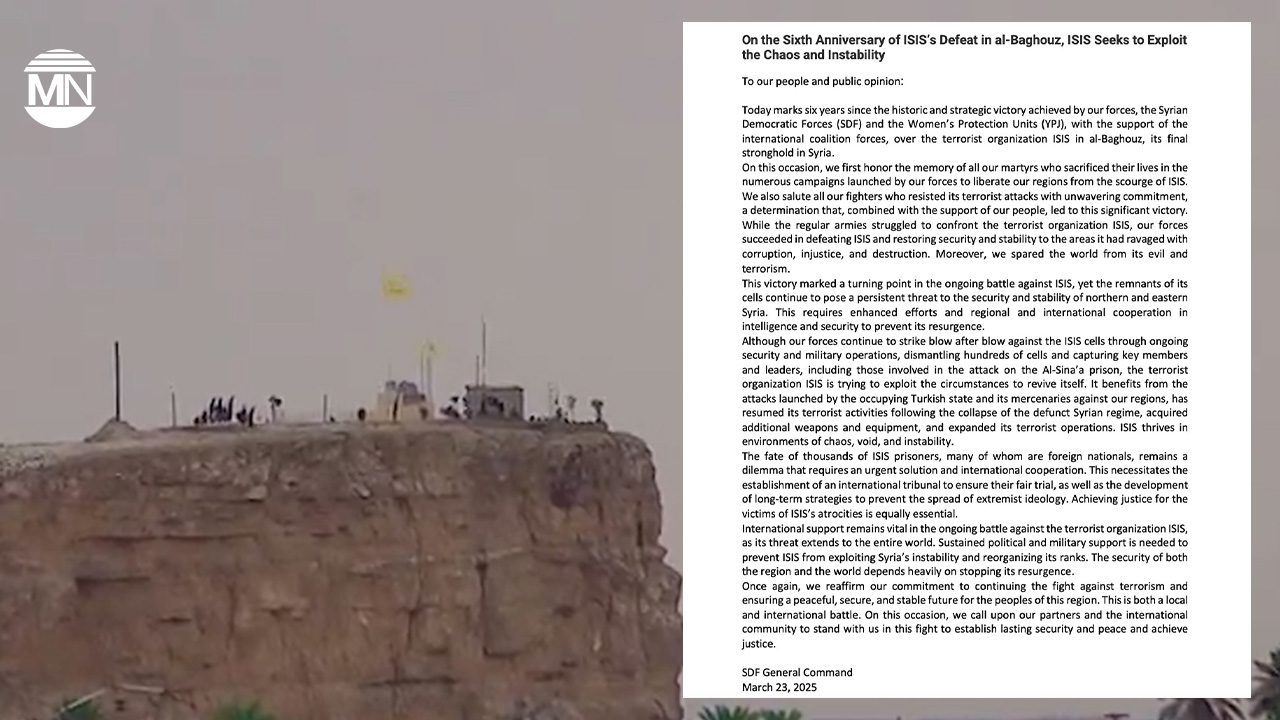
On the sixth anniversary of the territorial defeat of the Islamic State (ISIS) in al-Baghouz, the Syrian Democratic Forces (SDF) released a public statement warning of renewed threats posed by the group’s surviving elements. The statement, accompanied by a video, commemorates the 2019 victory achieved by the SDF and the Women’s Protection Units (YPJ), supported by the US-led Global Coalition to Defeat ISIS.
ISIS emerged during the early years of the Syrian and Iraqi conflicts, reaching its peak territorial expansion in 2014. In response, the United States spearheaded the formation of an international coalition to combat the group. Despite ongoing objections from Turkey over the participation of Kurdish forces, the US identified the SDF—including the Kurdish People’s Protection Units (YPG) and YPJ—as its most effective partner on the ground. The SDF’s contribution, particularly from Kurdish fighters who saw 20,000 losses during the anti-ISIS campaign, was central to the coalition’s final success.
The SDF General Command used the anniversary to honour fallen fighters and reaffirm its commitment to counterterrorism. “While traditional armies faltered in confronting ISIS, our forces reclaimed our territory and helped secure the broader region against terrorism,” the statement noted.
However, the SDF warned that the territorial defeat of ISIS has not eliminated the group’s threat. Sleeper cells continue to operate across northern and eastern Syria, particularly in areas marked by instability and the absence of central governance. The SDF argues that ongoing attacks by Turkish-backed forces and the fragmentation of the Syrian state have created conditions favourable to ISIS’s resurgence.
In response, the SDF has conducted a series of counterterrorism operations aimed at disrupting these cells. These efforts have led to the capture of numerous operatives, including individuals linked to the high-profile 2022 Al-Sina’a prison assault. Despite these efforts, ISIS has reportedly acquired new weapons, reorganised its ranks, and resumed operations in conflict-affected areas.
The unresolved status of thousands of detained ISIS fighters, many of whom are foreign nationals, poses an additional risk. The SDF reiterated its call for the establishment of an international tribunal to ensure accountability and justice for crimes committed under ISIS’s rule. The group also stressed the need for global cooperation on long-term strategies to counter violent extremism and prevent radicalisation.
The statement further emphasised that defeating ISIS requires sustained international involvement. “This is not merely a regional conflict; it is a shared responsibility to uphold global peace and stability,” the SDF declared. The General Command urged its international allies to maintain political, logistical, and military support to prevent a resurgence of the jihadist threat.
In a significant political development, the SDF also referenced its peace agreement signed on 10 March with the newly established interim Syrian government. The deal recognises the administrative autonomy of the SDF-held areas, acknowledges Kurdish cultural and political rights, and outlines the integration of SDF forces into the emerging Syrian national security framework. The agreement has been viewed as a step toward building a new, inclusive Syrian state structure, despite the ongoing challenges posed by regional actors and instability.
In closing, the SDF reaffirmed its determination to safeguard the region’s security and contribute to lasting peace. The statement framed the struggle against ISIS not only as a military campaign but as a broader defence of democratic values and human rights.