

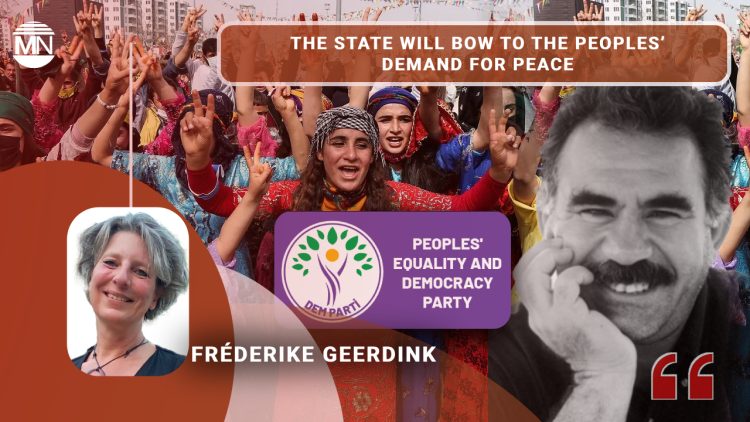
Fréderike Geerdink
The most pressing question people ask me about Öcalan’s call for the Kurdistan Workers’ Party (PKK) to lay down its arms and about the Equality and Democracy (DEM) Party’s hope that the government will make it possible through democratic reforms, is: “Why do the Kurds believe the state is sincere? Why do they have hope that this time, it will lead to results?” I understand the question, because from the beginning, the optics haven’t been good. Doesn’t this lead to disappointment? Well, it may, but then again, it may not.
It’s been almost three weeks since Abdullah Öcalan’s call on the PKK to lay down its arms and to dissolve itself. In fact, it was a call for democratic politics, as was clearly reflected in the title, ‘Call for Peace and a Democratic Society’. From the very beginning, peace (in the sense of a peace rooted in justice for all) and democracy has been the goal, not the laying down of arms and the dissolution of armed groups without the country and its citizens getting anything in return.
Support base
I think that’s quite logical. Even if you don’t follow the Kurdish issue at all and know not much more about the PKK than that it is an armed Kurdish group that has been in existence for quite a long time, you can figure out that an armed group doesn’t just lay down its arms without getting anything in return. Unless that group has been defeated militarily and lost all support from the people they are fighting for.
Neither is the case with the PKK. It may be in difficult times, but it has also adjusted itself to modern drone warfare and it has not been defeated.
And even though the Kurdish people are longing for peace, the PKK still has a large support base among the population.
People who do follow the PKK, the Kurdish issue and Turkey, are a little bit confused. I draw that conclusion from the reactions I get, as a journalist who has been reporting from Kurdistan, the Kurdish mountains, cities and villages for many years and still follows developments on an hourly basis. These people know that the Justice and Development Party (AKP) hasn’t been sincere about solving the Kurdish issue before. They also know that Devlet Bahçeli, the leader of the Natonalist Movement Party (MHP), AKP’s partner, is an ultra-nationalist. He may have extended his hand to DEM Party MPs as a first step towards the current developments, but he is also a Grey Wolf. What can we actually expect from these men? Why does the Kurdish movement see this all so positively?
Moulds
Well, let’s talk about expectations. Maybe we can’t expect much from these men, but maybe we shouldn’t focus on them. Maybe we should focus on the citizens of Turkey. Not necessarily only Kurds, but Turks too, and Arabs, Laz, Circassians, Armenians – all of them. What if people start demanding that the government takes action? What if they no longer accept that Turkish President Erdoğan is only in it to secure his own power once again by trying to get political parties on his side to change the constitution, so he can run for president for the third time? What if they massively insist on democracy, not just for Kurds but for themselves too? That it is just no longer feasible to live in a state that forces people into moulds they never comfortably fitted into?
Imagine that this group in society becomes a critical mass. A mass big enough to trigger change. A mass that sees that a military solution is not possible for the Kurdish issue to be solved. A mass that understands that this means that not just the PKK, but also the Turkish army has to wake up to reality and end its violent approach. A mass that takes to the streets to demand it, that dares to speak out in debates, at university, on social media.
This occured to me when I saw the DEM Party MP and member of the delegation that has visited Öcalan in prison, Sırrı Süreyya Önder, in a two hour long interview on a mainstream Turkish channel. Önder is an extremely intelligent, friendly, soft spoken but sharp politician and intellectual, who is very good at explaining what Öcalan’s call contained and what is necessary now to put Öcalan’s vision into practice.
Boundaries
I’m sure the Turkish TV watchdog gave permission for the interview and guaranteed the channel that they wouldn’t be in trouble for it, but what I’d like to focus on, is that this channel did choose to broadcast this. They didn’t have to do that. It must have been wonderful for the journalists working there to step outside the state’s boundaries, to freely work. What if they decide to take more liberties? What if they decide to not be afraid any more of dismissal and prosecution, but just do what they want to do, which is journalism? The state may think they can lock up all journalists who cross the lines, but honestly, they can’t.
What is needed, is momentum. That is why it is very smart of the DEM Party to have initiated a tour across the country to inform people about what is going on. If I were reporting in Bakur (Kurdistan in Turkey) and Turkey now, I’d travel with them to see how people react in different corners of the country.
Sure, there will be resistance, but it’s not only Kurds who long for peace. Who doesn’t long for it? Hasn’t it finally been enough?
Momentum
So no, I don’t think the DEM Party and the Kurdish movement are necessarily expecting something from the AKP-MHP government. They know the state very, very well. Of course, DEM Party politicians talk to all other political parties and want to directly engage with the president as well, because that is their job.
But the wider movement is a peoples’ movement, and they are doing absolutely everything they can to maintain the momentum that Öcalan’s call has created. They will put pressure on the state up to such heights, that state power will have to give in.
That’s what they are working on. Öcalan doesn’t bow. The PKK doesn’t bow. The wider Kurdish movement doesn’t bow. The people won’t bow. Eventually, the state will. The state will bow to the peoples’ demand for peace.
Fréderike Geerdink is an independent journalist. Follow her on Bluesky or X, or subscribe to her acclaimed weekly newsletter Expert Kurdistan.


