Amed Dicle
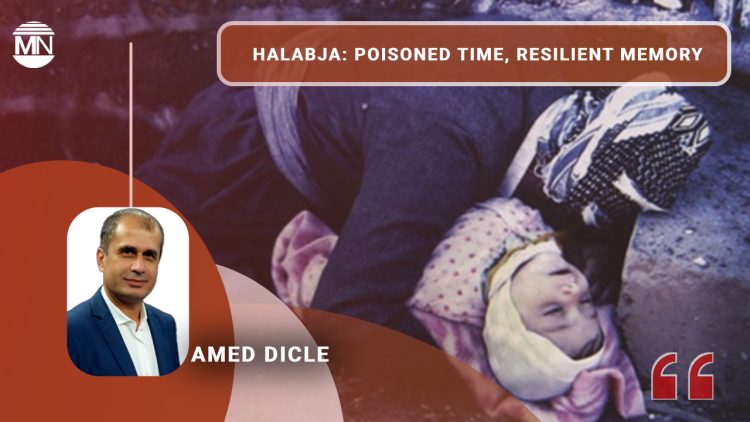
A father, arms outstretched, a prayer reaching towards the sky. But before the prayer could be completed, he collapsed. The child in his embrace, frozen by the cruellest truth of life, condemned to an untimely farewell. That photograph stands as a scream etched into time.
Halabja (Helebçe), 16 March 1988.
That day, death had a colour: yellow. A scent: rotting fruit. Halabja was a silence that seeped into people’s lungs. Mothers were left breathless. Fathers, clutching their children, turned to stone. No screams were heard—there was no time to scream.
Death rained from the sky.
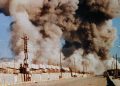
No tanks occupied the city. No gunfire echoed. The rules of war were not broken—because there was no war here. There were only those who betrayed humanity with chemical weapons. When mustard gas descended upon Halabja, the boundary between life and death evaporated into the air.
When we think of the Halabja massacre, one image comes to mind: Omar Muhammed Salih, cradling a baby. A man with his eyes fixed on eternity, making the ultimate sacrifice to shield his child. But the gas showed no mercy—it smothered every living being in its path. That photograph became the symbol of Halabja.
This tragedy found its way into the music of Koma Amed. Their song Qîza Helebçe engraved itself into memory with the lyrics:
“Wek rûkê zarê dikene,
Lê dev lê ken hate kuştin.”
“She laughed like a child,
They murdered her lips, her smile.”
This was not just a song—it was a dirge that carried the searing pain of the massacre. A lament of a people whose grief will never fade.
A cemetery that speaks
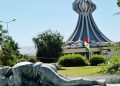
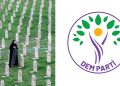
The white gravestones lined across Halabja’s green fields—this is not just a burial ground. It is a living memory. Each stone carries the name of a child. Each name represents a silenced voice. These gravestones are Halabja’s mute cries.
A man walks through the graves, his arms behind his back. He is not just a visitor. Perhaps he lost a brother, perhaps a child. We cannot see his face, but his posture whispers that the pain in this land has never ended.
In another frame, a woman in a long black dress walks past the gravestones. Her steps are softer, more contemplative. Perhaps she left her entire family in this soil. She traces the names on the stones with her hands, as if carving them into her memory.
Halabja’s cemetery does not only carry the weight of the dead — it carries the burden of the living. These stones, raised to ensure no name is forgotten, gain deeper meaning every year on 16 March. The people of Halabja lean against the stones, whispering each name, remembering.
Halabja is not just the name of those who perished—it is the name of those who still seek justice.
This massacre was not just a tragedy — it was a crime against humanity. It may be wished away, but it will never be forgotten. The names of the perpetrators may change, but the crime they committed will forever be remembered.
These graves are the silent witnesses of Halabja’s cry. There is no forgetting here. Halabja will remain an open wound in the memory of the living. Because history written in blood does not fade.
Helebçeya Şehîd…(The Martrdom of Halabja)
* Amed Dicle was born and raised in Diyarbakır, Turkey. He has worked for Kurdish-language media outlets in Europe, including Roj TV, Sterk TV and ANF. His work has taken him to Rojava, Syria, Iraq and many countries across Europe. Follow him on X (twitter).