

In a powerful act of remembrance and defiance, Kurdish women’s organisations led Diyarbakır (Amed)’s first Newroz fire of the year on the city’s ancient walls, symbolising the vital role of women in the Kurdish freedom movement. The celebration, held by women’s groups, paid tribute to decades of resistance while embracing a newfound sense of hope, as the Kurdish struggle enters a historic phase of negotiations with Abdullah Öcalan recognised as the top mediator in resolving the Kurdish issue.
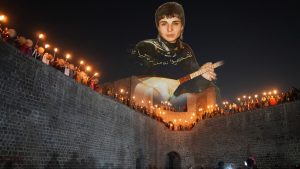
The event honours decades of women’s leadership in the Kurdish freedom struggle, reviving the tradition of defiance sparked by Zekiye Alkan, who lit the first political Newroz fire in Turkey in 1990, amid brutal state repression. With torches held high, thousands of Kurdish women and supporters marched along the ancient walls of Diyarbakır’s Sur district, reclaiming a space that has been at the heart of resistance for generations.
In all Newroz celebrations, Kurdish people commemorate the women as well as the men, like Zekiye Alkan and Mazlum Doğan who sacrificed their lives for freedom.
As crowds gathered along the UNESCO-listed walls of Sur, the MP Newroz Uysal addressed the crowd with an impassioned speech, linking the burning Newroz flames to a collective Kurdish resistance across all parts of Kurdistan.
“The fire you have lit here today will spread its light to Kobanê, to Derîk, to Efrîn. It will grow stronger and more beautiful!”
She invoked the spirit of cross-border Kurdish solidarity, emphasising that this fire symbolises more than a local celebration—it represents the unity of a people divided across Turkey, Syria, Iraq and Iran.
“The torch we have kindled will carry its flame to Merîwan, to Sînê. It will bring its warmth and hope to Pakshan Azizi, who has been sentenced to death for daring to dream of freedom.”
Pakshan Azizi, an imprisoned Kurdish woman in Iran, has become a symbol of Kurdish women’s defiance against state repression, much like Zekiye Alkan, who in 1990 set herself on fire atop these very walls to protest Turkey’s brutal crackdown on Newroz celebrations.
“This torch will reach Zekiye Alkan. She set her body on fire on these walls to ignite the Newroz flames in 1990. Today, we carry forward her resistance!”
Uysal dedicated the flames to Zekiye Alkan, and reminded the crowd of the countless Kurdish women martyrs who had made the ultimate sacrifice for freedom, listing names etched into the movement’s history:
“This fire will reach Rewşan, Berivan and Ronahi. They, too, lit the Newroz flames with their own bodies, showing the world that our struggle will never be extinguished.”
Unlike previous years, where Newroz celebrations often carried a tone of resistance against oppression, this year’s Newroz was filled with hope and anticipation. The shift comes after Abdullah Öcalan, the imprisoned Kurdish leader, was officially recognised as the chief negotiator in peace talks with Turkey—a major breakthrough in the decades-long conflict.
Öcalan’s “Call for Peace and a Democratic Society” of 27 February has already led to strategic shifts in political discourse across Turkey, Syria, Iraq and Iran, marking what many Kurds see as a potential turning point in their struggle for autonomy and rights.
“The Kurdish people welcome this Newroz as a Newroz of Freedom,” said one celebrator. “For the first time in years, we feel the winds of change.”


