

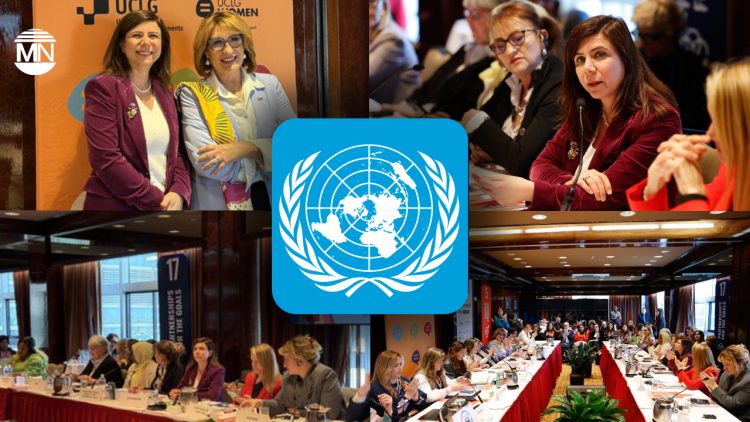
Kurdish co-mayor Serra Bucak called for global solidarity in defending women’s political participation and leadership at the 69th session of the United Nations Commission on the Status of Women (CSW69) in New York. Bucak delivered a powerful message for gender-focused governance and international solidarity against political repression.
The CSW69 summit, which runs from 10 to 21 March, marks the 30th anniversary of the Beijing Declaration and Platform for Action. It brings together political leaders, activists and international organisations to assess progress on gender equality and discuss strategies for implementing feminist policies within the UN’s 2030 Agenda for Sustainable Development.
Bucak, co-mayor of the Metropolitan Municipality of Diyarbakır (Amed), de facto regional capital of the Kurdish region of Turkey, addressed the high-level women’s leadership summit, shining a light on the fight of Kurdish women for equal representation, the co-mayorship model and the challenges posed by Turkey’s policy of replacing elected officials in Kurdish municipalities with state-appointed trustees, saying this was an attack on democratic representation and women’s rights. Bucak insisted that true peace, democracy and social justice require women’s full participation at all levels of governance.
Speaking at a panel titled “Localising Beijing+30: The Municipal Movement Leading the Way to Equality and Democracy,” Bucak detailed the gender-sensitive policies adopted in Diyarbakır (Amed), the largest Kurdish-majority city in Turkey, often regarded as the de facto capital of the Kurdish region due to its historical resistance against oppressive Turkish government policies.
“As co-mayor, I am not only a local administrator but also an activist,” she said. “Kurdish women have fought not just for their own liberation, but for the freedom of all peoples. Making this struggle visible on a global scale is our responsibility.”
She highlighted the implementation of the co-mayorship system, where male and female representatives share equal executive power, ensuring women’s representation at all levels of governance. “This is not just about power-sharing; it is a radical, democratic mechanism that empowers women’s assemblies and coordination units. But we know that political will alone is not enough – real change requires strong legal frameworks.”
Bucak condemned Turkey’s practice of removing elected mayors and replacing them with government-appointed trustees, a policy widely seen as targeting municipalities governed by the pro-Kurdish Equality and Democracy (DEM) Party. “Appointing trustees is not just an attack on the political will of the people but also a direct assault on women’s gains in local governance,” she said. “Women’s struggles cannot be confined to national borders. We must expand international solidarity to safeguard their role in decision-making.”
Bucak also stressed the need for women’s active involvement in peace processes, referring to UN Security Council Resolution 1325, which calls for increased female participation in conflict resolution and security policy.
“Women must be at the heart of peace negotiations,” she said. “The Kurdish women’s movement is one of the most powerful forces for regional stability, advocating not only for Kurdish rights but for peace across the Middle East.”
As the summit progresses, discussions will focus on implementing feminist policies within governance structures worldwide. UN Secretary-General António Guterres has acknowledged that no country has fully achieved gender equality and urged renewed efforts to bridge persistent gaps.
Bucak’s participation at CSW69 has drawn attention to the broader challenges faced by Kurdish women in politics and governance, with advocates calling for stronger international mechanisms to protect their rights.


