

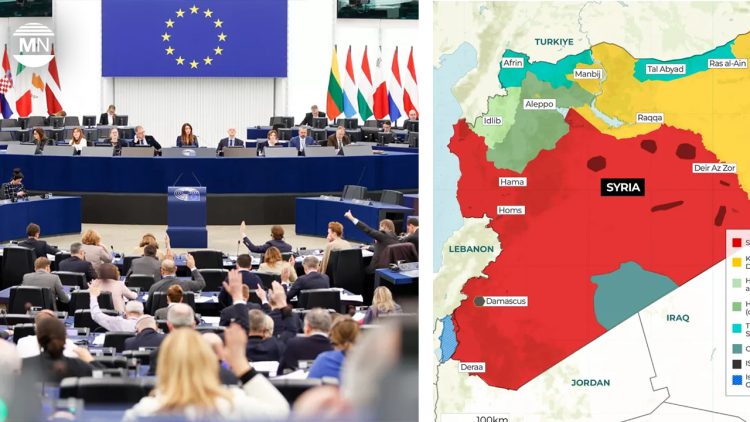
The European Parliament has signalled conditional and partial support for Syria’s post-war reconstruction and political transition, stressing the need for adherence to human rights, minority rights and justice. The resolution, announced on 7 March and set to be formally adopted, follows the overthrow of President Bashar al-Assad in December 2024 and the subsequent establishment of an interim government.
In the resolution, designated 2025/2569(RSP), the EU clarified that while it would engage with the interim authorities in Damascus, its assistance remains contingent upon Syria’s commitment to fundamental values. These include respect for human rights, minority protections—particularly for the Kurdish population—gender equality, freedom of belief, fair trials and accountability for war crimes. The EU will not provide military aid, nor will it fully lift sanctions until clear progress is demonstrated.
A new political landscape in Syria
The overthrow of Assad by an alliance of rebel groups led by Hayat Tahrir al-Sham (HTS) in December marked the end of more than five decades of autocratic rule. On 29 January, Ahmed al-Sharaa was named interim president, tasked with forming a transitional government and drafting a new constitution. The administration has pledged to hold elections within four to five years while dismantling key remnants of the former regime, including the Ba’ath Party and state security apparatus.
While the European Parliament acknowledged the historical significance of Assad’s fall, concerns persist over inclusivity in the new political framework. A recent National Dialogue Conference failed to ensure substantial representation for Kurdish leaders and civil society, particularly organisations led by women. The EU’s resolution urges the interim government to enhance inclusivity and protect Syria’s religious, ethnic and political diversity.
EU support: conditional and gradual
The resolution lays out a roadmap for potential EU engagement, but financial and technical aid will depend on concrete improvements in governance. The EU insists that Syria must demonstrate commitments to good governance, fundamental freedoms and human rights before receiving extensive aid.
“The fall of Assad does not mean automatic support. The EU will engage only if the new leadership ensures human rights protections, judicial accountability and an inclusive transition,” said Hannah Neumann, one of the resolution’s lead sponsors.
The EU’s decision to maintain key economic sanctions, while lifting some restrictions related to humanitarian aid, reflects its cautious approach. The resolution also calls for sustained international scrutiny of Syria’s handling of prisoners and missing persons and its prosecution of those responsible for atrocities during the war.
Military and geopolitical considerations
Despite the political transition, Syria’s security landscape remains volatile. The resolution denounces continued violence in Kurdish-majority areas, where Turkish-backed Syrian National Army (SNA) militias have launched operations, causing civilian casualties and mass displacement. The European Parliament has condemned Turkey’s ongoing military incursions and its role in the displacement of over 25,000 people in northern Syria. It has also criticised Israel’s recent seizure of the UN-patrolled demilitarised zone along the Golan Heights, which violates international law.
Russia and Iran, both key allies of Assad, have seen their influence wane following the regime’s collapse. Moscow has been forced to scale back its military presence, while Tehran’s logistical network in Syria is in disarray. However, Russia remains determined to retain its Tartus naval base and other strategic interests.
Humanitarian challenges and challenges of reconstruction
Syria’s humanitarian crisis remains acute, with 16.5 million people in need of aid and over 90% of the population living below the poverty line. Food insecurity, a collapsing healthcare system and a devastated economy pose additional challenges to the interim administration.
While the EU has pledged €235 million in humanitarian assistance, it remains reluctant to fund large-scale reconstruction efforts without guarantees that funds will not be misused by corrupt officials or militant groups. The resolution urges the interim government to prioritise securing and destroying Syria’s remaining chemical weapons stockpiles and to cooperate fully with the Organisation for the Prohibition of Chemical Weapons (OPCW).
Next steps
The resolution, expected to pass in the European Parliament’s plenary session, establishes a framework for engagement but makes clear that any EU support will be measured and conditional. Brussels is keen to avoid repeating past mistakes, ensuring that its policies align with democratic principles and human rights commitments.
While the international community debates its role in Syria’s future, the resolution highlights a critical message: Syria’s new leadership must earn European support through tangible democratic progress. With war-torn infrastructure, ongoing security threats and regional instability, the path ahead for Syria remains uncertain, but the EU has drawn its red lines.


