

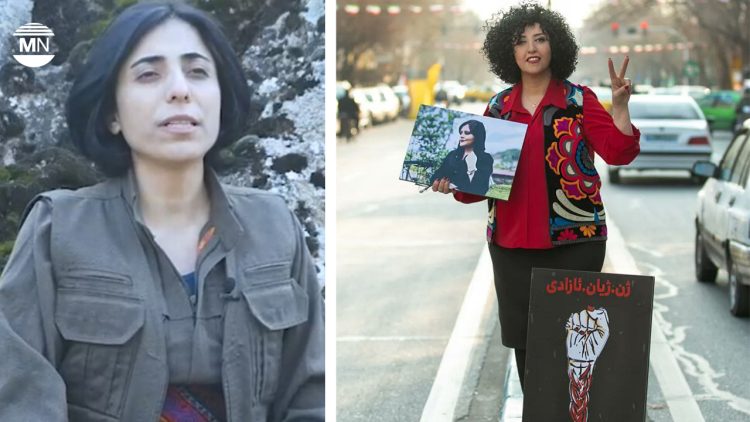
In the lead up to International Women’s Day on 8 March, women’s organisations inside and outside Iran, alongside political parties, are celebrating the occasion by highlighting their ongoing efforts to organise women in the struggle for a gender-equal world.
In this context, the Democratic Organisation of Iranian Women issued a statement condemning the Islamic Republic’s misogynistic policies and its dismissal of the historic significance of 8 March.
The statement reads:
“Despite the oppressive measures and brutal repression by the patriarchal regime—aimed at stifling any civil or political movement—Iranian women have continued their courageous struggle. Despite arrests, torture, and long-term imprisonment, they have taken bold actions, defying the regime’s so-called ‘red lines.’”
The statement also condemned the death sentences handed to Pakhshan Azizi, Warisheh Moradi, and Sharifeh Mohammadi, describing them as “a clear act of revenge against the ‘Women, Life, Freedom’ movement.”
Similarly, the Women’s Revolution Organisation denounced the Islamic Republic’s theocratic regime and its religious restrictions on women. They declared March 8 a day to honour the names of these three women and amplify the voices of those opposing their executions. The organisation called for the immediate revocation of the death sentences issued for Mohammadi, Azizi, and Moradi.
Kurdistan Free Life Party (PJAK) co-chair Peyman Viyan, in an interview with Firat News Agency, extended her congratulations to Kurdish, Arab, Baluch, and Gilak women in Iran on March 8. She stated:
“Inspired by the slogan ‘Jin, Jiyan, Azadî’ (Women, Life, Freedom) and the philosophy of Abdullah Öcalan, women are now waging more radical struggles. Their goal is to make March 8 a day of free life for all women and to transform every day into a celebration of life, struggle, and resistance.”
Viyan also stressed the importance of highlighting the resilience of Kurdish women in prisons, urging: “Let us use 8 March as an opportunity to bring the women’s struggle to victory in the new year of 2025.”
Narges Mohammadi, the imprisoned Nobel Peace Prize laureate and human rights activist, wrote in a note for Vogue magazine:
“I believe in the unstoppable power of women. We must not fear, and we must stand bravely against those who violate women’s rights and reject democracy. The women of the ‘Women, Life, Freedom’ movement were unafraid; they stood firm against the oppressors.”
she added:
“Iranian women are fighting tirelessly to overcome the oppressive religious regime.” She emphasised that resistance is the enduring legacy of Iranian women—one that transcends the fight for women’s rights and embodies a broader struggle for democracy and freedom for all.
The Council of Cooperation of Left and Communist Forces also expressed hope in a statement marking the significance of March 8 and women’s struggle for democracy:
“Despite the severe discrimination faced by women under the Islamic Republic, the ‘Women, Life, Freedom’ movement has delivered a significant blow to the fragile and decaying foundations of the regime.”
In parallel, the coalition of social activists, women’s groups, and feminist organisations from Iran and Afghanistan released a joint statement celebrating International Women’s Day.
They declared:
“We, the rebellious women of Iran and Afghanistan, call on our comrades worldwide to unite against the new wave of war on women, imperialist wars in the Middle East, and to deepen our political awareness of the root causes of these tragedies. We must organise with greater strength to fight this oppressive system and its agents.”
The statement continued:
“Today is the time to dare, to fight, and to ask bold questions. It is the time to stand firmly against both the small and large criminals of the world who seek to decide humanity’s future.”
Fueled by the spirit of “Jin, Jiyan, Azadî,” slogan, women’s activism in Iran and Rojhilat (Iranian Kurdistan) has entered a new phase. The outpouring of support for Moradi, Azizi, and Mohammadi—three female political prisoners facing execution—speaks to a deepening solidarity in the fight against gender oppression.


