

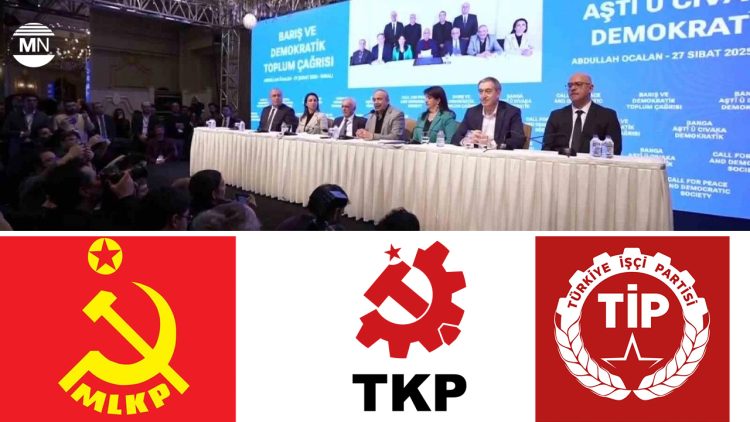
The Kurdish question has long been a divisive issue among Turkey’s leftist movements, and recent statements from three major leftist parties—the Marxist-Leninist Communist Party (MLKP), the Communist Party of Turkey (TKP), and the Workers’ Party of Turkey (TİP)—highlight their ideological differences.
The statements, issued in response to a recent call for peace by jailed Kurdish leader Abdullah Öcalan, illustrate the continued impact of the Kurdish struggle on Turkey’s radical left. The MLKP views the Kurdish cause as an essential part of the revolutionary struggle, calling for resistance against what it describes as Turkey’s “fascist colonialist” policies. The TKP, in contrast, warns that the peace process is shaped by nationalist and liberal influences rather than the interests of Turkish and Kurdish workers. Meanwhile, the TİP argues that any meaningful peace process must extend beyond armed conflict and include structural democratic reforms, particularly in the judiciary, to ensure broader political freedoms.
The MLKP has reaffirmed its commitment to Kurdish national democratic rights, framing the Kurdish cause as a key component of Turkey’s revolutionary movement. “We firmly uphold our view of the inalienability of the Kurdish people’s national freedom, equality, and national unity rights,” the party declared, calling for a united struggle against what it termed Turkey’s “fascist colonialist” policies. The MLKP demands the immediate release of Abdullah Öcalan and other political prisoners, an end to Turkish military operations in northern Syria and Iraq, and the constitutional recognition of Kurdish identity and language rights.
In contrast, the TKP remains sceptical of the current peace discussions. While acknowledging that “silencing the guns” cannot be opposed, the TKP asserts that the ongoing process does not genuinely represent either Turkish or Kurdish workers. “The claim that this process is driven by Turks and Kurds is inaccurate,” the TKP stated. “The key players are the political power or the People’s Alliance (the ruling coalition led by AKP) and the PKK and its affiliates.” The TKP dismissed the idea that peace negotiations could serve as the foundation for democratic progress, arguing that Turkey’s problems cannot be resolved through “Neo-Ottomanist” regional ambitions or a process dominated by religious discourse.
The TİP has taken a different stance, supporting Kurdish rights while emphasising the necessity of broader democratic reforms. Party leader Erkan Baş questioned whether the peace process would extend beyond ending armed conflict to also include an end to legal and political repression. “Will the judiciary also put down its weapon in the name of peace?” Baş asked, stressing that peace should encompass not just negotiations between the state and the PKK but also meaningful democratic changes in Turkey’s legal and political system. The TİP advocates for a democratic resolution to Turkey’s crises, underlining the need for a comprehensive approach to peace that includes legal and institutional reforms.
The split between the MLKP, TKP, and TİP reflects a deeper ideological battle over Turkey’s history and the role of communism in confronting the state’s long-standing policies of denialism. The MLKP openly condemns Turkey’s colonial and repressive policies toward Armenians, Kurds, and other ethnic groups, while the TKP avoids direct criticism of these policies.
The TKP’s framing of the Kurdish issue as secondary to class struggle echoes the position taken by French communists during Algeria’s war of independence, when many prioritised anti-capitalist struggles over national liberation. In Turkey, this stance has led to the dismissal of Kurdish struggles as “separatism” rather than recognising them as a legitimate fight against national oppression.
The MLKP strongly criticised the TKP’s position, accusing it of “chauvinism and social chauvinism” for failing to embrace Kurdish national aspirations. “We invite all revolutionary and consistent anti-fascist forces of our peoples to adopt a stance against chauvinism,” the MLKP stated, condemning the TKP’s rejection of armed struggle.
While Abdullah Öcalan’s call for peace represents a potential turning point, the MLKP maintains its commitment to all forms of resistance, including armed struggle, arguing that revolutionary force remains necessary as long as the ruling class monopolises violence. “MLKP will continue its struggle against the fascist dictatorship, denialist colonialism, the male-dominated system, capitalist exploitation, and imperialism by utilising all means and methods,” the party declared.
The TİP, however, argues that peace must include democratic guarantees and an end to repression through legal and political means. Its position advocates for structural democratic changes while supporting Kurdish rights.
The unresolved tensions over Kurdish national rights continue to challenge Turkey’s leftist movements, forcing them to confront their ideological contradictions in the face of a state which built its identity on denial.


