

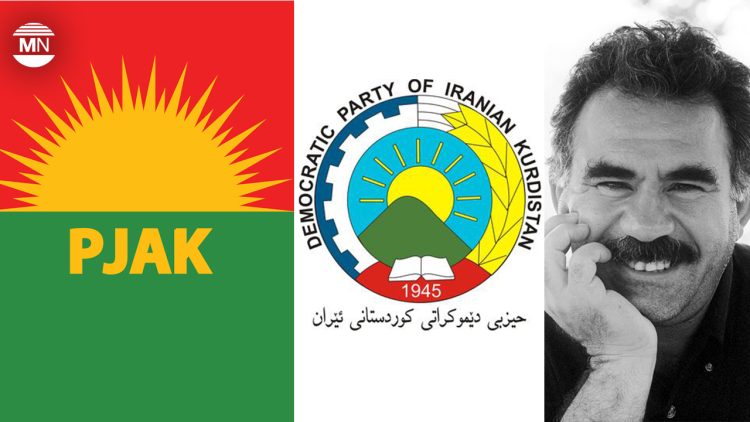
Abdullah Öcalan’s call for peace has garnered significant attention in Iran, particularly among Kurdish parties in Iranian Kurdistan (Rojhilat), as well as the general public.
In a recent statement, the Kurdistan Democratic Party of Iran (PDKI) reiterated its long-standing commitment to a peaceful resolution of the Kurdish issue. The party expressed hope that this initiative would achieve its goals and ultimately benefit both the Kurdish people and Turkey.
PDKI spokesperson Khalid Azizi stressed the importance of the Kurdish issue in the broader context of the Middle East. “With Öcalan’s call for a democratic approach, it is crucial to explore how existing obstacles can be addressed and overcome,” he said.
Kurdistan Free Life Party (PJAK) co-chair Peyman Viyan has welcomed Abdullah Öcalan’s call for peace, noting its deep significance for Kurds in Iranian Kurdistan (Rojhilat).
Speaking to Medya News, Viyan said:
“Since Öcalan’s message was made public, Kurds in Iranian Kurdistan have followed it closely, knowing that any change in one part of Kurdistan profoundly impacts the others.”
She further highlighted the strong ties between Kurds in Iran and Kurds in Turkey, asserting that Öcalan’s vision of peace, democracy and freedom offers a historic opportunity for all Kurds to realise their aspirations.
Viyan also reflected on the role of the PJAK, explaining that the foundation of her party was rooted in Öcalan’s philosophy, which had gradually spread across Iran. “The PJAK has grown into a broad movement, enabling our people in the East [referring to East Kurdistan or Rojhilat] to organise themselves through Öcalan’s ideology. Naturally, his message will have a far-reaching impact on our struggle,” she added.
Concluding the interview, Viyan referred to the recent ceasefire declaration of the Kurdistan Workers’ Party (PKK), highlighting its importance in the pursuit of peace:
“With the PKK’s ceasefire declaration, a path toward peace and a democratic Turkey has been paved. It is now up to the Turkish state to take the necessary and meaningful steps to advance this critical and historic process. If realised, this could lay the foundation for democratic coexistence and equality between Kurds and Turks. Moreover, progress in Turkey could inspire a broader movement for coexistence among peoples in Iran and the freedom of Kurds in the East.”
Meanwhile, the assembly of the PJAK has declared its full support for Abdullah Öcalan’s call for peace, noting its significance for the Kurdish freedom struggle in the Middle East. In an official statement, the party highlighted the fundamental, vital and transformative nature of Öcalan’s message:
“As a party that has embraced Öcalan’s philosophy and the paradigm of a democratic society as the foundation of our struggle, we fully support this call for peace.”
The Kurdish United Front, has announced the endorsement of over a hundred political and civil activists in Iranian Kurdistan, with widespread support from Kurdish opposition parties, for Abdullah Öcalan’s call for peace. This collective backing has been formalised in a statement.
The statement notes that after decades of violence and conflict, Öcalan’s message marks a historic turning point. It advocates for democracy, pluralism and the recognition of Kurdish rights in Turkey, while calling for an end to armed struggle. The statement goes on to stress that at this critical moment the path forward must be rooted in dialogue, democratic principles and a clear acknowledgement of the region’s realities.
It further asserts that in light of recent geopolitical shifts, the era of shaping politics through heavy weapons, tanks and missiles is over. The democratic aspirations of the Kurds must now be pursued through peaceful and democratic means.
While centrist Iranian media had responded to Öcalan’s peace call through the narrow lens of the centralised Iranian nation-state’s interests, the reaction from Kurds in Iran reflects their deep hopes in his call for peace.


