

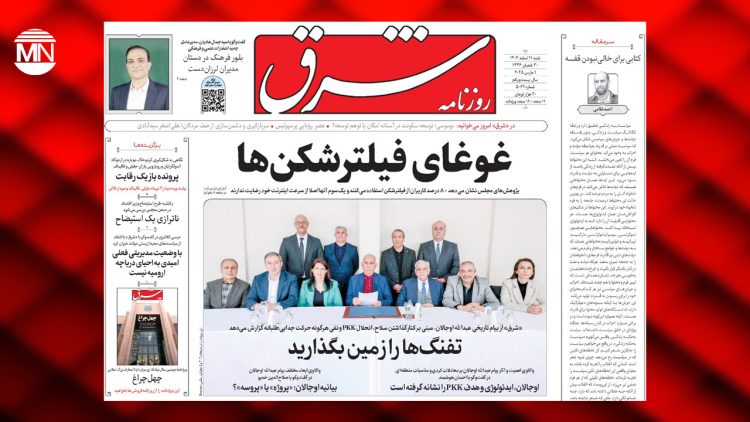
The Shargh Daily News, Iran’s leading reformist newspaper based in Tehran, moved swiftly to cover the historic call for peace and a resolution to the Kurdish question from Kurdish leader Abdullah Öcalan, imprisoned in Turkey. Under the bold front-page headline “Down the guns!” the paper highlighted the development as significant, complementing its report with interviews featuring two experts on Kurdish affairs providing different perspectives. Four days after the release of the call, the newspaper continues to delve into the issue, offering ongoing analysis and commentary in its pages.
While the main headlines steer clear of any direct reference to Iran, focusing instead on themes of peace and political stability, the accompanying interviews have offered contrasting viewpoints. The first interview, adopting a security-oriented perspective, portrayed Öcalan’s appeal as a result of the global decline of leftist ideologies and, concurrently, the perceived failures of the Kurdish movement in the Middle East.
The second, adopting a very different approach, viewed Öcalan’s statement as part of a long-term evolution in his intellectual and political thought, rooted in his ideological trajectory and the broader socio-political shifts in the region. This analysis highlighted his enduring hope and sense of historical responsibility for coexistence and peace.
Conversely, the Kayhan, a hardline conservative newspaper aligned with Iran’s ruling establishment, sought to frame the call of the Kurdish leader as a sign of the broader dissolution of the Kurdish movement across the region, offering a hasty analysis that questioned the validity of the Kurdish cause in the Middle East.
The Iranian Diplomacy website, which maintains close ties to Iran’s security circles, dedicated several reports to the issue. While implicitly welcoming Öcalan’s message, it also cast the Turkish peace process as a potential threat to Iran’s territorial integrity. The reports argued that an end to armed conflict in Turkey and Syria could, paradoxically, endanger Iran’s national security by shifting regional power dynamics.
In this context, some analysts argue that the imprisoned Kurdish leader’s call for peace, in parallel with the removal of Bashar al-Assad in Syria, could expand Turkey’s regional influence while undermining that of Iran, leading to certain factions in Iran seeing the start of a peace process in Turkey as a less than welcome development. There are also serious concerns that a resolution of the Kurdish issue in Turkey could set a precedent, putting pressure on Iran to open up its own political space.
The Tabnak News Agency, affiliated with Iran’s conservative security apparatus, maintained a neutral tone, publishing excerpts from Öcalan’s statement while noting security concerns. It stressed that the PKK’s Iranian offshoot, the Kurdistan Free Life Party (PJAK), remains a national security issue for Iran, and highlighted the need for a unified stance on Turkey’s peace process between Iran, Turkey and Iraq’s Kurdistan Regional Government (KRG). The outlet also highlighted Israel’s presence in the region as a major concern in Kurdish affairs, referring to the Iran-Iraq security agreement, which mandates the relocation of the Komala (Komala Party of Iranian Kurdistan) camps away from border areas, and the repatriation of what it calls “anti-Iranian terrorists.”
Meanwhile, KurdPress, a news agency closely affiliated with the Quds Force of the Iranian Revolutionary Guard Corps (IRGC), took a more analytical stance, publishing numerous reports assessing the implications of Öcalan’s call for peace.
While some analysts viewed the development with cautious optimism, the outlet remained skeptical about the Turkish government’s willingness to fully recognise the Kurdish identity. Nevertheless, it acknowledged Öcalan’s call as a potential opening for bringing an end to violence against Kurds in Turkey.
Since Iran’s media is tightly controlled by the central government or aligned with various political factions—ranging from conservative to reformist—and tends to view the Kurdish issue in the Middle East as an existential threat, coverage of the Kurdish leader’s call for peace has largely converged on Iran’s national interests and its regional rivalry with Turkey. As a result, while maintaining a cautious, conservative-leaning rhetoric, their response to this historic development appears somewhat uncertain and conflicted.


