

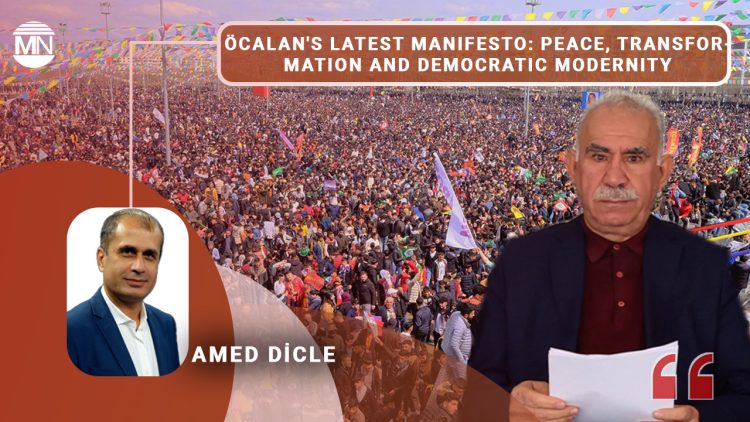
The twenty-seventh of February 2025 was a historic turning point for the political balance in the Middle East. Abdullah Öcalan addressed the world with a manifesto that redefined the Kurdish issue and regional problems. His call was not limited to the struggle of one people, but was a strategic move that may affect the entire Middle East. The move is not only the closure of a period of conflict, but also the beginning of radical political and legal change.
Öcalan declared that the solution to the Kurdish question should no longer be sought by the use of arms, but by political and legal means. In actual fact, he had been making efforts towards this goal for 33 years, but the Turkish state and international powers prevented this process. Now, assessing the new stage the world and the region have reached, he once again proposes a peaceful transformation.
The PKK [Kurdistan Workers’ Party] was born in 1978. Öcalan believes that its birth was due to the political and military conditions of the period, and that although it has changed over time, it cannot continue using the same methods in today’s world. Öcalan’s approach does not mean minimising the target, but rather expanding and transforming the struggle. This transformation is a necessary step not only for the Kurdish people and for the PKK, but also for the Turkish state and regional balances.
Öcalan stresses that for the transformation process to succeed, not only the PKK but also the Turkish state must change. He believes that change in the PKK will impose change on the state. In saying that the Kurdish issue is essentially a problem of democracy and freedom, Öcalan undermines Turkey’s argument that ‘we do not have a problem with the Kurds, our problem is with the PKK and with arms’. If arms are the problem, then the deactivation of arms in this equation will be a process that will test the true intentions of the state.
Öcalan does not want the paradigm of democratic modernity, which will be effective worldwide, to be associated with weapons and violence. According to him, democratic modernity means self-government of peoples, direct democracy, an environmental and women’s liberationist society. He believes that this paradigm can be built in a healthier way in an environment free of violence.
However, he sees the right to legitimate defence as a principle that applies to everyone. In Öcalan’s view, although legitimate defence is a right, war should not be an option except in the last resort. What is important here is to end the conflict and create an environment in which peoples can attain their rights peacefully. Öcalan has constantly emphasised that the greatest defence begins with ideological direction and organisation.
In the coming period, the PKK is expected to transform itself in line with Öcalan’s call and decide to end the armed struggle. However, this process cannot work unilaterally; the state also has obligations. If Turkey does not take legal and political steps to guarantee the fundamental rights of the Kurdish people, the peace process will be blocked.
Öcalan’s manifesto offers a new road map not only for the Kurdish issue but also for oppressed peoples around the world. Öcalan is more than a leader of a people, he is a global thinker and an architect of peace. To limit him to Kurdistan or to the PKK would be an injustice to his ideas and paradigm.
Öcalan’s ideas and paradigm are needed not only by Kurds but by all humanity. In the face of inequalities, wars and environmental crises created by global capitalism, the model of democratic modernity proposed by Öcalan offers a solution for the self-determination of peoples, so people around the world who embrace Öcalan’s ideas carry a great responsibility.
Öcalan’s call opens the door to a new era not only for the Kurdish people, but also for oppressed peoples all over the world, international revolutionaries and all sectors struggling for freedom. Today, in the face of the crises, social inequalities, environmental destruction and war policies created by capitalist modernity, Öcalan’s ideas in line with democratic modernity are more necessary than ever. It is time for those who adopt these ideas not just to think about them, but also to take action.
Revolutionaries, popular movements, academics, women’s liberation activists, environmental activists and democratic resistance organisations from different countries of the world should see Öcalan’s solution paradigm as the basis for a global movement. Öcalan’s call presents a historical task of the creation of a new international line of struggle. Democratic structures based on the direct participation of peoples, local assemblies, women’s organisations and environmental movements will play a critical role in the construction of this paradigm.
The spread and growth of Öcalan’s paradigm on a global level is imperative not only for the Kurds but also for the liberation struggles of the peoples of the world. His perspective on a solution based on peace and democracy necessitates a non-violent but strong line of resistance against the militarist and repressive policies of states. This endeavour should not be limited to the Middle East, but should be embraced by international revolutionaries struggling all over the world, from Latin America to Africa, from Europe to Asia.
For those who adopt Öcalan’s ideas, the time has come to organise, to take political action and to grow the democratic struggle. The expansion of democratic politics, people’s initiatives and grassroots organised resistance networks will be the strongest response to the order of exploitation imposed by capitalist modernity. Answering this call, accelerating the construction of a new international struggle and realising the democratic modernity proposed by Öcalan is a responsibility that everyone who seeks freedom bears on their shoulders.
Öcalan’s call, beyond solving the Kurdish issue, opens the doors to a new era for the freedom of the peoples of the Middle East and the world. Seeking a solution in the realm of law and politics rather than in the shadow of weapons is not a form of surrender, but a more powerful form of struggle.
It is not yet clear whether the state will take steps and how the process will proceed. However, one thing is certain: with Öcalan’s move, everything has changed. A new path has opened up for peoples trapped in a spiral of violence. This path is the path of democracy, freedom and peace. It is the responsibility of everyone who believes in Öcalan’s ideas to walk on this path.
As Öcalan said: ‘Historic decisions are taken only by historic personalities.’ And today, in the face of this historic call, the peoples of the world face an important test.
* Amed Dicle was born and raised in Diyarbakır, Turkey. He has worked for Kurdish-language media outlets in Europe, including Roj TV, Sterk TV and ANF, travelling widely in the course of his journalism. Follow him on X.


