

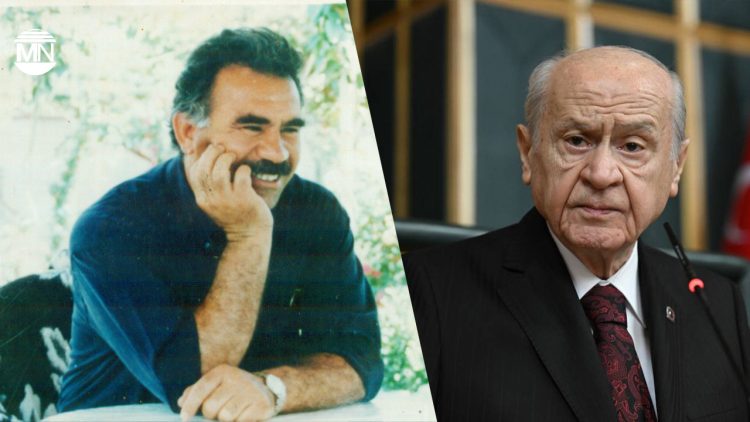
Devlet Bahçeli, leader of Turkey’s far-right Nationalist Movement Party (MHP) and a key ally of Turkish President Recep Tayyip Erdoğan, has emerged as a pivotal figure in shaping the country’s response to the historic call by imprisoned Kurdish leader Abdullah Öcalan for the end of the armed struggle and the dissolution of the Kurdistan Workers’ Party (PKK). Despite recent heart surgery and ongoing health concerns, Bahçeli has positioned himself at the forefront of this political shift, signalling his full engagement in Turkey’s evolving Kurdish policy.
Öcalan, who has been imprisoned in near-total isolation for 26 years, with absolute incommunicado detention from March 2021 to December 2024, made his landmark appeal on 27 February, calling for the PKK to disarm and dissolve itself in order to pave the way for a democratic solution to the Kurdish issue. His call has sparked growing demands, both nationally and internationally, for his release as part of a broader peace process.
Bahçeli’s stance became clear following a telephone conversation with the countrry’s pro-Kurdish Equality and Democracy (DEM) Party co-chair Tuncer Bakırhan on 28 February, during which he reaffirmed his support for Öcalan’s call and pledged to do “everything necessary to establish a democratic framework that strengthens the brotherhood of Kurds and Turks.”
In a written statement released on March 1 through the MHP’s official channels, Bahçeli welcomed Öcalan’s appeal and the PKK leadership’s confirmation that they would disarm, emphasising that this marks the beginning of a new political chapter for Turkey.
Despite his reputation as an ultranationalist hardliner, Bahçeli acknowledged Öcalan’s central role in this process, while also commending the PKK leadership for aligning with the call for disarmament. He described the group’s response as “supportive and complementary,” saying:
"Forty-seven years on, the PKK’s founding leader has called upon the organisation to dissolve itself. The statements from [the PKK leadership in] Qandil in support of this call are both significant and satisfying. The PKK’s alignment at this point with Öcalan’s call of 27 February demonstrates organisational coherence, and is in the best interest of all parties involved."
This is the first time that Bahçeli has directly referenced both Öcalan and the PKK in such terms, marking a critical shift in his rhetoric.
Bahçeli highlighted the importance of this moment for democratic progress in Turkey, positioning himself as a key actor in the reconciliation process. He asserted that Turkey must not let this opportunity slip away and reiterated his commitment to promoting a “democratic framework where all citizens feel equal and included.”
He further addressed the provocative rhetoric of certain other ultra-nationalist circles:
"Those who ask, ‘What do we get in return?’ do not understand the magnitude of this moment... This is a turning point that will bind our thousand-year-old brotherhood in an unbreakable manner.... Whoever contributes sincerely to a Turkey free from terrorism will have our gratitude."
While his statement stopped short of detailing specific political reforms, Bahçeli’s tone indicated a willingness to navigate this transition within the state’s security and political framework.
His ongoing health struggles, including recent heart surgery, have not prevented him from playing a decisive role in shaping this process. Insiders suggest that Bahçeli sees this as a legacy-defining moment, ensuring that his imprint on Turkish-Kurdish relations will outlast his tenure.
Despite his endorsement of the process, Bahçeli also issued a stark warning against internal and external provocations that could derail progress. He accused certain political groups and media outlets of attempting to “sabotage” the initiative and create “artificial debates” over what Turkey may have offered in exchange for Öcalan’s call.
"There are those who fear a Turkey free from terrorism. Those who attempt to undermine this moment, who spread doubt and question the sincerity of this step, are in fact playing into the hands of those who seek to divide us," Bahçeli warned.
He also referred to foreign powers that have historically intervened in Turkey’s security affairs, cautioning that “regional actors with hidden agendas must not be allowed to exploit this process for their own gains”.
While Erdoğan has described Öcalan’s call as a “historic opportunity”, Bahçeli’s strong intervention in the process suggests he will play a leading role in shaping its trajectory. His explicit recognition of the PKK’s leadership in the Qandil mountains, coupled with his call for unity, has raised expectations that the Turkish government may be laying the groundwork for a structured political transition rather than merely a security-focused approach.
Related Articles:
Turkey’s far-right nationalist leader Bahçeli: ‘Peaceful era beckons as barriers crumble’

Sinn Féin calls for Öcalan’s release as international support for peace call grows

Italy’s former PM Massimo D’Alema praises Öcalan’s peace initiative
Despite this, Bahçeli’s emphasis on maintaining counterterrorism operations signals that Ankara is unlikely to fully disengage from its military presence in northern Iraq and northern Syria any time soon. The coming weeks will determine whether Turkey’s ruling coalition chooses a securitised response or a path toward broader political reconciliation.
Meanwhile, the push for Öcalan’s release continues to gain traction, with pro-Kurdish activists, political parties, international organisations and human rights groups calling for an end to his prolonged isolation and for his greater participation in the peace process.


