

Tülay Hatimoğulları, co-chair of Turkey’s pro-Kurdish Peoples’ Equality and Democracy (DEM) Party, has sharply criticised the Turkish government’s approach to the Kurdish question, warning that while dialogue continues regarding jailed Kurdish leader Abdullah Öcalan, state repression against the Kurdish political movement is escalating. The situation highlights a contradiction in Ankara’s stance – talks of peace on one hand and a deepening crackdown on Kurdish representation on the other, Hatimoğulları told ANF on Tuesday.
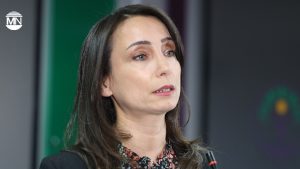
“The Kurdish question is a process currently being discussed all over Turkey and by all sectors of society,” Hatimoğulları said, highlighting the significance of ongoing discussions regarding a peaceful resolution. “The messages that Mr Abdullah Öcalan has sent out through the delegation during this period are quite comprehensive. On the one hand, they contain important messages regarding a peaceful and democratic resolution to the Kurdish question. On the other, they contain very important messages in the context of Turkey’s general democratisation.”
Turkey remains deeply divided over its approach to the long-standing Kurdish question. Despite sporadic reports of the Turkish state having indirect contact with Öcalan, the founder of the Kurdistan Workers’ Party (PKK), who has been held in near-total isolation on İmralı Island since 1999, the state has simultaneously been intensifying operations against pro-Kurdish political forces.
“At the same time as the process of meetings and dialogue continues, the delegation travels to İmralı, Mr Öcalan’s messages are delivered to their recipients and all this effort is being expended, operations against the Peoples’ Democratic Congress [HDK – a left-wing alliance supporting the Kurds], cross-border operations against Rojava [Kurdish-led North and East Syria], and the appointment of trustees [in place of elected officials] to our municipalities in Turkey are all continuing apace,” Hatimoğulları said, criticising the government’s crackdown.
“Additionally, there are operations targeting ‘urban consensus’ [political alliances to prevent AKP winning urban seats]. There are serious operations targeting Istanbul municipalities. Each of these, one by one, is actually a point we need to deeply consider.”
Her comments reflect growing concerns within the pro-Kurdish movement and opposition circles that any attempt at dialogue with Öcalan is being overshadowed by Ankara’s increasingly authoritarian measures.
Since 2016, the Turkish government has removed dozens of elected Kurdish mayors in the country’s southeast, replacing them with state-appointed trustees. The crackdown has also targeted the broader opposition, including leftist and socialist groups aligned with the Kurdish movement. Hatimoğulları warned that recent operations, such as those against the Peoples’ Democratic Congress and the DEM Party, represent an ongoing assault on democratic politics.
“Now, on the one hand, we say ‘peace’, we say ‘resolution of the Kurdish question’, but we do not respect the Kurds’ right to vote and be elected,” she said, referring to the government’s contradictory stance. “The trustee [policy] represents a mentality that takes away the right of Kurds to vote and be elected. What does that say? If you do not have the right to vote and be elected, that says, ‘I am taking away your right to be a citizen.’”
The renewed discussions around Öcalan’s potential role in peace negotiations coincide with broader debates over Turkey’s political future, particularly as opposition parties seek to challenge President Recep Tayyip Erdoğan’s increasingly centralised rule. Hatimoğulları noted that calls for a peaceful resolution have gained traction within Turkish opposition circles and civil society groups, but questioned the government’s sincerity in engaging with such demands.
“What does the executive authority want to do? Does it have a plan or project for a solution? If so, what is this plan or project?” she asked. “These are still major question marks.”
As tensions continue to rise, Hatimoğulları called on all opposition forces, civil society groups and democratic movements to unite in demanding a peaceful resolution. “The way to build peace is to strengthen the belief in peace and the voice of peace among workers, labourers, the poor, women, young people, environmental and human rights defenders, Alevis, Christians, and all peoples and faiths in Turkey.”
Despite the growing uncertainty surrounding the government’s next steps, Hatimoğulları remained firm in her party’s commitment to the dialogue process. “While we as democratic politicians are doing what we can with the release of this statement, we expect the same from the administration, the government and the president,” she said.
With the Kurdish question remaining one of Turkey’s most polarising political challenges, the coming weeks could prove critical in determining whether Ankara pursues genuine dialogue or continues its crackdown on pro-Kurdish movements.


