

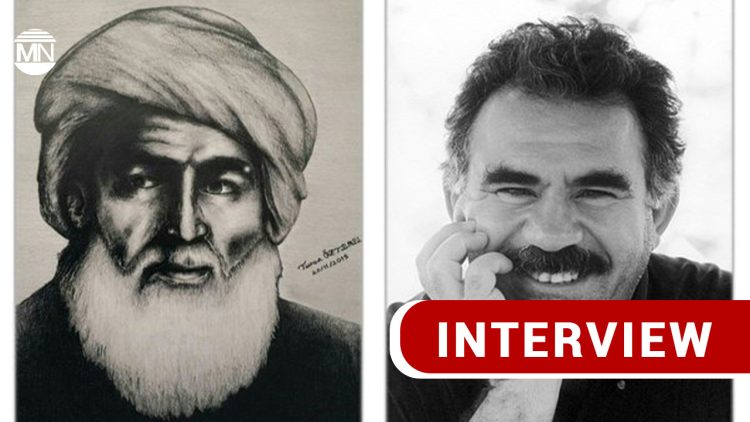
A century has passed since Sheikh Said and his associates launched their Kurdish resistance movement against the Turkish Republic in 1925. During this period, Kurdish leaders have faced continued challenges, while policies of suppression have intensified. After World War I, international treaties divided the Kurdish lands between Turkey, Iraq, Syria and Iran. The political and cultural rights of the Kurdish people were denied and promises of autonomy by the Turkish leader Mustafa Kemal Atatürk went unfulfilled. Kurdish religious schools were systematically closed, and an intensive assimilation campaign began.
The Kurds organised under the Azadî (Kurdish: Liberation) Movement to advocate for their rights. Two of the movement’s leaders, Khalid Beg Jibrani and Yusuf Ziya, were arrested early on. Khalid Beg was executed alongside several companions in Bitlis on 15 April 1925. Sheikh Said travelled to Kırıkhan village near Bingöl (Çewlig) on 4 January 1925. After holding a meeting there, he proceeded to Bingöl itself. He held talks with prominent figures there before moving on to the home of his brother Sheikh Abdurrahim in the Dicle (Pîran) district of Diyarbakır (Amed) on 13 February.
A raid on Sheikh Abdurrahim’s house led to a confrontation in which three soldiers lost their lives. This incident triggered Sheikh Said’s resistance movement, which was still in its planning stages. Following the outbreak, the resistance fighters gained control of several centres in Bingöl, Diyarbakır, Erzurum (Erzîrom), Muş (Mûş) and Urfa (Riha). However, their siege of central Diyarbakır was unsuccessful. Sheikh Said was arrested during their withdrawal on 15 April 1925, after his brother-in-law Kasım Ataç cooperated with the state authorities.
Sheikh Said and 47 of his associates were sentenced to death on 28 June 1925 and executed on the following day. Even after 100 years, the burial locations of Sheikh Said and his associates remain undisclosed.
The state executed Sheikh Said on 29 June 1925, and 74 years later, on 29 June 1999, the state issued a death sentence against Kurdistan Workers’ Party (PKK) leader Abdullah Öcalan. Öcalan points out that it is no coincidence that his death sentence was issued on the anniversary of Sheikh Said’s execution. He also observes that “the genocide against the Kurds began in 1925.”
Kasım Fırat, grandson of Sheikh Said and chairman of the Sheikh Said Association, answered the questions of Müjdat Can from the Mezopotamya Agency about the similarities between historical events and current developments.
Kurdistan was first divided in two by the Treaty of Zuhab (Kasr-ı Şirin), and then into four parts by the Treaty of Lausanne. After Lausanne, all Kurdish rights were denied. How did this situation develop?
The division of Kurdish territories dates back to the Treaty of Zuhab. In 1639, Sultan Murad IV came to Diyarbakır and stayed for a month, holding talks with Kurdish leaders about their lands. Sheikh Said’s ancestor from six generations prior voiced opposition during these meetings. He told the Sultan they were neglecting and oppressing the people, and that they were not legitimate rulers. Murad IV did not respond to these statements. Later, he went on campaign to Baghdad, won the war, and consolidated his power. The Treaty of Zuhab was signed with the Persians that same year. The denial and elimination of Kurdish rights was fundamental to this treaty, in which the Kurdish territories were divided for the first toime. Six months later, Murad IV returned to Diyarbakır and initiated a massacre. Kurdish emirs, sheikhs and prominent families were put to the sword. Sheikh Said’s family was among those targeted. Their villages and religious schools were destroyed. The survivors scattered in all directions. Pressure and oppression against the Kurds has continued from that time up to the present day.
What drove Sheikh Said and his associates to resistance?
The 1921 Constitution did not include satisfactory provisions for Kurds, but nor did it deny their existence. There was no official denial of the Kurdish existence. However, the 1924 Constitution did deny the Kurdish existence in every aspect. In parliament, where the Kurds had no representation, laws were passed declaring that Kurds did not exist and that everyone was Turkish. Sheikh Said and his associates refused to accept this. Though not very powerful, the Kurds were well organised. Sheikh Said had connections with their organised groups. He had close relationships with prominent Kurdish figures such as Khalid Beg Jibri, Khalid Beg Hasani, Yusuf Ziya and Haji Musa. They would visit him and seek his help. Sheikh Said’s son, Sheikh Ali Riza, had good diplomatic relations and frequently travelled to Lebanon and Syria for trade and political matters.
In 1925, Khalid Beg and many members of the Azadî Society were summoned to court in Bitlis (Bedlîs). Sheikh Said was among those summoned, but he refused to appear. The district governor sent a letter explaining that Sheikh Said couldn’t attend due to cold weather and illness, suggesting he could come in the summer. However, Khalid Beg and many others went and were detained there. Sheikh Said was determined not to appear in court. He said, “We are a people, we have our language. We have our religion and traditions and customs. The laws you passed in 1924 do not apply to us.” As an individual, Sheikh Said was culturally rich. His religious school offered classes in five languages across many fields. He set out on his path, sacrificing all his wealth for this cause.
There’s a saying: “The games never end in Byzantium.” The Turks have had states for centuries, and their games never end either. On 4 January, Sheikh Said left his home with family members and supporters. He went to Bingöl, then to Kırıkhan village between Tekman (Tatos) and Karlıova (Kanîreş). It was a large village. There they made a decision and announced they would hold a congress. Sheikh Ali Riza was in Syria, conducting trade and had significant wealth. A group went to Istanbul and spent 10-15 days meeting with prominent Kurdish leaders there. They discussed what they could do for the imprisoned Khalid Beg. They decided to consult with Sheikh Said and secure support from those in Istanbul. Subsequently, a meeting was held in Kırıkhan with 200 participants from many tribes, where they declared that resistance against the denial and elimination of Kurds was a religious duty. In Islamic literature, this is called jihad. They named the struggle “jihad” and called the participants “mujahideen.” Just as today people say “guerrilla” and “peshmerga,” back then they said “mujahid”. They declared the leader of this struggle to be “Chief Mujahid”. Sheikh Said was proclaimed Chief Mujahid. After the meeting, Sheikh Said wrote letters to all prominent Kurdish leaders using this title.
In his letters, he said that Kurds were being denied their existence and that everyone needed to struggle against the 1924 Constitution. He travelled through Bingöl, Karlıova, Genç (Darahêne) and Dicle. This took 40 days. Sheikh Said and his associates alerted all Kurds, stating that Kurds should be able to live with self-determination like other peoples. They began awakening people to this purpose. After people became conscious of this, they aimed to communicate with Ankara, arguing that denying Kurdish existence was unconscionable, and seeking legal recognition of the Kurdish existence. They said that it was the right of Kurds to live equally. If no solution could be found in Ankara, they planned to send a letter to the United Nations requesting mediation between the Kurds and the Turks.
What was the response to these letters?
In order to prevent this, Ankara organised a provocation, using their connections among the Kurds. On 13 February, soldiers came to the house Sheikh Said was staying in in Dicle, claiming they were there to apprehend some escaped prisoners. Sheikh Abdurrahim, who was guarding outside, told them they were being disrespectful, that there were thousands of people inside and that these individuals would surrender after those inside had dispersed. However, the soldiers became abusive. At this point, weapons were drawn and a point of no return was reached. Sheikh Said said, “We come from Allah and to Allah we shall return” adding, “May our revolution be blessed.” Sheikh Said and his associates left Dicle and continued their activities towards the towns of Hani and Gel.
Word of this spread like waves across the region. The people seized control of power in many places. Genç was quickly declared the capital. Feqî Hassan was put in charge and order was established. Legal decisions were made prohibiting injustice, oppression and robbery. After 13 February, Sheikh Said changed his signature from Chief Mujahid and called himself Muhammad Said of Palu el-Amedi. He declared himself a servant, seeing himself as a servant of the revolutionaries. He used this signature on his letters. There was no surrender in his spirit. He knew that one should not surrender to oppressors, that they had no mercy or conscience. For this, he trusted in his weapon, and together with his entire family, joined the struggle . He had several children, all fighting on different fronts, and three of his brothers fell as martyrs. He brought all his relatives into the struggle. He worked to make the struggle a social movement.
How do you view the fact that the burial locations of Sheikh Said and his associates have remained undisclosed for 100 years?
Sheikh Said and his associates are symbolic in Kurdish history. The occupiers are merciless. They do everything they can to prevent Kurdish leaders from being remembered. They executed him (Sheikh Said) out of fear, and out of the same fear, they concealed his burial place. They fear the writing of truths. For years, we have been fighting in courtrooms and parliament to find out where they are buried. Fortry-seven people were executed in one day, but the locations pof their graves remain unknown. It’s not that they don’t know; they won’t disclose it because they’re afraid. They still fear Sheikh Said. They’re afraid that if the burial site becomes known, “people will visit and learn the truth”. The people were unlawfully killed then, and the massacre continues today, through the concealment of their burial places. One person was executed simply because they “didn’t know Turkish”.
Ahmet Süreyya Örgeevren wrote about this in his memoirs. He described staying at a hotel in Dağkapı, saying “We passed the death sentence, we executed them, and that child came to me in my dream.” The child in his dream asked, “Why did you execute me? What was my sin?” He mentions waking up and falling asleep several times, seeing the child each time. In the morning, Örgeevren went to the committee saying, “This oppression we’ve committed is immoral. We shouldn’t do these things,” and left the committee. His colleagues were angry with him. They sent a telegram about the matter to Prime Minister İsmet İnönü, who responded to the telegram saying, “Send my regards to Ahmet Süreyya, someone who doesn’t know Turkish is not acceptable to us, if a Kurdish youth doesn’t know Turkish, they deserve death. Ahmet Süreyya, don’t interfere with these matters and do what the committee says.” Kurds need to learn from this and take steps accordingly.
Seventy-four years later, the leader of another Kurdish uprising, Abdullah Öcalan, was sentenced to death. Again, the dates of the start of the uprising coincides with the dates of the plot against PKK leader Öcalan. Was this a coincidence?
The timing of the international plot on 15 February, just like the death sentence being passed on 29 June, was no coincidence. These historical dates were chosen to send historical messages. Their plots never end. They’re telling the Kurds, “What we did in 1925, we’re doing again today.” We need to learn from this. Today, some steps are being taken, but in my view, there are still conspiracies behind these steps. Kurdish leaders should learn from these experiences and take steps accordingly. Kurds have a century of experience. We’ve experienced much in this century. Iran, Iraq, Syria and Turkey have been pursuing policies of denial of the Kurds for a century. This policy continues today. The person they’ve put in power in Syria today is someone who has massacred people. One oppressor has gone, but he is replaced by another. Their alliance based on denial of the Kurds continues. Today, though Iran may appear to oppose Syria, they unite again when it comes to the Kurdish issue. We should act accordingly. Kurds have been resisting for a century and have sacrificed thousands of martyrs. The existence of Kurdish politics today, is thanks to the martyrs. Kurds don’t have the right to make mistakes. If Kurds unite strongly, they can’t be denied from now on and won’t face the massacres they experienced in the past. The world knows the Kurds today and recognises their rights. If Kurds unite, the coming days will be bright for them, but if we can’t do this, we will experience disappointment again.
Did the conspiracies you mentioned achieve their goal?
Throughout history, conspiracies and annihilation policies have always been met with resistance. In 1967, Sait Elçi asked Sheikh Said’s son, Sheikh Ali Rıza Efendi, “Why did Sheikh Said fail?” Sheikh Ali Rıza replied, “Sait Efendi, you are mistaken. Sheikh Said and his comrades succeeded.” When Sait Elçi asked how, Sheikh Ali Rıza explained, “They succeeded in two ways. All who joined this struggle were people of position, rank and knowledge. At the outset, it was declared that those participating in this struggle would become martyrs, the highest rank in Islam. They attained this honour by becoming martyrs. This is the spiritual success. There is also a physical success. Had we not engaged in this struggle, the republic would have distributed money among poor villages, killed a few village headmen, and given some land to peasants. Those poor villagers would have said, ‘The republic made us rich, we got rid of the headmen.’ Turkish families would have been settled in Kurdish areas, and there would be no trace left of the Kurds. Without this struggle, when asked ‘Are you Kurdish?’ everyone would deny it and claim to be Turkish. But what did we do? We eliminated sectarian and class differences, uniting all Kurds for a common cause and creating a national identity. Today, Kurds exist, and continue their struggle. By setting aside class differences, we united everyone for a shared purpose. The issue transcended class and gained national identity. That is our success. If today you say ‘We are Kurds,’ that is our achievement.” Sait Elçi then asked, “What should we do? What is your advice to us?” Sheikh Ali Rıza responded, “Read, always read. Attain positions of influence and always speak your language, regardless of your status. Never turn your back on your people.” This is why they succeeded.
A new process has been initiated for the solution of the Kurdish issue. The government and MHP frequently call for ‘brotherhood.’ How can this brotherhood be established?
Brotherhood requires justice and equality. Merely stating “Kurds and Turks are brothers” is not enough. For a solution, Abdullah Öcalan must be free, and a secure environment must be established.
Brotherhood is beautiful when it is not just words. True brotherhood requires justice and equality. How can Kurds and Turks be brothers when Turks have a state and language, but Kurds do not? To achieve genuine brotherhood is admirable. Saying “Bury your weapons or we will bury you with them” is a hostile approach. These people have not fought for 40 years for money or rank. Asking them to surrender their weapons unconditionally is neither ethical nor realistic. If Kurdish rights are recognised and equality between Kurds and Turks is established, brotherhood in line with Islam is possible and desirable. The Kurds have paid a heavy price. After such sacrifices, unconditional surrender is impossible. For 100 years, Kurds have not been annihilated. We exist, we have our language, and we will not bow our heads. Respect Kurdish rights, and both religious and ethnic brotherhood will follow. Everyone would accept that.
What steps must be taken for the new process to reach a conclusion?
For a solution, Abdullah Öcalan must be free. A secure environment must be established. This cannot be achieved through mere promises or conspiracies. Calling for peace while undermining the Kurds by turning to Syria one day, Iran the next, and Iraq the day after will not work. You cannot deceive the Kurds. International powers must act as observers. There must be a secure environment, with the United Nations involved. Commissions should be established, and everyone must acknowledge their shortcomings. Reconciliation means saying, “God, I have sinned and I am remorseful.” Only then can true reconciliation occur. Why did people fight and kill each other? This must be acknowledged. The Kurdish issue is an international matter. Kurds, in turn, will make sacrifices when the time comes. We will also do our part when required. True tranquility lies in an honourable peace.


