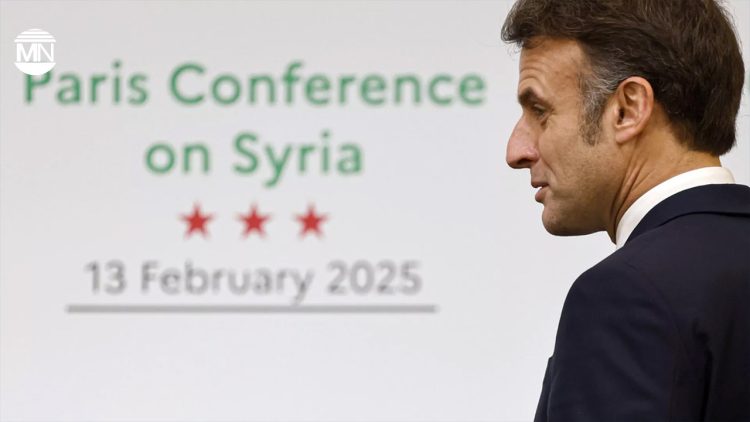
French President Emmanuel Macron used the closing session of an international conference on Syria’s transition to underline the crucial role of the Kurdish-led Syrian Democratic Forces (SDF) in ensuring the war-torn country’s stability and future.
Addressing Syria’s new interim leader, Ahmed al-Sharaa (al-Julani) and his government, Macron stressed the need for an inclusive security strategy and praised the SDF’s effectiveness in the ongoing fight against the so-called Islamic State (ISIS). The president stressed that the SDF – seen by Western countries as a key ally against ISIS – must be woven into any transitional framework, including a reformed national military. For their part, the new Syrian authorities have already called for such inclusion, although negotiations on the details remain unresolved.
“Your responsibility today is to integrate them (…) with the same objective of fighting the terrorist groups that are destabilising your country,” Macron said. “Whatever we can do to support this, for the sake of your security and that of your neighbours, we will do it.”
Macron’s comments came as he renewed France’s broader commitment to the fight against ISIS in Syria, underlining that despite being largely defeated in 2019, the jihadist group still poses a threat in parts of the country and in neighbouring Iraq. He urged the international coalition, led by the United States, to step up coordinated strikes against remaining pockets of extremist fighters.
President Macron’s remarks emphasising the SDF’s role in Syria’s reconstruction coincide with a process during which the transitional government under Ahmed al-Sharaa has declared Sharaa as president. Moreover, representatives of the SDF were not invited to the reconstruction conference recently organised by the transitional government.
“The fight against Daesh [ISIS] is an absolute priority,” Macron stressed. “Ensuring a close partnership with the [international] Inherent Resolve coalition is an excellent idea, and I ask all coalition partners to reconsider their position.”
Beyond the campaign against ISIS, Macron stressed that Damascus must ensure that Syria does not become a staging ground for Iranian-linked militias. Pointing to regional concerns, he called for a concerted effort against all terrorist organisations:
“We must prevent Syria from becoming a logistical platform for Iran-linked groups that threaten to destabilise the region,” he noted. “The Syrian State must continue its fight against all terrorist networks that sow chaos inside and outside the country.”
Macron also reiterated Western calls for a government that respects Syria’s diverse population. The new interim administration in Damascus plans to form a permanent government on 1 March that will reflect the country’s ethnic and political pluralism following the fall of Bashar al-Assad.
At the same time, French Foreign Minister Jean-Noël Barrot announced that the European Union was working on a “rapid lifting” of certain sanctions to facilitate reconstruction in Syria – an effort that the United Nations estimates will cost more than $400 billion. The move is conditional on ensuring that the transition remains inclusive and committed to restoring stability.
By placing the integration of the SDF at the centre of his remarks, Macron has made it clear that any viable peace and reconstruction effort will depend on forging practical alliances within Syria – especially with those who have long been on the front lines against ISIS.