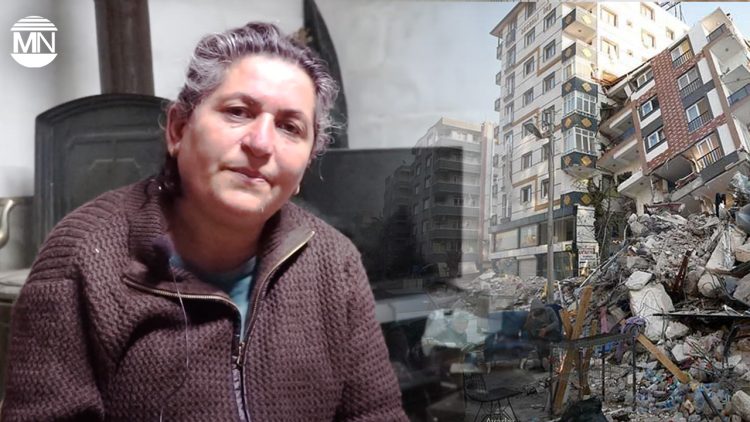
At 04:17 on 6 February 2023, two powerful earthquakes struck southern and southeastern Turkey, primarily affecting Kurdish-majority regions. The quakes registered magnitudes of 7.7 in Pazarcık (Bazarcix) and 7.6 in Elbistan (Albîstan), with tremors felt as far as Syria. The disaster caused massive destruction across 11 cities. Official reports state that 53,537 people lost their lives and 107,213 were injured, though many believe the actual death toll is significantly higher.
In Elbistan (Albîstan), thousands of homes collapsed, leaving half the population displaced. Two years on, basic needs such as housing, healthcare, and food remain unmet. Many survivors still live in container settlements or makeshift shelters, enduring harsh winter conditions with little support. Government aid has been minimal, and rebuilding efforts have stalled. Medine Mamedoğlu of Jin News visited the earthquake-affected regions, speaking to victims, documenting their stories, and highlighting the ongoing victimisation that persists two years after the disaster.
Ayşe Algaş, a 56-year-old survivor from the village of Sevdilli, shared her harrowing experience with Mamedoğlu. “During the first quake, there was no one to help us. We were trapped in the barn when the walls collapsed, and we managed to escape with our own efforts,” she recalled. Her family members were not as fortunate; many perished beneath the rubble.
For two years, Ayşe has lived in a single-room shelter she built herself. “No one has come to our door in these two years. We were left to deal with our pain alone,” she told the reporter. The bitter cold claimed the lives of her relatives who could not escape the initial quake. “After that day, we died a little every day,” Ayşe expressed, highlighting the emotional toll of continued neglect.
Ayşe noted that as the anniversary of the earthquake approaches, the trauma resurfaces. “Every year on 6 February, I relive that pain. We cannot forget that day,” she said. Despite the severe conditions, government agencies such as Turkey’s Disaster and Emergency Management Authority (AFAD) have provided little to no assistance.
Survivors remain in makeshift homes, with some forced to live under plastic sheets or in partially collapsed buildings. Schools and hospitals are barely functioning, and essential infrastructure is still in ruins. The Ministry of Environment, Urbanisation and Climate Change designated some of these areas as ‘reserve zones’, yet no clear plans for reconstruction have been presented.
Ayşe Algaş’s story reflects the broader crisis faced by thousands of survivors across the earthquake-affected regions. “We didn’t just survive the rubble; we’re surviving abandonment,” she told Mamedoğlu. The lack of governmental action has left communities to fend for themselves, with no roadmap for recovery.
As Turkey marks the second anniversary of this tragedy, survivors and advocates are demanding immediate action, transparency, and accountability from the authorities to address the ongoing humanitarian crisis.