

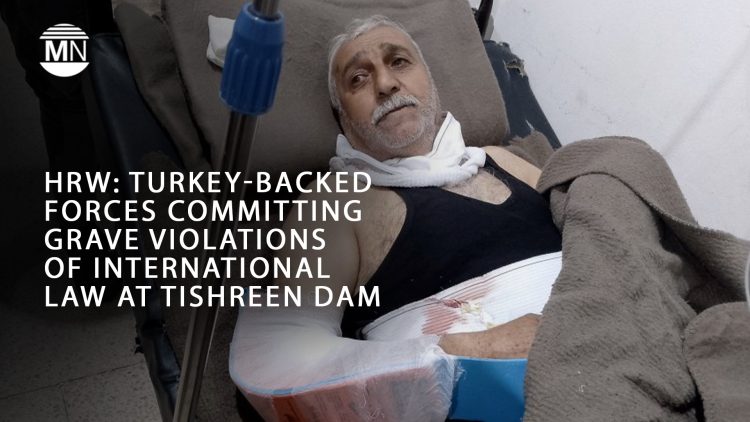
After the collapse of Bashar Al-Assad’s regime and the shifting geopolitical dynamics in Syria, war crimes committed by the Turkish-backed Syrian National Army (SNA)—particularly around Tishreen (Tişrîn) Dam—have come under increasing scrutiny from human rights organisations.
Since 8 January 2025, Turkish airstrikes and artillery attacks on North and East Syria (Rojava) have killed 41 civilians and injured 245, including journalists and medical personnel, according to ANHA News Agency.
The assaults have primarily targeted Tishreen Dam, Kobani (Kobanê), Sirin (Sarrin), and Zirgan, resulting in widespread civilian casualties and destruction. In the Tishreen Dam region alone, 24 civilians have been killed and 221 injured. On 25 January, Turkish forces bombed Sirin, killing 12 people, including children, and injuring 13 others. A drone strike on Kobani on 30 January killed two civilians and wounded a woman, while in Zirgan, three civilians, including a child, were killed, and 10 others—including four children and three women—were injured.
Among the wounded are seven journalists and six medical personnel, underscoring Turkey’s deliberate targeting of essential workers.
In this context, Hiba Zayadin, Senior Middle East and North Africa Researcher at Human Rights Watch (HRW), condemned these violations, stating:
“The SNA and Turkish forces have demonstrated a clear and disturbing pattern of unlawful attacks against civilians and civilian infrastructure—often appearing to celebrate them.”
She further emphasised:
“Turkey, as the primary backer of the SNA, is obligated to rein in its abuses or risk complicity in war crimes.”
RELATED ARTICLES
Syria: Drone attack footage reveals deliberate targeting of Tishreen Dam protesters

From Kobane to Tishreen: A story of liberation and struggle

Kurdish actor Bavê Teyar dies following Turkish airstrike on Syria’s Tishreen Dam

Parents of injured German activist Lea Bunse condemn Turkish attacks on Rojava
HRW has highlighted that Tishreen Dam has become a focal point in the conflict between the Turkey-SNA coalition and the Syrian Democratic Forces (SDF) since December 2024. As a result, the dam has remained inoperable since 10 December 2024, cutting off water and electricity to approximately 413,000 people in Manbij (Minbîc) and Kobani.
Regarding the sustained attacks on civilians and infrastructure, HRW underscored that ambulances and medical facilities are fully protected under the laws of war and must never be targeted, regardless of whether they are treating enemy combatants. Likewise, dams and critical infrastructure are afforded special protections due to the catastrophic risks posed to civilians.
On 23 January 2025, the Autonomous Administration of North and East Syria (AANES) accused Turkey and its allied forces of escalating attacks on critical infrastructure, particularly targeting the Tishreen Dam.
Since December, Turkish-backed forces, including the Syrian National Army (SNA), have focused on vital infrastructure, with the SDF condemning the attacks as deliberate attempts to destabilise the region.
On January 8, a Turkish drone strike targeted civilians, killing and injuring demonstrators. Further assaults, including airstrikes on 16 January, killed several and heightened concerns over potential flooding from dam damage. Between 8 and 21 January 2025, airstrikes also targeted health workers and journalists and artists. The AANES has called for international intervention to prevent further escalation.
The targeting of civilians near the Tishreen Dam occurs against a backdrop of shifting political dynamics, with Turkish interventions and growing ties between the Haya’at al-Tahrir al-Sham (HTS) group, Turkey, and Qatar posing serious challenges to Syria’s political future. These developments jeopardize the stability and sovereignty of AANES, pushing it toward an existential crisis.


