

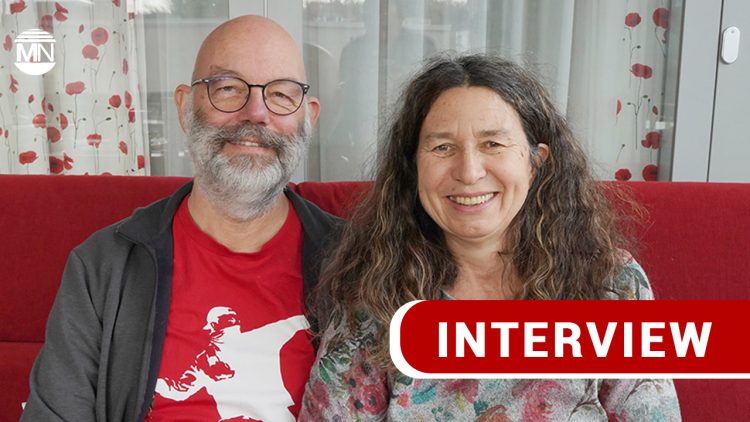
Monika and Volker Bunse, the parents of German climate and human rights activist Lea Bunse, who was injured in a Turkish drone strike at the Tishreen Dam in northern Syria on 21 January, gave an exclusive interview to Medya News. They explained how even before being personally affected due to the injury of their daughter in a Turkish attack, they have been deeply devoted to supporting and learning from the people’s struggle in North and East Syria, commonly known as Rojava, which they were able to get to know closely during their own trips to the region.
Monika and Volker shared the inspiration they gained from their trips to Rojava, saying that the deep solidarity amongst the people and their commitment to defending their homeland can be seen in the recent civilian sit-in protests at the Tishreen Dam, which have continued non-stop since the beginning of January in the face of Turkish attacks which have directly targeted the peaceful protestors, killing at least 24 civilians and injuring over 200. They expressed admiration for the protests continuing despite the ongoing attacks.
Declaring their full support for Lea joining the sit-in as a climate and human rights activist despite being well aware of the dangers, they added that they would have made exactly the same decision as her. The Bunses explained how they follow the situation on the ground closely and that the injury of their daughter made them even more committed to being active and bringing international publicity, both to the Turkish attacks on North and East Syria and to the socialist revolution taking place there.
🚨#BREAKING | German activist Lea Bunse, injured in today’s Turkish airstrike on a peaceful sit-in at Syria’s Tishreen (Tişrîn) Dam , says civilians were deliberately targeted while performing traditional dances. With the toll since 8 January now at 17, she urges: “Stand up for… pic.twitter.com/ALyWih3fEl
— MedyaNews (@medyanews_) January 21, 2025
Lea’s mother Monika is deeply inspired by the new social model being build up in Rojava, which she explains is based on “equal rights for women, grassroots democracy, protection of nature, coexistence of cultures and religions”. She says it was her daughter who first brought her into contact with the ideas of the so-called ‘Rojava Revolution’, which is based on Abdullah Öcalan’s model of Democratic Confederalism.
Volker and Monika themselves were originally politicised by Catholic and socialist circles, and have been politically active since their youth. Having brought up their five daughters with these world views, they found it all too understandable that their daughter decided to leave her home country and travel to North and East Syria, to live and learn among the people building up a social revolution there. “Lea is exactly where she needs to be”, Monika said, explaining how many young people in Germany are desperately looking for solutions to the problems they face themselves and see in the world and turn to the revolution in Rojava for solutions.
Highlighting the importance of the Tishreen Dam, Volker, who is an engineer himself and had visited the dam during his trip to North and East Syria, explained that the dam is crucial for “the population, for the water supply, for irrigating the fields, for the power supply. If the dam were to break because of the attacks, it would be a disaster.” A break of the dam would have catastrophic consequences for the region, as it could flood lands between it and Iraq.
He also shared a story of an elderly man, which Lea had met at the protest at the Tishreen Dam and which he was deeply touched by:
An elderly man who was injured in the head came back to the dam after receiving medical treatment to continue protesting. He said that these concerns of the population must be brought to the public and that the armed forces must be supported. So I say, he knows exactly and has experienced for himself that he is risking his life and yet he comes back and says, I stand up for it.
Monika and Volker explained that supporting the revolution in Rojava has become a matter of the heart to them and remember the words of killed journalist Cîhan Bilgin, which they had met themselves and asked what the worst part of the Turkish attacks is in their opinion, to which she answered:
“The worst thing is when attacks take place and the world remains silent.”
They expressed their demands to the public and to German politicians, saying that the utmost importance lies in the need for the people in Germany to take notice of the attacks against the civilian population in North and East Syria, so pressure can be put on the German government to stop supporting Turkey militarily as well as financially and to put an end to the attacks.
Read a summarised version of the interviews with Monika and Volker Bunse here:
Medya News: Can you please introduce yourselves?
Monika Bunse: I’m Monika Bunse, I’m 63 years old and I live in Heilbronn. I grew up in a Christian family with the values that charity is simply important. And there was a saying that I always liked: “What you don’t want others to do to you, don’t do to others.” I have five children myself and have tried to bring them up in this spirit.
Volker Bunse: My name is Volker Bunse and I’m an engineer by profession. My basic socialisation actually came from Christian circles. […] I also got that from my mother, i.e. empathetic thinking about the world. This then became more and more politicised towards society as a whole through the peace movement at the beginning of the 80s.
How did you first hear about Kurdistan and how did you first come into contact with the Kurds?
Volker Bunse: I’ve always been interested in global events, whether in Abya Yala [South America] or in Africa or wherever. I’ve always heard about it as part of my general background. And then a bit more intensively during the urban war in Bakur [southeast Turkey]. I was always shocked that it was only reported in niche media, that whole districts were razed to the ground and people killed. But these were always isolated events that made me pay more attention to the topic. I only really came into contact with it when our daughter became involved in the Kurdish movement.
Monika Bunse: For me, it was through my daughter that I came into contact with the Kurdish movement and its ideas. And I think my trip to northern and eastern Syria in particular changed a lot. The great thing about this movement and the self-administration in Rojava is the equal rights for women, the grassroots democracy, the protection of nature, the coexistence of cultures and religions: that is simply what fills my heart. And I remember in the past it was said that we would make a revolution now and that we would deal with women’s equality later. And here we finally have a movement where women’s liberation is the top priority. I think that’s another reason why it’s incredibly important to me and why I’m simply fascinated by it.
How did you find out your daughter Lea had been injured by a Turkish attack at Tishreen Dam? What were your first thoughts, your first feelings when you found out?
Monika Bunse: I have to say, we were relatively calm. I think it’s because the day before, my husband and I talked about whether our daughter would go there. And we’d been thinking about what the consequences might be for some time. My husband, he said: “I think I would go too.” At first I was a bit like “What? You’d go there too?” I thought about it and then I thought, yes, I think I would too. And then we just said that, knowing our daughter, it was clear that she would go there. And we were just glad that she was only slightly injured. It could have turned out very differently. In this respect, it was more a feeling of gratitude that it wasn’t different.
Volker Bunse: […] It didn’t throw us completely off course, but rather motivated us to be even more active. And we had already organised a rally here three days earlier on the subject of the events at the Tishreen Dam. And ultimately, after what we experienced there ourselves on our trip, what I experienced a year ago, I can understand what happened very well. I would say that my indignation about what is happening there, whether it is now with the current situation, since the SNA [Syrian National Army] attack or even before, I am so outraged and angry about it that it could not be increased. I find it so incredible that the people are doing this vigil. My first contact with the issue was the convoy that was attacked, with the dead and the corresponding pictures and so on. And since then I’ve been angry or upset and outraged about it. It wasn’t even the case that I saw my daughter and thought it was even worse now, after her injury. I’m already in such a rage that it couldn’t have been made any worse.
Society in North and East Syria is in a state of upheaval, there is a major change taking place. A women-led revolution is underway. At the same time, the population is under attack from Turkey. Can you explain why your daughter Lea decided to go there despite the risks?
Monika Bunse: So I’ve also been thinking a lot about this. And I’ve met a lot of young people who are simply looking for something here in Germany. And who despair at the injustice of the world here, who are sensitive, important, valuable people. And they are always against a lot of things. And I think that simply makes it difficult for their psyche. And when she found this model of society, like many other young people who come across it in their search for a good solution, they go there [North and East Syria]. And suddenly they’re in favour of something. They can be for something. For building a society. For something good. And that’s why she went there. And others say, why did you let her go? And I say, that’s her place. She had to go there. She couldn’t stand it here because she feels like she’s part of the system. And she simply can’t do what she would like to do here.
Volker Bunse: Of course this also plays an important role for me, that we are often asked, how do you feel about your daughter being there? And I came back from my visit [to North and East Syria] with a very strong feeling, where I was able to talk to her a lot, that I always say that Lea is where she needs to be. She deliberately put herself in danger, which of course doesn’t make the attack any better or excuse it. But I know, and she told us this again today in a conversation, that she said it was so important for her to be there. She is convinced of it and stands behind it, I just respect that.
How are you continuing the protest here that Lea is currently participating in within Kurdistan? What are your expectations from German politics in this regard?
Monika Bunse: So we joined the Families for Peace association. And we then exchanged ideas about what we could do here. We also came into contact with the local Kurdish community here. I think networking is particularly important. Before, we were pretty isolated as parents, but now we’re coming together. And now my husband and I have organised an information stand in the city together with the Kurdish community, where we simply provide information. And I give talks about my trip to northeast Syria. And I also remember this journalist I met in Rojava who I asked “What is the worst thing about these attacks?” And she said that the worst thing is when attacks take place and the world remains silent. And I’m just trying to be a small piece of the mosaic so that a few more people find out about these attacks.
Volker Bunse: So the issue is and remains public relations work. We organise information stands together with the Kurdish community here and organise educational events, we take part in them ourselves. Sometimes Kurds thank us for our commitment and I’m happy about that, of course, but I also express my gratitude for the inspiration I’ve received and what I’ve learned from the Kurdish movement. And that’s why it’s not a one-way street, like classic development aid or whatever you want to call it, but that we learn an incredible amount from it and also try to implement something like that here.
There was once an impressive letter from a friend, shortly after Christmas a year ago, where she wrote that she heard on the radio that two Russian drones had been shot down over Ukraine, as a big news item, and at the same time she heard the bombs falling outside in Rojava. So it’s simply ignored because people aren’t interested enough in what’s happening. And we are simply calling for a stop to arms deliveries from Germany and Turkey, which have exploded in volume in the last few years.
And what we demand from the German public is that they finally take note of what is happening there. It’s been a bit of an issue now, incidentally, because of the fall of Assad, but it simply has to become much more widely known. We demand that politicians recognise the Autonomous Administration of North and East Syria. We demand a stop to the attacks. So there simply has to be a change in policy, which is of course geopolitically difficult, we realise that. And that will only happen if the people here exert pressure.
🔴Monika and Volker Bunse, the parents Lea Bunse, a German climate and human rights activist injured by a Turkish drone strike during a sit-in at the Tishreen (Tîşrîn) Dam in northern Syria on 21 January, have spoken out: 📽️ pic.twitter.com/092qW1SMSP
— MedyaNews (@medyanews_) January 29, 2025
related articles:
German human rights activist visits northern Syria: ‘They are determined to defend their land’


