

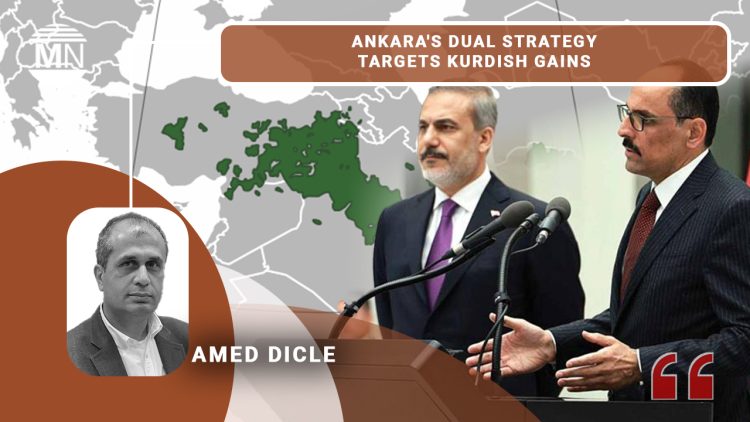
On 25 January, Turkey’s Foreign Minister Hakan Fidan visited Baghdad for critical meetings with Iraq’s President, Prime Minister, and Foreign Minister. On the same day, MİT (Turkish Intelligence) Chief İbrahim Kalın met with Hayat Tahrir al-Sham (HTS) leader Ahmed al-Sharaa [nom de guerre Abu Mohammad al-Julani], in Damascus. These two parallel visits highlight Ankara’s ongoing efforts to deepen its anti-Kurdish regional strategy.
Ahead of Fidan’s visit, Iraq’s Foreign Minister Fuad Hussein expressed concerns in Davos about Turkey’s attacks on Rojava. Following these remarks, a significant clash occurred on 24 January in the Heftanin region of Duhok (Dihok). During a confrontation near the villages of Sorya and Şîlanê, Turkish soldiers advancing into guerrilla-held areas faced resistance. Official reports confirmed casualties on the Turkish side, including the death of Engineering Sergeant Ufuk Akıncı.
One striking detail of this incident was the Turkish forces’ request for assistance from Peshmerga units operating under the guise of ‘Iraqi Border Guards’, affiliated with the Kurdistan Democratic Party (KDP). These units, composed of KDP’s Gulan and Zerevan forces, are known to coordinate with Turkey. The Border Guards intervened in the conflict zone, but two Peshmerga members were killed. Local sources suggest these deaths resulted from Turkish military bombardments. While the full details remain unclear, the incident is widely seen as part of Ankara’s broader regional calculations. Fidan reportedly used this clash, and the deaths of the Peshmerga fighters, as leverage during his Baghdad meetings to persuade Iraq to align with Turkey’s stance. This has led to speculation that the confrontation was orchestrated as part of a pre-visit plan.
In Baghdad, Fidan emphasised the clash as evidence of the Kurdistan Workers’ Party (PKK) being a “shared threat” to the region. This narrative formed a key argument in his discussions, aligning with Ankara’s strategy to use such incidents to justify its military actions.
Meanwhile, in Damascus, MİT Chief İbrahim Kalın’s meeting with HTS leader Colani signals Turkey’s evolving plans in Syria. Turkey reportedly aims to integrate HTS with factions of the Syrian National Army (SNA) to form a more cohesive and powerful structure. This move is seen as part of a broader strategy to intensify attacks on Rojava.
Kalın’s discussions with Colani also aimed to pit the Autonomous Administration of North and East Syria (AANES) against the central government in Damascus. By framing these attacks as a conflict between Damascus and Rojava, Turkey seeks to legitimise its actions on the international stage.
Ankara’s moves against Kurdish unity
Amid growing calls from Kurdish communities for national unity, a meeting was recently held between KDP leader Masoud Barzani and Syrian Democratic Forces (SDF) Commander Mazloum Abdi. Positive statements following the meeting raised hopes for strengthened Kurdish solidarity. However, shortly after, KDP Special Forces Commander Mansour Barzani travelled to Ankara for discussions with Turkish Chief of General Staff Yaşar Güler, indicating deeper military cooperation between the KDP and Turkey.
These developments suggest Ankara’s continued efforts to undermine Kurdish unity. The Gulan forces, trained by Turkey and led by Mansour Barzani, play a key role in eroding trust among Kurds. The Peshmerga units deployed in the Duhok clash also belong to this group.
During his Baghdad meetings, Fidan proposed a “four-nation alliance” against ISIS, including Iraq, Syria, Jordan, and Turkey. However, this proposal appears less about combating ISIS and more about marginalising Kurdish gains. By using such alliances, Ankara seeks to weaken Kurdish legitimacy internationally and roll back their achievements.
Following his return from Baghdad, Fidan’s remarks revealed a new phase in Turkey’s policy towards paramilitary structures in Syria. He called on the Damascus government to integrate all armed groups under a single “national army”. This proposal appears to serve two objectives:
*1-Integrating SNA with HTS
The SNA has suffered heavy losses in its war against Rojava. By merging it with HTS, Turkey aims to revitalise these factions and use them against both the Damascus government and Rojava.
*2-Targeting the SDF:
Turkey frequently highlights the SDF’s refusal to disarm as a major issue. Fidan has repeatedly used the argument that “all groups must disarm except the SDF” to undermine its international legitimacy.
A Systematic Policy of Hostility
Turkey’s simultaneous actions in Baghdad and Damascus reflect its systematic hostility toward Kurdish gains. Under the guise of promoting “regional peace” and “stability”, Ankara continues to target Kurdish achievements while fostering chaos in the region. The coordinated efforts of Hakan Fidan and İbrahim Kalın demonstrate that Ankara’s military and diplomatic strategies to neutralise Kurdish influence remain relentless.


