

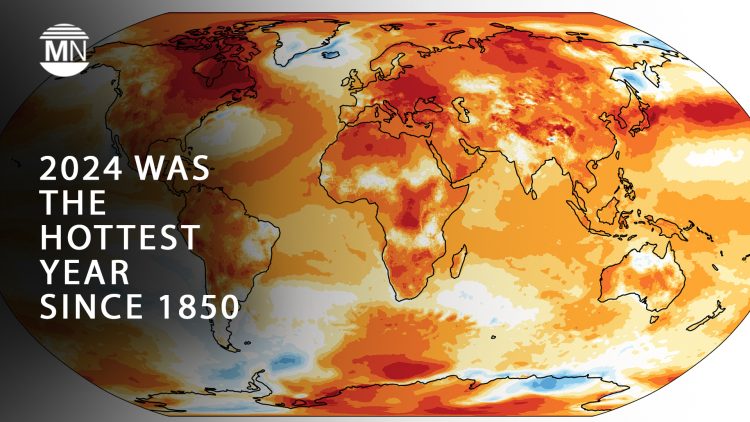
The year 2024 was the hottest on record since 1850, when measurements of global surface temperature began. This information has been released by the Copernicus Climate Change Service (C3S), one of the six services which form the European Union’s Copernicus programme.
According to the C3S report, the global average temperature in 2024 was 1.6°C higher than the pre-industrial level (the average temperature between 1850 and 1900). If we look back in time, each of the last 10 years (2015-2024) was one of the 10 hottest years on record. Preliminary measurements released during 2024 led C3S to predict that 2024 would become the hottest year on record.
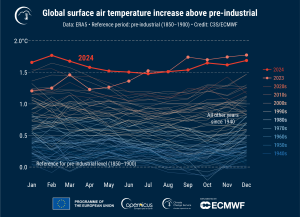
Other climate indicators also signalled record levels, the C3S report explains. In terms of temperature, the monthly average temperature increase since July 2023 was, with the exception of July 2024, above 1.5°C. The concentration of CO2 in the atmosphere, which is linked to the use of fossil fuels, has increased by 2.9 parts per million (ppm), reaching it’s record level of 422ppm in 2024.
Commenting on the report’s findings, Carlo Buontempo, director of C3S, said. “Humanity is in charge of its own destiny, but how we respond to the climate challenge should be based on evidence. The future is in our hands – swift and decisive action can still alter the trajectory of our future climate,” he said.
Climate change, caused mainly by the burning of fossil fuels, is leading to rising temperatures and worsening extreme weather events, among many other negative impacts on the stability of oceans, the atmosphere, forests and human life.
The annual Conference of Parties (COP) of the United Nations Framework Convention on Climate Change has been working for decades to coordinate and organise action to reduce the effects of climate change. However, the practical impact of these meetings has been marginal, with efforts hampered by economic and power interests.
As the climate crisis worsens, the search for an effective solution has been taken up increasingly by civil society organisations. In recent years, young people all over the world have been protesting in movements such as ‘Fridays for Future‘ and ‘Extinction Rebellion‘. They’ve been looking for a way out of the vicious circle of crises in which the world finds itself, of which the climate crisis is only one.
Related story:
Öcalan’s solution for our crises: Restoring social ethics to politics
The Academy of Democratic Modernity (ADM) has been investigating the ecological problem in capitalism in connection with the thinking of the leader of the Kurdistan Workers’ Party (PKK), Abdullah Öcalan. In a brochure shared in 2024, they wrote: “For Öcalan, the ecological crisis cannot be detached from social conditions. The roots of the ecological crisis, which is intensifying in parallel with the capitalist systemic crisis, should be sought at the beginning of civilisation”.
According to ADM, while it’s important to follow the developments related to the climate and its effects scientifically, the search for a solution to the ecological and climate problem must reach the social field.


