

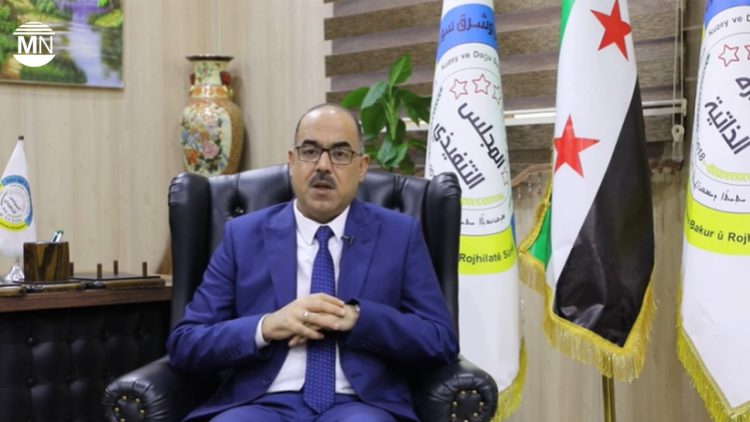
“We urgently need a national conference that brings together all political forces in Syria,” said Hussein Othman, co-chair of the Autonomous Administration of North and East Syria (AANES), on Tuesday. Speaking after Hay’at Tahrir al-Sham’s (HTS) Abu Muhammad al-Julani, also known as Ahmad al-Shar’a, extended his transitional government’s mandate for four years, Othman highlighted the urgent need for political inclusion to secure Syria’s stability and sovereignty.
Othman emphasised that the transitional government must reflect the diverse fabric of Syrian society, including ethnic minorities, women, and religious groups. He warned that marginalisation or narrow agendas would replicate past mistakes made under the Ba’ath regime and exacerbate Syria’s long-standing challenges.
“The AANES has consistently advocated for Syrian-Syrian dialogue,” Othman added, underlining the administration’s belief in achieving mutual understanding through national discourse. The proposed conference, he noted, should include a preparatory committee to guarantee full representation and address core issues such as governance, sovereignty, and decentralisation.
Othman reaffirmed the AANES’ vision for a decentralised Syria, framed as a solution to ensure balanced governance while preserving national sovereignty. He dismissed accusations of separatism, stating that the initiative is “rooted in Syrian identity” and aims to protect the country from external meddling.
Concerns over al-Julani’s leadership continue to grow. Once a jihadist leader, al-Julani now heads Syria’s de facto transitional government, raising questions about his commitment to safeguarding human rights, particularly for women and minorities. The AANES has also criticised his reported collaboration with Turkey, accusing Ankara of destabilising Syria and facilitating the resurgence of extremist groups such as ISIS.
Othman called on the international community to support Syria’s political transition while respecting its sovereignty. He stressed that external interventions have historically fuelled instability and undermined the efforts of Syrian-led governance models, such as that of the AANES.
By reiterating its commitment to dialogue, inclusion, and decentralisation, the AANES continues to position itself as a key actor in shaping Syria’s post-Assad political landscape.


