

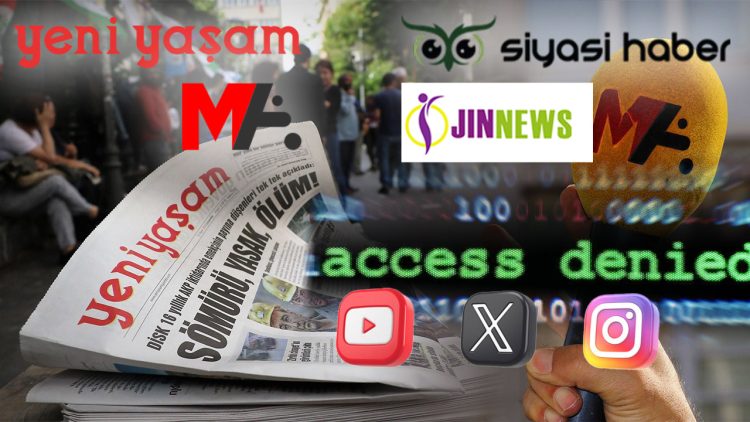
As if to highlight the ongoing suppression of press freedom in Turkey, the government has imposed access bans on the X (formerly Twitter) accounts of several prominent Kurdish and independent media outlets, including Mezopotamya Ajansı @Maturkce , Jin News @jinnewsturkce , Yeni Yaşam @yeniyasamgazete , and SiyasiHaber @SiyasiHaberOrg . The restrictions, imposed without explanation, come as the ruling Justice and Development Party (AKP) and its partner, the Nationalist Movement Party (MHP), promote a narrative of democratisation and Kurdish-Turkish brotherhood as part of a so-called “normalisation” process.
On 27 December, access to Mezopotamya Ajansı’s X account, which has 263,000 followers, and its YouTube channel, with 148,000 subscribers, was blocked, along with its domain name, mezopotamyaajansi40.com. Jin News, Yeni Yaşam, and SiyasiHaber faced similar arbitrarily applied restrictions, including Yeni Yaşam’s website being blocked twice in the past month and its Instagram account restricted.
These actions stand in sharp contrast to the government’s stated vision of a transition to democracy, raising concerns on press freedom and citizens’ right to access unbiased information. Siyasi Haber’s website was blocked by a ruling from Ankara’s Criminal Court of Peace No.10, a decision widely criticised for its apparent arbitrary nature.
Related Articles
Pro-Kurdish DEM Party to hold key talks with political parties in Ankara

Turkey’s DEM Party co-chair urges talks with imprisoned Kurdish leader

2025: A turning point for Turkey? Öcalan’s vision for peace and democracy
Advocates for press freedom have denounced the bans as an assault on the freedom of information and a blatant effort to suppress independent voices. Critics contend that these actions expose a stark contradiction to the government’s current rhetoric on democratisation and Kurdish-Turkish unity, as it persists in silencing Kurdish media outlets and independent journalism.
Turkey’s pro-Kurdish Peoples’ Equality and Democracy (DEM) Party has issued a statement condemning the latest government crackdown on free Kurdish media, describing it as a deliberate attack on the public’s right to access truthful and independent reporting. The party also highlighted the contradiction between the government’s proclaimed commitment to democratisation and its actions targeting press freedom.
The statement reads:
"This latest blow against Mezopotamya Ajansı, Jin News, Yeni Yaşam and SiyasiHaber is not merely an attack on these outlets but an attack on the public’s right to the truth. The government’s censorship, veiled by arbitrary and unexplained decisions, exposes its fear of a society informed. Their actions reveal that the motto ‘Bi Her Zimanî Bijî Heqîqet!’ (Long live truth in every language!) is nothing more than empty rhetoric. In practice, the government operates under the principle of ‘Bi her awayî astengî û sansur’ [Obstruction and censorship in every way]."
The DEM Party further stressed the crucial role of the independent media in holding those in power accountable, ending with a call to action:
"At a time when discussions about democratisation and the so-called 'brotherhood' of Kurdish and Turkish peoples are being promoted, the silencing of the Kurdish media proves the government's reluctance to embrace genuine democratic transformation. The Kurdish press has long been a voice for justice, equality and freedom, and its suppression is a direct assault on these values.
We demand the immediate lifting of these shameful blocks and call on all democratic forces to stand in solidarity with the free press. The truth cannot be silenced, and we will not remain silent in the face of such blatant oppression. Journalism is not a crime; it is a cornerstone of democracy.”
The reaction highlights the broader implications of the censorship, framing it as a litmus test of the government’s sincerity in its claims of democratic reform.
The blocks arrive at a pivotal moment, when access to truthful reporting is crucial for public trust and democratic discourse. Calls for the immediate lifting of these restrictions and stronger protection for press freedom are intensifying, as journalists and organisations stress that the truth cannot be permanently silenced.


