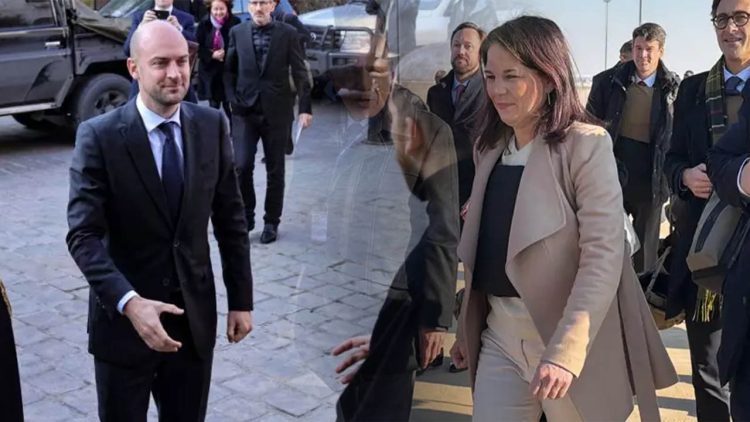
German Foreign Minister Annalena Baerbock and her French counterpart Jean-Noel Barrot arrived in Damascus today, the first official representatives of European countries to visit Syria since the fall of Bashar al-Assad’s regime four weeks ago. Their mission is to engage with the Syrian transitional government led by Ahmad al-Shara (formerly known as Abu Muhammad al-Julani), the leader of Hay’at Tahrir al-Sham (HTS), and explore avenues for a new chapter in Europe-Syria relations.
While the full implications of the German and French foreign ministers’ meeting with the Syrian transitional government and Ahmad al-Shara remain uncertain, the EU is reportedly viewing the engagement with considerable scepticism. This wariness stems from HTS’ historical ties to al-Qaeda and its current close relationship with Turkey.
“My trip today — together with my French counterpart and on behalf of the EU — is a clear signal to the Syrians: A new political beginning between Europe and Syria, between Germany and Syria, is possible”. She added that despite “scepticism” about HTS, which leads an alliance of opposition factions that toppled Assad in early December, “we must not miss the opportunity to support the Syrian people at this important juncture.”
Baerbock set conditions for Syria’s new de facto rulers to resume relations with Germany and the EU, saying that she was coming to the Syrian capital with her French counterpart with “outstretched hand, but also with clear expectations from the new rulers”.
Baerbock stated that there can only be a new beginning if the new Syrian society gives all Syrians – women and men, regardless of ethnic or religious group – a place in the political process, gives them rights, and provides them with protection, adding that these rights must be protected and “not undermined by very long periods of time until elections are held or if steps are taken to Islamise the justice system or education.”
She emphasised that a genuine new beginning for Syria is contingent upon addressing past injustices, establishing a robust system of justice, and ensuring that acts of revenge against any segment of the population are avoided. She firmly stated that extremism and extremist groups should have no place in Syria’s future. “We know where HTS comes from ideologically, and what it has done in the past,” Baerbock noted. However, she also pointed out that there are indications of a desire for moderation and understanding among key actors in Syria. In particular, she highlighted the commencement of talks with the Kurdish-dominated Syrian Democratic Forces (SDF) as an important signal of progress in this direction.
Paying attention to the existence of reports regarding the continuation of contacts between the leadership of HTS, al-Qaeda and Turkey, Baerbock added: “Germany is trying to ensure that the internal process of Syria is not affected from outside the borders, and all neighbouring countries, including Turkey and Israel, which is pursuing its interests in Syria, should maintain the sovereignty and territorial integrity of this country.”
In this regard, she stated: “We will continue to evaluate HTS through its actions. Despite all doubts, we should not miss the opportunity to support the Syrian people at this important crossroads.”
In this context, French Foreign Minister Barrot, speaking to journalists at the French embassy in Damascus, expressed his hopes for a “sovereign, stable and peaceful” Syria. It was also a “hope that the aspirations of all Syrians can be realised”, he added, “but it is a fragile hope”. His trip to Syria was aimed at promoting a “peaceful” transition for “the Syrian people and for regional stability”, he said in a post on social media platform X.