

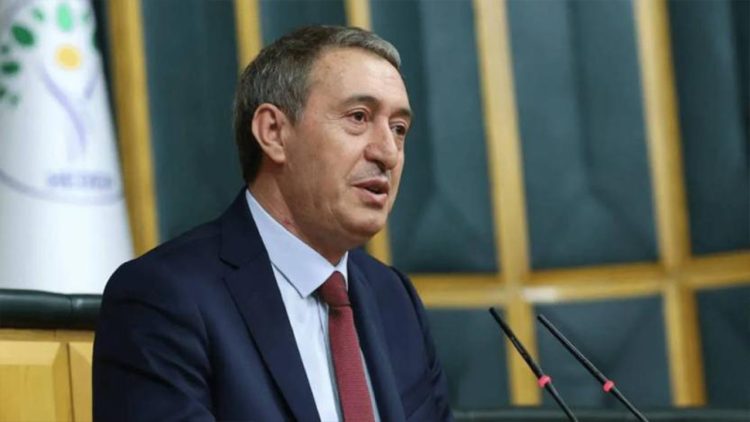
Turkey must confront the Kurdish question to achieve lasting peace and stability, Turkey’s pro-Kurdish Peoples’ Equality and Democracy (DEM) Party Co-Chair Tuncer Bakırhan said on Tuesday, criticising Ankara’s policies towards Syria and Kurdish populations in the region. Speaking at his party’s weekly parliamentary group meeting, Bakırhan condemned recent drone strikes that killed journalists Nazım Daştan and Cihan Bilgin in northern Syria, calling it a “crime against humanity”.
“In the last five years, 13 journalists have been killed and seven others seriously injured in attacks targeting those who amplify the voices of Kurds and the oppressed,” Bakırhan said. “Killing journalists to bury the truth is unacceptable. The pens and cameras of Nazım and Cihan will not be left behind.”
Bakırhan also criticised Turkey’s judicial crackdown on dissent, highlighting the detention of journalists and lawyers for speaking out against the killings. “Seven journalists and two activists have been arrested for opposing these attacks. Those who think they can silence dissent through arrests and intimidation are wrong,” he said.
Addressing the broader geopolitical situation, Bakırhan accused Turkey of obstructing efforts to establish Kurdish autonomy in Syria’s northeast. “Turkey stands alone at the United Nations in opposing Kurdish rights in North and East Syria,” he stated. “The government’s refusal to recognise the legitimacy of Kurdish self-rule undermines regional stability.”
Bakırhan called for a new political framework in Syria to protect minorities and ensure peace. “Alevi, Druze, Christian, Kurdish, and Arab identities must be safeguarded under a new system,” he said. “Turkey must abandon its export of concrete and weapons to Syria, which only fuels chaos and deepens instability.”
On the economic front, Bakırhan slammed the Turkish government’s handling of the economic crisis, describing 2024 as a “year of hunger and misery”. He highlighted soaring inflation, rising poverty, and corporate bankruptcies. “The 2025 budget is not for the people; it is for warlords, interest lobbies, and capitalists,” he argued. “Six trillion lira is allocated to war and capital, leaving workers and the poor in despair.”
Bakırhan linked economic justice to social peace, arguing that the failure to address economic inequality exacerbates ethnic and sectarian divisions. “Without economic justice, there can be no social peace,” he said.
Focusing on foreign policy, Bakırhan warned that Turkey’s interventionist stance in Syria risked destabilising the region further. “No one has seen a single stone thrown from northern Syria into Turkey,” he stated. “Yet bombs dropped by Turkey in Rojava explode in the hearts of millions of Kurds in Turkey. This destroys the path to peace.”
Bakırhan urged Ankara to support inclusive governance in Syria and promote voluntary repatriation of refugees. “Turkey has a responsibility to aid Syria’s reconstruction and ensure refugees can return home voluntarily and safely,” he said. “But imposing military and economic dominance will not bring stability; it will only deepen the crisis.”
Concluding his speech, Bakırhan called for unity against oppression and solidarity with journalists, workers, and marginalised communities. “We will continue to demand justice and equality until peace prevails,” he vowed.


