

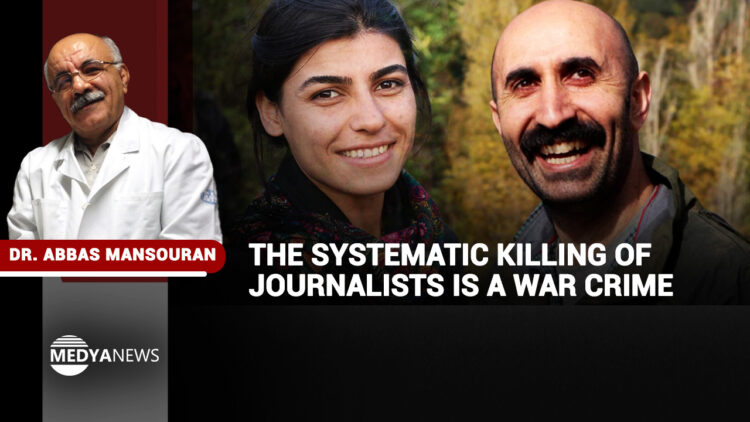
Dr Abbas Mansouran
The assassination of Cîhan Bilgîn and Nazım Daştan, two courageous and conscientious journalists in Rojava [Kurdish-led North and East Syria], by a direct Turkish drone strike constitutes a part of the Turkish government’s continuing policies of genocide and war crimes.
On the evening of 19 December 2024, while working in the self-administration region of Rojava, Bilgîn and Daştan were tragically killed, travelling between the Tishrin Dam and the town of Sirin [Sarrin] in North and East Syria.
Just three hours before their martyrdom, Bilgîn and Daştan, who were dedicated to uncovering the truth, recorded a video report documenting war crimes. They worked tirelessly, risking their lives to expose the suffering of the people under the relentless bombardment and attacks of the Turkish government and its proxy forces. These brave journalists acted as truth-tellers, documenting the pain and displacement of civilians caused by the Turkish invasion and occupation of Afrin (Efrîn), Shahba (Şehba) and other regions.
Their courageous reporting provided irrefutable evidence of war crimes, including those committed by the Turkish government’s fully armed and trained proxy forces. They bravely exposed the lies and false claims of the government, which sought to deny its involvement in these atrocities while aligning itself with criminal groups such as ISIS, al-Qaeda and [Hay’at] Tahrir al-Sham (HTS).
The murder of Bilgîn and Daştan serves as a chilling reminder of the dangers faced by journalists who dare to expose the truth. Their deaths are a tragic loss for the people of Rojava and a blow to the fight for justice and accountability.
They rushed to document the pain and suffering of the working people and the suffering in the autonomous region, under the rain of mortars and bombings by the Turkish government and its proxy forces, in a tireless effort, aware of the danger of death. For this crime, the enemies of the people ordered their murder. Bilgîn and Daştan’s courageous reports provide solid and truthful but horrific evidence of war crimes and genocide and the consequences and devastating effects of the Turkish government’s invasion and occupation.
Cîhan and Nazım responsibly and courageously exposed the faces, leadership, and false claims of the Turkish government that it was not involved in the crimes but was in alliance with criminal groups such as ISIS, Al-Qaeda and Tahrir al-Sham.
Cîhan and Nazım, in the heart of the darkness of war and criminal occupation, were and still are illuminating the ideals of resistance and the people who want to take control of their destiny through self-administration. These Newruz torches will never fade, because they have a revolutionary and historical dynamism arising from historical and revolutionary ideals in their hands and breasts. Their names, memories and paths are in the hearts of the four parts of Kurdistan and of the freedom-seekers and free thinkers of the world.
A large gathering organised by the Tigris-Euphrates Journalists Association (DFG) and the Mesopotamian Women Journalists Association (MKG) in Van (Wan), Turkey on 21 December condemned the recent drone strike that killed journalists Nazım Daştan and Cîhan Bilgîn. This peaceful protest was met with a violent crackdown by Turkish authorities. Repressive forces attacked the gathering, resulting in the arrest of at least 10 journalists and 57 other citizens.
Despite this repression, the protesters, carrying signs with the slogan “Our pen and our camera will never be left on the ground,” and images of the slain journalists, continued to denounce the crimes of the Turkish regime and its allies.
The killing of Daştan and Bilgîn is not an isolated incident. In the past five years, the Turkish army has carried out attacks both in the Kurdistan Region of Iraq (KRI) and in North and East Syria, resulting in the deaths of at least 13 journalists and injuries to seven others. These attacks highlight a pattern of violence against journalists who seek to expose the truth about the Turkish government’s actions in the region.
• 1 October 2019: Turkish government killed journalist Vedat Erdemci with banned chemical bombs in a drone attack in the occupied areas of Ras al-Ayn (Serêkaniyê) and Tal Abyad (Girêspî), KRI.
• 13 October 2019: Havar News Agency journalists Saeed Ahmed and Mohammad Hasan Resho were killed in a direct bombing in Ras al-Ayn. On the same day, journalist Diluvan Gur was killed in a drone attack on a journalist’s vehicle in Tal Abyad.
• October 2019: Zeiss Sinke, a member of Frî Bor Marincir media, was killed in a bombing in Tel Tamar (Til Temir), North and East Syria.
• 4 October 2022: Nagihan Akarsel, a Jineology Academy member and editor-in-chief of Jineology magazine, was assassinated in Sulaymaniyah (Silêmanî), KRI.
• 19 November 2022: Havar News Agency reporter Isa Abdullah was killed in a drone airstrike in Derik (Dêrik), KRI.
• 23 August 2023: Gene TV network’s vehicle was bombed on theQamishli (Qamishlo) to Amuda (Amûdê) road in North and East Syria. Gene TV employee Nejmedin Faisal Al-Haj Sinan was killed, and Dalilah Agaid was seriously injured.
• 8 July 2024: A vehicle belonging to Chira TV and Chira FM journalists was targeted in Sinjar (Şengal) by a Turkish airstrike, injuring Murad Mirza, who died days later.
• 23 December 2023: Kurdish filmmaker Mansour Karimian (39) from Iranian Kurdistan (Rojhilat) was killed in Derik by a Turkish drone strike.
• 23 August 2024: A Turkish drone bombed a vehicle belonging to Chatr Productions in Sulaymaniyah, killing Gulîstan Tara and Hero Bahadin, and injuring six other journalists.
To date, dozens of journalists, and independent and grassroots reporters in Turkey have been arrested and sentenced to long prison terms under torture for speaking the truth. On 21 December 2024, Özlem Gürses, a well-known Turkish journalist, was arrested in Istanbul for telling the truth.
She said the Turkish army had “committed torture and murder together with terrorist groups and acted as an occupying force”. The state prosecutor’s office lodged a case against Görses and arrested her on charges of “insulting state institutions and organs” and “publicly disseminating misleading information”. In a video, Özlem Görses, said, referring to the Turkish armed forces’ operations in North and East Syria: “As you can see, the ISIS structure, namely the Turkish armed forces (TSK-SMO) [TAF and Syrian National Army, SNA], has achieved small successes in the Kurdish areas!” On her arrest, she claimed forcefully that her comparison of the Turkish Armed Forces to the ISIS terrorist organisation was unintentional.
Nevşin Mengü, a committed Turkish journalist who showed a courageous response to the [Iranian] government’s murder of [young Kurdish woman] Jina (Mahsa) Amini in Iran is also among the journalists who have been arrested and harassed many times for telling the truth and defending human principles. Mengü faced judicial harassment and a coordinated online smear campaign after publishing an interview with Salih Müslim, an official of a Syrian Kurdish group that Turkey has designated as a terrorist organisation.
The global community must demand justice for victims like Pakhshan Azizi, Varisheh Moradi, Zeinab Jalalian and Sepideh Qulyan, who are unjustly imprisoned and tortured in Iran. Their pursuit of truth and freedom must be honoured.
A statement by the International Federation of Journalists (IFJ), which includes 190 organisations representing more than 600,000 journalists in 146 countries, displayed a responsible response to the murder of Nazım Daştan and Cîhan Bilgîn by the Turkish government in condemning this war crime. “Both esteemed journalists were working on the situation in northern Syria. They were deliberately targeted by a drone while carrying out their work, which is a bizarre incident. We condemn this attack on our colleagues and demand that the perpetrators of this murder be held accountable,” IFJ secretary general Anthony Belanger said.
The targeted killings of journalists, filmmakers and media professionals in regions affected by the Turkish military operations highlight a deliberate and systematic effort to suppress dissent and silence the truth. These attacks, often carried out with drones, bombs and in some cases, potentially chemical weapons, demonstrate the lethal nature of these operations. Many of the victims have been associated with Kurdish media outlets, suggesting that the Turkish government’s actions are not only aimed at curbing press freedom but specifically at targeting Kurdish voices and their efforts to document atrocities. The precision of these killings and the use of military resources indicate a calculated approach to eliminate those who expose the truth about war crimes and human rights violations.
These actions, which include the destruction of evidence and the silencing of truth-seekers, are clear examples of war crimes and potentially genocide. By targeting journalists and other media professionals, the Turkish government seeks to cover up its crimes, instill fear and suppress the public’s right to know. The ongoing impunity with which these attacks are carried out points to a troubling disregard for international law and human rights. The international community must take a firm stance, condemning these crimes and demanding accountability from those responsible. The pursuit of truth, freedom and justice must be upheld, honouring those who continue to resist oppression and fight for a better future.
Dr. Abbas Mansouran is an Iranian-born epidemiologist based in Sweden. He has expertise in burn injuries, having worked extensively in this field during the Iraq War in the 1980s. Mansouran has also conducted independent research in North and East Syria, investigating medical facilities and providing treatment to the wounded, amid allegations of chemical weapons use by Turkey.


