

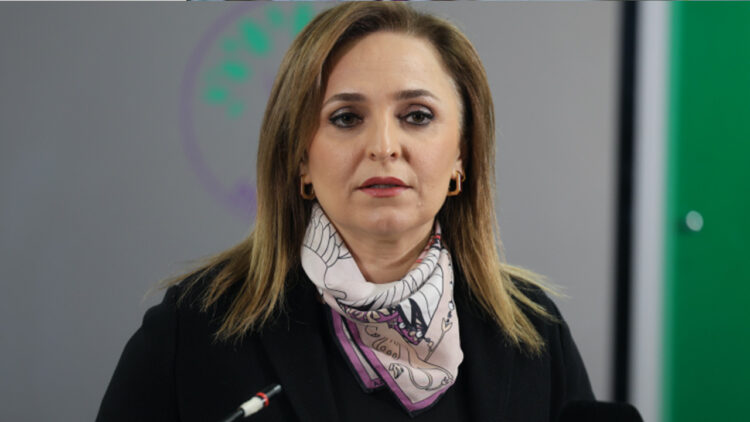
Ayşegül Doğan, a representative of the pro-Kurdish Peoples’ Equality and Democracy (DEM) party and parliamentarian for Şırnak (Şırnex) in the Turkish Parliament, delivered a speech on 19 December, sharply critiquing the Turkish state’s neglect of the Kurdish issue and its disregard for justice.
‘Lack of accountability’
19 December was the 46th anniversary of the 1978 massacre of Alevis and Alevi Kurds by members of the Nationalist Movement Party (MHP) in Maraş. While the true number of victims is still believed to be concealed by the authorities, official figures put the number of fatalities at 111 and the injured at a few hundred during a week of atrocities between 19-26 December 1978, as buildings were torched and whole neighbourhoods were razed to the ground.
She condemned the ongoing lack of accountability for historical atrocities, such as the Maraş massacre, and highlighted the rapidly unfolding historical moment in Syria.
‘A pivotal moment in history’
Doğan remarked, commenting on the situation in Syria:
“We are again witnessing a pivotal moment in history, and this is most evident in Syria. As a member of a political party that has consistently advocated for peaceful solutions, I urge you to closely observe and consider the actions and calls we make today. A new Middle East is taking shape. Those who resist democratic transformation and change are being surpassed one by one. They are either forced to confront their past mistakes or compelled to alter their stance, driven by the resolute struggle of the people. This is the scenario unfolding in Syria.”
Turning her attention to North and East Syria (Rojava), Doğan underscored the necessity of opening democratic channels to facilitate dialogue. She remarked:
“A political solution can only be attained through the respect of the political will and preferences of the Syrian people. Excluding the Kurds and relegating them to the margins will render any resolution unfeasible. We are speaking of the most organised force on the ground [in Syria], a movement embodying the most pragmatic model to overcome the current turmoil—a model rooted in free unity. This is the reality forged by the people. We advocate for the recognition and acceptance of this people’s reality.”
The ‘Rojava Model’
Doğan described what has been achieved in northeast Syria as the ‘Rojava Model’. She reaffirmed the Rojava revolution’s potential to form the cornerstone of a political resolution in Syria, while challenging the claim that it jeopardises Turkey’s security. She asserted:
“How are the Kurds in northern and eastern Syria, especially Rojava, perceived? It is often claimed that the DEM Party focuses solely on the Kurdish perspective in Syria. This is a mischaracterisation. As we’ve consistently emphasised, the Kurdish-led model offers a viable solution for Syria, demonstrating how diverse communities can coexist equally and freely. This model provides a path to help resolve Turkey’s current crises. Contrary to the narrative presented to the Turkish public, the northern and eastern regions of Syria pose no threat to Turkey’s security, unity, or territorial integrity. Rojava is not a threat—this is well-established. Dialogue was initiated years ago, and it’s time to return to it. How can the Kurds, who have fought for equality and freedom for all, be a threat to the Turkish people? This reality guarantees coexistence.”
Call for a demilitarised zone in Kobani
Doğan also criticised Turkey’s dismissive response to Mazloum Abdi’s recent call for a demilitarised zone in Kobani (Kobanê), which was designed to address Turkey’s security concerns and promote a lasting ceasefire across Syria. She noted:
“Instead of engaging constructively, portraying these initiatives as security threats misleads the public and distorts history. Despite consistent calls for dialogue, Turkey has diverted resources to defense, deepening the nation’s impoverishment. This security-focused strategy has fueled injustices and massacres, marking a historical turning point.”
Doğan concluded by emphasising that neither Turkey nor the broader Middle East can progress without acknowledging the Kurdish reality. She asserted:
“Any attempt to exclude the Kurds or perceive their advancements as a threat will inevitably falter.”
Doğan has frequently expressed concerns that the Turkish state continues to fail in learning from its history. It appears that this state, like its predecessors, has not learned from the past.


