Sarah Glynn
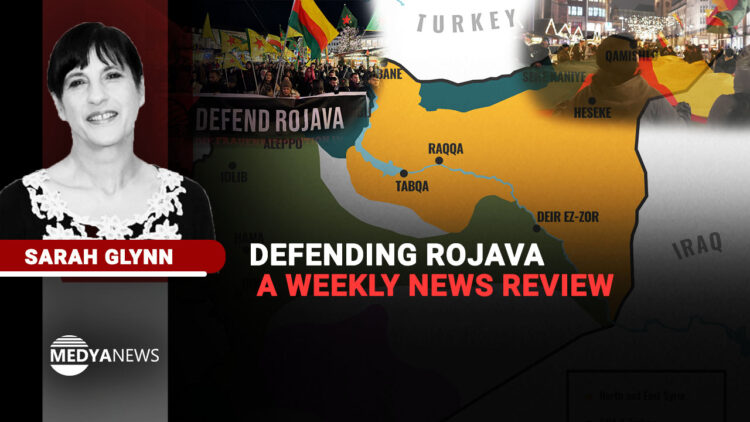
Today, in cities across the world, Kurds and their friends will be on the streets responding to the call to “Defend Rojava”. International attention has been busy with the transformation of Hay’at Tahrir al-Sham (HTS) from a “terrorist group” in an unsung province, to governors of Syria, and with watching, in morbid fascination, as the opening of Syria’s prisons reveals the profound depths of the brutal oppression carried out by two generations of Assad rulers. But, meanwhile, Turkey’s operation against the Kurds and the Autonomous Administration of North and East Syria has accelerated.
HTS made clear to the Kurds from the start of their attack on Aleppo that they were not targeting the Autonomous Administration or the Administration’s Syrian Democratic Forces (SDF), but, for Turkey, these, not Assad, are the national enemy. Like Turkey’s earlier invasions into Syria, the current operation is being pursued through the use of mercenary militias who have become infamous for their brutalised interpretation of Islamism and their extreme sadistic and misogynist violence. Turkey labels them the Syrian National Army (SNA). For the Turkish government, use of the SNA avoids the political embarrassment of Turkish soldiers arriving home in body bags. HTS grew up under Turkish support and protection, but still retained their autonomy. By contrast, the SNA militias are mercenaries, trained, armed, and paid for by Turkey. And they are fully backed up by Turkish planes and drones.
At the hands of these militias, the one part of Syria that prioritises women’s rights and the peaceful co-existence of different ethnicities and religions, and that can provide an example for a new inclusive society, is under existential threat. Its population faces the possibility of ethnic cleansing, or worse. Politicians and media who love to display their liberal values have been slow or reluctant to pick up on the seriousness of what is happening, though warnings that this could lead to the revival of ISIS have begun to find some resonance. Mazloum Abdi, Commander in Chief of the SDF, has been interviewed about this on both Sky and Fox News.
Writing about the situation in Syria is like trying to describe an iceberg. So much of what is going on – the vital talks and negotiations – is taking place beneath the surface where we can’t see. These talks provide an incentive for Turkish forces to act quickly to make new “facts on the ground” and so strengthen their bargaining position. Even the tip of the iceberg is obscured by a fog of misinformation, both deliberate propaganda and the dreams of an army of armchair warriors.
Out in the public world, there has been a lot of debate on possible outcomes from these talks and on potential deals, but in any agreement, there also remains a question whether the different parties will honour it, and for how long. When it comes to ceasefires, at least, Turkey’s record is very poor. Amy Holmes found that in the year following the 2019 US-backed ceasefire agreement, Turkey violated it over 800 times; and this week’s record has not been encouraging. In addition, no Kurds can forget Erdoğan’s denial, in 2015, of all knowledge of the “Dolmabahçe Agreement”. This was an agreement between his Justice and Development Party (AKP) and the pro-Kurdish Peoples’ Democratic Party (HDP), following meetings with Abdullah Öcalan, and it set out a list of priorities for the resolution of the Kurdish Question.
I will touch very briefly on these discussions at the end, but I want to focus on all that has happened in North and East Syria this week – or at least those events that we can see and know about.
Last week, day by day
Last Saturday, fears were already growing for Manbij where there were reports of severe clashes and drone strikes; but the SDF was still advancing into western Deir ez-Zor in an attempt to prevent ISIS taking over the areas vacated by the Syrian government and their Iranian Allies
By Sunday, the day that Assad fled the country, Turkey’s mercenaries had penetrated some Manbij neighbourhoods. Manbij is to the west of the Euphrates and is a city of around 300,000 people. It is majority Arab, but with 30,000 Kurds and large communities of other ethnicities. It was liberated from ISIS by Kurdish fighters in 2016, when it became part of the Autonomous Administration, and huge effort has been put in to bring different groups together in the remaking of the city and its local administration. As in the other parts of North and East Syria, both administration and defence were done by local people and reflected the local ethnic mix.
Further south, SNA militias were on their way to try and claim control of SDF-run Deir ez-Zor, starting with the areas west of the Euphrates where the Syrian Government had recently been in charge. Among these fighters was the man primarily responsible for the murder of four Kurds in Turkish-occupied Jindires in 2023 to punish them for the crime of lighting a small Newroz bonfire.
With Russian and Syrian troops now gone, the United States was free to carry out airstrikes on central Syria, where they targeted 75 ISIS cells; and President Biden confirmed that US troops would remain in Syria to prevent ISIS from taking advantage of the power vacuum. US National Security Advisor, Jake Sullivan, also reiterated that they would work with the Kurds to prevent the resurgence of ISIS. There are some 900 American soldiers, mainly in North and East Syria. However, Donald Trump, who will be president again from 20 January, reiterated on Twitter last Saturday his determination that America should have nothing to do with Syria, which “is not our fight”.
By Monday, SNA militias, aided by sleeper cells in the city, had damaged Manbij infrastructure and medical facilities. A report on Turkish television showing the SNA near Manbij, casually included a fighter wearing an ISIS patch. There was shelling on Qere Qozaq where the main east-west road crosses the Euphrates between Manbij and Kobanê. And Turkish airstrikes killed twelve women and children in Ain Issa and a further ten civilians in the Manbij countryside.
Other air strikes destroyed weapons depots that had been used by the Syrian Government in Qamishlo. These were originally thought to be part of the Israeli attacks, but the strikes were later claimed by Turkey.
While shells were hitting the people that the UK, like the US, regards as their partners in the fight against ISIS, British Foreign Secretary, David Lammy, gave a statement on Syria in the House of Commons. Former MP Lloyd Russell-Moyle Tweeted, “I was concerned that Foreign Secretary didn’t mention our Kurdish led allies @SDF_Syria by name and seemed to suggest Turkey’s bombing of them was legitimate.”
By Tuesday, Manbij was in the hands of Turkey’s mercenaries and the US had negotiated a withdrawal of the SDF from the city. On Tuesday night, Mazloum Abdi spoke of a ceasefire agreement, but this didn’t seem to stop Turkey’s attacks.
The Syrian Observatory for Human Rights reported that SNA factions executed dozens of wounded soldiers in a military hospital north of Manbij city, after blocking their evacuation, and that they had carried out identity-based killings of Kurds, and looted and burnt Kurdish property. SNA fighters shared videos of themselves murdering two hospitalised wounded soldiers and capturing Manbij women.
Turkey and the SNA were now focussed on Qere Qozaq Bridge. The SDF claimed to have fended off their attack and to have killed over a hundred mercenaries. And the Tishreen dam was under heavy attack. It sustained damage and could no longer generate electricity. The dam is a strategic point, and more serious damage could lead to widespread catastrophe.
There was heavy bombardment in the Kobanê countryside, and a drone hit the city’s strategic and symbolic Mishtenur Hill. Eight members of one family were killed by an airstrike near Ain Issa, and three members of the Syriac Military Council – which is part of the SDF – were killed by Turkish bombardment in Tel Tamir.
In Deir ez-Zor, where tribal allegiances have often changed in line with changing power dynamics, two tribal leaders defected from supporting the Autonomous Administration, but others confirmed their continued support. Tensions erupted in Deir ez-Zor and Raqqa, and curfews were imposed.
US General Kurilla visited US bases in Syria and met with the SDF.
Rojava Information Centre’s Daily report noted that IDPs from Shahba were now occupying 185 schools, and the pressures on the region were leading to food shortages.
Wednesday brought more accounts of atrocities from Manbij. Looting was being accompanied by threats and killings. Zenobia Arab women’s association, which had lost three members to airstrikes the day before, reported other members had been kidnapped. An ambulance was struck by a drone. Mercenaries filmed themselves torturing prisoners of war. Medical facilities were vandalised.
In Deir ez-Zor the SDF had retreated back across the Euphrates and the west bank was now under the control of HTS.
Mazloum Abdi announced that ISIS was increasing in strength but that the SDF had had to halt their counter-ISIS operations as their troops were needed elsewhere.
Living conditions for the IDPs from Shahba were still grim.
The Kurdistan Democratic Party of the Kurdistan Region of Iraq, who have increasingly become as one with the Turkish State, closed the Semalka Crossing – the only point of entry from Iraq to North and East Syria.
US National Security Council spokesperson, John Kirby, preluded a statement about partnering with the SDF against ISIS, with the familiar weasel words: Turkey “has a right to defend its territory against terrorist attacks.” The SDF, as he must know, has never attacked Turkey and has no intention to do so – though they do, of course, defend themselves against Turkey’s attacks on them.
On Wednesday evening, as a gesture of goodwill, the SDF announced that they were ready to return the tomb of Suleiman Shah to its earlier location near Kobanê. Suleiman Shah is said to be the grandfather of the first Ottoman Emperor, and the tomb is an island of Turkish territory within Syria. In 2015, Kurdish forces helped Turkey to move the tomb and its garrison away from the danger of ISIS. Now they have offered to help move it back.
On Thursday, despite the ceasefire, Turkey and its mercenaries continued to attack the dam and bridge, but they were beaten back and, according to an SDF statement published yesterday, suffered heavy losses in men and equipment.
In Manbij, the looting and vandalism of medical services now included the central hospital, and homes of people who worked for the Autonomous Administration were being targeted. Anger at the extent of the looting coalesced into street protests.
In another political gesture, the Autonomous Administration announced that they would fly the new Syrian flag in all institutions to affirm their long commitment to Syrian unity.
In Raqqa there appears to have been an agent provocateur trying to stir up discontent and inter-ethnic strife. At the celebrations for raising the flag, someone fired on the crowd. The security forces did not rise to the bate, but attempts were made to claim the shots came from them, despite a video showing otherwise.
Turkey’s intelligence chief, İbrahim Kalın, visited Abu Mohammad al-Julani, head of HTS, in Damascus. Amed Dicle observed that “Ankara’s sole motivation now is to pit HTS against the Kurds”.
An attempted breakout from Al Hol camp, which houses the radicalised families of ISIS members, was thwarted, but Abdi again raised concerns about the potential dangers of the ISIS prisons.
Yesterday, there were some clashes in Tel Abyad as the SDF repelled an attempt to infiltrate their frontlines, but a new ceasefire for the Manbij region seemed to be largely holding. This called for the SDF to be able to leave Manbij safely, and for the dam to become a demilitarised zone. Yesterday’s fighting over Tishreen appears to have taken place more in the media – which was full of conflicting claims – than in real life.
In Manbij, where most shops have been looted, the city library was burnt down.
Behind closed doors
It is difficult enough separating the grains from the chaff in these publicly visible actions, but for private discussions we only have the statements from different parties, which may be primarily about grandstanding or about setting a bargaining position.
The Kurds – Abdi who is most often quoted, but also the veteran Kurdish politician Saleh Muslim, and others – have shown themselves more than ready to sit down and negotiate with all parties. They are also ready to make pragmatic compromises: Abdi states that the Euphrates can be their new border. They have said that they want to put together a Kurdish delegation that includes Kurdish opposition parties – which could be difficult as these are close to Turkey and hostile to the social project built up by the dominant Democratic Union Party (PYD).
The Turkish government, which has undoubtedly been given a boost by recent events, remains uncompromising. Hakan Fidan, their Foreign Minister and former head of intelligence, speaking on Turkish television, stated that elimination of the YPG (the Kurdish forces within the SDF) is Turkey’s strategic goal. He claimed that the new Syrian government would not recognise the YPG, and demanded that YPG leaders leave the country and YPG fighters lay down their arms.
It is the YPG fighters and their female counterparts in the YPJ that have defended North and East Syria from all that ISIS and Turkey have thrown at them, allowing the Kurds and their neighbours to develop the feminist and inclusive society that has inspired people across the world, and that could provide a model for a future Syria. Turkey wants to use the brute force of the second largest army in NATO to impose their will, and extinguish all that has been built. On past form, the United States and other European countries will be too concerned about upsetting links with Turkey to do much to persuade them to act differently. Turkey has learnt from experience that they can kill and oppress with impunity: which is why Kurds and their friends are demonstrating in defence of Rojava today.
Who is a terrorist
In general, world politics has not looked so alarming since the Second World War. The mechanisms created after that war to try and bring a semblance of order are being destroyed, and double standards are rampant – never more so than in the treatment of “terrorism”.
One of the most effective tools that Turkey has used to subvert criticism of their actions is persuading other countries to label the Kurdistan Workers’ Party (PKK) as terrorists. This makes it difficult for those countries to criticise Turkey, and extends Turkish oppression to Kurdish activists living abroad. These activists find themselves accused of supporting the PKK, and punished by often draconian terrorist legislation. That is what is currently happening to six activists in London, who have been charged with being members of a proscribed terrorist group.
Even if they were members, and we have been given no evidence that they are, there is no reason, other than UK-Turkey relations, for the PKK to be on the terrorism list. When the PKK was proscribed in 2001, they were in a long period of unilateral ceasefire and calling for peace. They observed the Geneva conventions, and, as was later ruled in Belgium’s highest court, should legally be regarded as a non-state actor in a war, not a criminal organisation. But, as we learnt this week, from the case of HTS, the way to be considered for removal from a terrorist list is to oust a government that didn’t meet with Western approval.
Sarah Glynn is a writer and activist – check her website and follow her on Twitter or bluesky